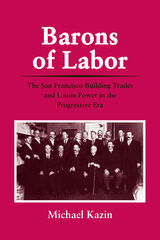
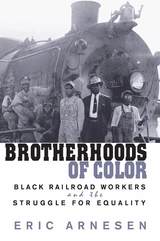
front cover of Barons of Labor
Barons of Labor
The San Francisco Building Trades and Union Power in the Progressive Era
Michael Kazin
University of Illinois Press, 1989
From the depression of the 1890s through World War I, construction tradesman held an important place in San Francisco's economic, political, and social life. Michael Kazin's award-winning study delves into how the city’s Building Trades Council (BTC) created, accumulated, used, and lost their power. He traces the rise of the BTC into a force that helped govern San Francisco, controlled its potential progress, and articulated an ideology that made sense of the changes sweeping the West and the country. Believing themselves the equals of officeholders and corporate managers, these working and retired craftsmen pursued and protected their own power while challenging conservatives and urban elites for the right to govern. What emerges is a long-overdue look at building trades as a force in labor history within the dramatic story of how the city's 25,000 building workers exercised power on the job site and within the halls of government, until the forces of reaction all but destroyed the BTC.
[more]

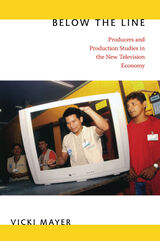
front cover of Below the Line
Below the Line
Producers and Production Studies in the New Television Economy
Vicki Mayer
Duke University Press, 2011
Below the Line illuminates the hidden labor of people who not only produce things that the television industry needs, such as a bit of content or a policy sound bite, but also produce themselves in the service of capital expansion. Vicki Mayer considers the work of television set assemblers, soft-core cameramen, reality-program casters, and public-access and cable commissioners in relation to the globalized economy of the television industry. She shows that these workers are increasingly engaged in professional and creative work, unsettling the industry’s mythological account of itself as a business driven by auteurs, manned by an executive class, and created by the talented few. As Mayer demonstrates, the new television economy casts a wide net to exploit those excluded from these hierarchies. Meanwhile, television set assemblers in Brazil devise creative solutions to the problems of material production. Soft-core videographers, who sell televised content, develop their own modes of professionalism. Everyday people become casters, who commodify suitable participants for reality programs, or volunteers, who administer local cable television policies. These sponsors and regulators boost media industries’ profits when they commodify and discipline their colleagues, their neighbors, and themselves. Mayer proposes that studies of production acknowledge the changing dynamics of labor to include production workers who identify themselves and their labor with the industry, even as their work remains undervalued or invisible.
[more]

front cover of Blue Hours
Blue Hours
A Novel
Daphne Kalotay
Northwestern University Press, 2019

A mystery linking Manhattan circa 1991 to eastern Afghanistan in 2012, Blue Hours tells of a life-changing friendship between two memorable heroines. When we first meet Mim, she is a recent college graduate who has disavowed her lower middle class roots to befriend Kyra, a dancer and daughter of privilege, until calamity causes their estrangement. Twenty years later, Kyra has gone missing from her NGO’s headquarters in Jalalabad, and Mim—now a recluse in rural New England—embarks on a journey to find her. In its nuance, originality, and moral complexity, Blue Hours becomes an unexpected page-turner.

[more]


Send via email Share on Facebook Share on Twitter