
 A SCHOLARLY BOOK REPOSITORY
The essays selected by the editors to explore these apocalyptic visions are: “The Remaking of Zero: Beginning at the End,” by Gary K. Wolfe; “The Lone Survivor,” by Robert Plank; “Ambiguous Apocalypse: Transcendental Versions of the End,” by Robert Galbreath; “World’s End: The Imagination of Catastrophe,” by W. Warren Wagar; “Man-Made Catastrophes,” by Brian Stableford; and “The Rebellion of Nature,” by W. Warren Wagar.
Wolfe sees in these postholocaust narratives a central attraction—“the mythic power inherent in the very conception of a remade world.” This power derives from three sources: the emergence of a new order from the ashes of the old system, and thus a kind of denial of death; the reinforcement of one set of values as opposed to another; and as something always replaces whatever was destroyed, a promise that nothing can annihilate humanity.
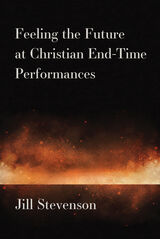
The book’s main focus is contemporary Christian End-Time performances and how they theatrically construct encounters with future time—not just images or ideas of a future, but viscerally and immediately real experiences of future time. Author Jill Stevenson’s examples are Hell Houses and Judgement Houses; Rapture House, a similarly styled “walk through drama” in North Carolina; Hell’s Gates, an “outdoor reality drama” in Dawsonville, Georgia; Ark Encounter, a full-size recreation of Noah’s Ark; and Tribulation Trail, an immersive thirteen-scene drama ministry based on the Book of Revelation. The book’s coda considers similarities between these Christian performances and secular survivalist prepper events, especially with respect to constructions of and language about time. In doing so, the author situates these performances within a larger tradition that challenges traditional secular/sacred distinctions and illuminates how the End Times has been employed in our current social and political moment.
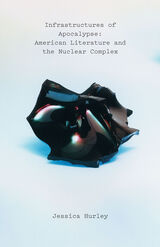
A new approach to the vast nuclear infrastructure and the apocalypses it produces, focusing on Black, queer, Indigenous, and Asian American literatures
Since 1945, America has spent more resources on nuclear technology than any other national project. Although it requires a massive infrastructure that touches society on myriad levels, nuclear technology has typically been discussed in a limited, top-down fashion that clusters around powerful men. In Infrastructures of Apocalypse, Jessica Hurley turns this conventional wisdom on its head, offering a new approach that focuses on neglected authors and Black, queer, Indigenous, and Asian American perspectives.
Exchanging the usual white, male “nuclear canon” for authors that include James Baldwin, Leslie Marmon Silko, and Ruth Ozeki, Infrastructures of Apocalypse delivers a fresh literary history of post-1945 America that focuses on apocalypse from below. Here Hurley critiques the racialized urban spaces of civil defense and reads nuclear waste as a colonial weapon. Uniting these diverse lines of inquiry is Hurley’s belief that apocalyptic thinking is not the opposite of engagement but rather a productive way of imagining radically new forms of engagement.
Infrastructures of Apocalypse offers futurelessness as a place from which we can construct a livable world. It fills a blind spot in scholarship on American literature of the nuclear age, while also offering provocative, surprising new readings of such well-known works as Atlas Shrugged, Infinite Jest, and Angels in America. Infrastructures of Apocalypse is a revelation for readers interested in nuclear issues, decolonial literature, speculative fiction, and American studies.
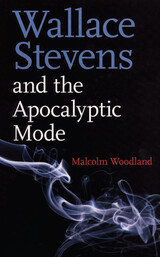
This study begins with an examination of the textual and generic issues surrounding apocalypse, culminating in the idea of apocalyptic language as a form of “discursive mastery” over the mayhem of events. Woodland provides an informative religious/historical discussion of apocalypse and, engaging with such critics as Parker, Derrida, and Fowler, sets forth the paradoxes and complexities that eventually challenge any clear dualities between apocalyptic and antiapocalyptic thinking.
Woodland then examines some of Stevens’s wartime essays and poems and describes Stevens’s efforts to salvage a sense of self and poetic vitality in a time of war, as well as his resistance to the possibility of cultural collapse. Woodland discusses the major postwar poems “Credences of Summer” and “The Auroras of Autumn” in separate chapters, examining the interaction of (anti)apocalyptic modes with, respectively, pastoral and elegy.
The final chapter offers a perspective on Stevens’s place in literary history by examining the work of a contemporary poet, Jorie Graham, whose poetry quotes from Stevens’s oeuvre and shows other marks of his influence. Woodland focuses on Graham's 1997 collection The Errancy and shows that her antiapocalyptic poetry involves a very different attitude toward the possibility of a radical break with a particular cultural or aesthetic stance.
Wallace Stevens and the Apocalyptic Mode, offering a new understanding of Stevens’s position in literary history, will greatly interest literary scholars and students.
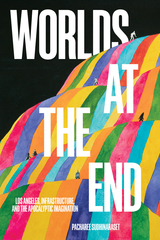
Worlds at the End analyzes destruction, rupture, and continuance through texts ranging from Karen Tei Yamashita’s Tropic of Orange, which considers racial colonial infrastructure, to the work of Diné poet Esther Belin, which illuminates how the separation between the Indian reservation and LA is part of a broader infrastructural network of termination. And she unpacks Octavia Butler’s post-apocalyptic novel, Parable of the Sower, where LA’s freeways and roadways are routes of forced migration, colonization, and flight.
Tearing down existing institutions that marginalize people of color and moving past them, Worlds at the End highlights the imaginaries of those subjugated, racialized, and made other, for whom modernity, freedom, and progress meant violence, brutality, and relegation to the status of devalued surplus populations. As Sudhinaraset deftly shows, the apocalypse marks moments of historical and spatial transition, offering stories of doomsdays that will give rise to resurgence and regeneration.
READERS
Browse our collection.
PUBLISHERS
See BiblioVault's publisher services.
STUDENT SERVICES
Files for college accessibility offices.
RECENTLY PUBLISHED


UChicago Accessibility Resources
home | accessibility | search | about | contact us
BiblioVault ® 2001 - 2026
The University of Chicago Press