front cover of Ecopoetry
Ecopoetry
Critical Introduction
Scott Bryson
University of Utah Press, 2002

The burgeoning field of ecocriticism is beginning to address the work of such ecopoets as Gary Snyder, Mary Oliver, W. S. Merwin, and Wendell Berry, among others, whose poems increasingly deal with ecological and environmental issues. Ecopoetry: A Critical Introduction assembles previously unpublished contributions from many of the most important scholars in the field as they discuss the historical and crosscultural roots of ecopoetry, while expanding the boundaries to include such themes as genocide and extinction, the lesbian body, and post colonialism. This volume gathers these necessary voices in the emerging conversation regarding poetry’s place in the environmental debate.
[more]

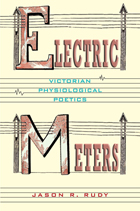
front cover of Electric Meters
Electric Meters
Victorian Physiological Poetics
Jason Rudy
Ohio University Press, 2009
Victorian poetry shocks with the physicality of its formal effects, linking the rhythms of the human body to the natural pulsation of the universe. In Electric Meters: Victorian Physiological Poetics Jason R. Rudy connects formal poetic innovations to developments in the electrical and physiological sciences, arguing that the electrical sciences and bodily poetics cannot be separated, and that they came together with special force in the years between the 1830s, which witnessed the invention of the electric telegraph, and the 1870s, when James Clerk Maxwell’s electric field theory transformed the study of electrodynamics.

Combining formal poetic analysis with cultural history, Rudy traces the development of Victorian physiological poetics from the Romantic poetess tradition through to the works of Alfred Tennyson, the “Spasmodic” poets, Elizabeth Barrett Browning, Gerard Manley Hopkins, and Algernon Swinburne, among others. He demonstrates how poetic rhythm came increasingly to be understood throughout the nineteenth century as a physiological mechanism, as poets across class, sex, and national boundaries engaged intensely and in a variety of ways with the human body’s subtle response to rhythmic patterns. Whether that opportunity for transcendence was interpersonal or spiritual in nature, nineteenth–century poets looked to electricity as a model for overcoming boundaries, for communicating across the gaps between sound and sense, between emotion and thought, and—perhaps—between individuals in the modern world.

Electric Meters will appeal to those interested in poetry of any period and particularly those interested in nineteenth–century culture and history.

[more]

front cover of Elizabethan Poetry in Manuscript
Elizabethan Poetry in Manuscript
An Edition of British Library Harley MS 7392(2)
Edited by Jessica Edmondes
Iter Press, 2022
This volume presents the first printed edition of a late sixteenth-century poetic miscellany and provides invaluable insight into understanding the literature of the period. Its owner and principal scribe, Humfrey Coningsby, drew on texts circulating in manuscript , predominantly by contemporary writers of the time—including Philip Sidney, Edward Dyer, Arthur Gorges, Walter Ralegh, Elizabeth I, the Earl of Oxford, Nicholas Breton, George Peele, and Thomas Watson. Coningsby also added at least two of his own compositions, along with anonymous poems not found in any other manuscripts or printed books.

This edition preserves the appearance, spelling, and punctuation of the original manuscript while expanding antiquated contractions to provide an easily readable text. Textual notes appear on the page, and in-depth contextual notes and word glosses are provided in the commentary section. The analyses add to our knowledge of early modern manuscript culture and literary manuscript transmission, and a substantial introduction provides context for the compilation of the anthology.
[more]

front cover of Eloquence and Mere Life
Eloquence and Mere Life
Essays on the Art of Poetry
Alan Williamson
University of Michigan Press, 1994
Assesses past and future generations of poets and examines the standards by which they should be measured
[more]

front cover of English Mercuries
English Mercuries
Soldier Poets in the Age of Shakespeare
Adam N. McKeown
Vanderbilt University Press, 2009
English Mercuries examines war and literature through the writings of veterans who came home from their deployments to pursue literary careers. From their often neglected writings emerges a new picture of the Elizabethan world at war. For centuries Elizabethan England has been characterized by booming patriotism and martial energy, and the literature of this period, epitomized in works like Shakespeare's Henry V, has been seen as celebrating a proud and defiant kingdom unified around its wars with Spain. Beneath this patriotic veneer, however, was a country withering under the costs of seemingly endless military commitments and ripped apart by doubts about the purpose of war and mistrust of state officials who advanced their own political interests through war at the expense of the people who had to fight and pay for it.

These misgivings are a powerful undercurrent in much of the literature of the period, even the most ostensibly patriotic works, but it is in the writings on war by soldier poets where they are most clearly pronounced. Fashioning themselves as servants of both Mars and Mercury (the god of war and the god of writing), Elizabethan soldier poets focused their war stories on the gritty realities of military campaigning, the price individuals paid for serving the state, and the difficulties of returning to civilian life. The book reconsiders some familiar writers like John Donne and Ben Jonson in the context of their military experiences and provides comprehensive studies of some important but underappreciated soldier poets like Thomas Churchyard, George Gascoigne, and John Harington.

[more]

front cover of Enraptured Space
Enraptured Space
Gender, Class, and Ecology in the Work of Paula Meehan
Kathryn J. Kirkpatrick
West Virginia University Press, 2025
In the first book-length study of Paula Meehan, one of Ireland’s leading contemporary poets emerges as an original voice whose perspectives on gender, class, and ecology are transforming the Irish literary landscape and beyond. Drawing on her own lived experience as a practicing poet, Kathryn J. Kirkpatrick explores how scholarship is grounded in an imaginative exchange between the words on the page and the material conditions of the scholar who works to inhabit them. With chapters of literary analysis swimming in a conversation between two poets, this book breaches the boundaries between criticism and memoir, suggesting ways that every scholar is transformed by the subjects they study.

In Paula Meehan, Kirkpatrick has found a powerful poet to both study and love, and her reading of Meehan’s poetry and prose through the lenses of gender studies, the environmental humanities, and social class offers a passionate endorsement of Meehan’s radical interventions in the canon of Irish poetry. This work explores eight volumes of Meehan’s poetry, including Dharmakaya, Painting Rain, and Geomantic.
 
[more]

front cover of The Environmental Unconscious
The Environmental Unconscious
Ecological Poetics from Spenser to Milton
Steven Swarbrick
University of Minnesota Press, 2023

Bringing psychoanalysis to bear on the diagnosis of ecological crisis


Why has psychoanalysis long been kept at the margins of environmental criticism despite the many theories of eco-Marxism, queer ecology, and eco-deconstruction available today? What is unique, possibly even traumatic, about eco-psychoanalysis? The Environmental Unconscious addresses these questions as it provides an innovative and theoretical account of environmental loss focused on the counterintuitive forms of enjoyment that early modern poetry and psychoanalysis jointly theorize.

Steven Swarbrick urges literary critics and environmental scholars fluent in the new materialism to rethink notions of entanglement, animacy, and consciousness raising. He introduces concepts from psychoanalysis as keys to understanding the force of early modern ecopoetics. Through close readings of Edmund Spenser, Walter Ralegh, Andrew Marvell, and John Milton, he reveals a world of matter that is not merely hyperconnected, as in the new materialism, but porous and off-kilter. And yet the loss these poets reveal is central to the enjoyment their works offer—and that nature offers.

As insightful as it is engaging, The Environmental Unconscious offers a provocative challenge to ecocriticism that, under the current regime of fossil capitalism in which everything solid interconnects, a new theory of disconnection is desperately needed. Tracing the propulsive force of the environmental unconscious from the early modern period to Freudian and post-Freudian theories of desire, Swarbrick not only puts nature on the couch in this book but also renews the psychoanalytic toolkit in light of environmental collapse.

[more]


Send via email Share on Facebook Share on Twitter