
 A SCHOLARLY BOOK REPOSITORY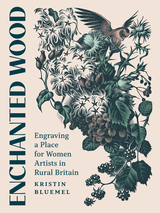
How women wood engravers helped reshape the visual and literary landscape of modern Britain
Amid the austerities of Depression-era publishing in Britain, urban editors and women artists recognized a unique opportunity to make and sell popular books illustrated with wood engravings. Enchanted Wood focuses on four of these artists—Gwen Raverat, Agnes Miller Parker, Clare Leighton, and Joan Hassall—weaving together their lives and work to tell a compelling and little-known story about a modern art that transformed the lives of both urban and rural women.
In this richly illustrated book, Kristin Bluemel demonstrates how women engravers used wood engraving to redraw professional and personal boundaries for themselves and other women. Depicting realistic scenes of country life, these illustrations are reminiscent of the aesthetic of eighteenth-century artist, naturalist, and print innovator Thomas Bewick even as they present distinctly modern reflections on gender, age, marriage, and motherhood. Reproducing and analyzing white-line engravings, pen and ink drawings, and rare color engravings from these four artists’ books for children and adults, Enchanted Wood reveals the magnified power and meaning of gentle arts for everyday people and for national patterns of work and play.
Integrating vignettes from Bewick’s natural history with formal, thematic, and cultural analysis of the women’s art as she recovers their medium, oeuvres, and stories, Bluemel shows how wood engraving led Raverat, Miller Parker, Leighton, and Hassall to achieve professional stature, public affirmation, and personal independence. A visually rich history of collective achievement, Enchanted Wood establishes these women engravers as important modern artists and literary figures in their own right.
Retail e-book files for this title are screen-reader friendly with images accompanied by short alt text and/or extended descriptions.

In 1585, the British painter and explorer John White created images of Carolina Algonquian Indians. These images were collected and engraved in 1590 by the Flemish publisher and printmaker Theodor de Bry and were reproduced widely, establishing the visual prototype of North American Indians for European and Euro-American readers.
In this innovative analysis, Michael Gaudio explains how popular engravings of Native American Indians defined the nature of Western civilization by producing an image of its “savage other.” Going beyond the notion of the “savage” as an intellectual and ideological construct, Gaudio examines how the tools, materials, and techniques of copperplate engraving shaped Western responses to indigenous peoples. Engraving the Savage demonstrates that the early visual critics of the engravings attempted-without complete success-to open a comfortable space between their own “civil” image-making practices and the “savage” practices of Native Americans-such as tattooing, bodily ornamentation, picture-writing, and idol worship. The real significance of these ethnographic engravings, he contends, lies in the traces they leave of a struggle to create meaning from the image of the American Indian.
The visual culture of engraving and what it shows, Gaudio reasons, is critical to grasping how America was first understood in the European imagination. His interpretations of de Bry’s engravings describe a deeply ambivalent pictorial space in between civil and savage-a space in which these two organizing concepts of Western culture are revealed in their making.
Michael Gaudio is assistant professor of art history at the University of Minnesota.
READERS
Browse our collection.
PUBLISHERS
See BiblioVault's publisher services.
STUDENT SERVICES
Files for college accessibility offices.
RECENTLY PUBLISHED





UChicago Accessibility Resources
home | accessibility | search | about | contact us
BiblioVault ® 2001 - 2025
The University of Chicago Press