Results by title

5 books match the query 'Equatorial Guinea'
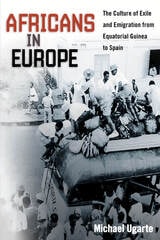
cover of Africans in Europe: The Culture of Exile and Emigration from Equatorial Guinea to Spain

Africans in Europe

The Culture of Exile and Emigration from Equatorial Guinea to Spain

Michael Ugarte

University of Illinois Press, 2013

What differentiates emigration from exile? This book delves theoretically and practically into this core question of population movements. Tracing the shifts of Africans into and out of Equatorial Guinea, it explores a small former Spanish colony in central Africa. Michael Ugarte examines the writings of Equatorial Guinean exiles and migrants, considering the underlying causes of such moves and arguing that the example of Equatorial Guinea is emblematic of broader dynamics of cultural exchange in a postcolonial world.

Based on personal stories of people forced to leave and those who left of their own accord, Africans in Europe captures the nuanced realities and widespread impact of mobile populations. By focusing on the geographical, emotional, and intellectual dynamics of Equatorial Guinea's human movements, readers gain an inroad to "the consciousness of an age" and an understanding of the global realities that will define the cultural, economic, and political currents of the twenty-first century.
[more]
cover of An Introduction to the Literature of Equatorial Guinea: Between Colonialism and Dictatorship

An Introduction to the Literature of Equatorial Guinea

Between Colonialism and Dictatorship

Marvin A. Lewis

University of Missouri Press, 2007

Spain’s only former colony in sub-Saharan Africa, Equatorial Guinea is home to a literature of transition—songs of freedom in which authors reflect on their identity within the context of recent colonialism and dictatorship.

            An Introduction to the Literature of Equatorial Guinea is the first book-length critical study of this literature, a multigenre analysis encompassing fifty years of poetry, drama, essays, and prose fiction. Both resident and exiled authors offer insights into the impact of colonialism and dictatorship under Spanish rule and consider the fruits of “independence” under the regimes of Francisco Macías Nguema and Teodoro Obiang Nguema. Examining these works from the perspective of postcolonial theory, Marvin A. Lewis shows how writings from Equatorial Guinea depict the clash of traditional and European cultures and reflect a dictatorship that produced poverty, misery, and oppression. He assesses with particular care the impact of the Macías reafricanization process and its manifestations in literature.

In showing how the views of the nation correspond and diverge in works of writers such as Maria Nsue Angue, Donato Ndongo-Bidyogo, and Juan Tomás Ávila Laurel, Lewis brings to light artists who articulate their concerns in Spanish but are African in their souls. In analyzing the works of both renowned and emerging writers, he marks the themes that contribute to the formation of national identity: Hispanic heritage, the myth of Bantu unity, “bonding in adversity” during the Nguema regime, and the Equatoguinean diaspora.

            Lewis provides an accessible introduction to the work of central writers in a new area of literary study and includes the most exhaustive and up-to-date bibliography available on the subject. His is a groundbreaking work that broadens our understanding of African literature and will be the bedrock for future studies of this Hispanic corner of Africa.
[more]
cover of Shadows of Your Black Memory

Shadows of Your Black Memory

Donato Ndongo

Swan Isle Press, 2007

Set during the last years of Spanish rule in Equatorial Guinea, Shadows of Your Black Memory presents the voice of a young African man reflecting on his childhood. Through the idealistic eyes of the nameless protagonist, Donato Ndongo portrays the cultural conflicts between Africa and Spain, ancestral worship competing with Catholicism, and tradition giving way to modernity. The backdrop of a nation moving toward a troubled independence parallels the young man’s internal struggle to define his own identity.

Now in paperback, Shadows of Your Black Memory masterfully exposes the cultural fissures of Ndongo’s native land. “Spanish Guinea” is a heated, sensual landscape with exotic animals and trees, ancient rituals, ghosts, saints, and sinners. We come to know the narrator’s extended family, the people of his village, merchants, sorcerers, and Catholic priests; we see them critically at times, even humorously, yet always with compassion and a magical dignity. Michael Ugarte’s sensitive translation captures the spirit of the original Spanish prose and makes Ndongo’s powerful, gripping tale available to English-speaking readers for the first time. 
 
[more]
cover of Silenced Resistance: Women, Dictatorships, and Genderwashing in Western Sahara and Equatorial Guinea

Silenced Resistance

Women, Dictatorships, and Genderwashing in Western Sahara and Equatorial Guinea

Joanna Allan

University of Wisconsin Press, 2021
Spain’s former African colonies—Equatorial Guinea and Western Sahara—share similar histories. Both are under the thumbs of heavy-handed, postcolonial regimes, and are known by human rights organizations as being among the worst places in the world with regard to oppression and lack of civil liberties. Yet the resistance movement in one is dominated by women, the other by men. In this innovative work, Joanna Allan demonstrates why we should foreground gender as key for understanding both authoritarian power projection and resistance. She brings an ethnographic component to a subject that has often been looked at through the lens of literary studies to examine how concerns for equality and women’s rights can be co-opted for authoritarian projects. She reveals how Moroccan and Equatoguinean regimes, in partnership with Western states and corporations, conjure a mirage of promoting equality while simultaneously undermining women’s rights in a bid to cash in on oil, minerals, and other natural resources. This genderwashing, along with historical local, indigenous, and colonially imposed gender norms mixed with Western misconceptions about African and Arab gender roles, plays an integral role in determining the shape and composition of public resistance to authoritarian regimes.
[more]
cover of The Licit Life of Capitalism: US Oil in Equatorial Guinea

The Licit Life of Capitalism

US Oil in Equatorial Guinea

Hannah Appel

Duke University Press, 2019

The Licit Life of Capitalism is both an account of a specific capitalist project—U.S. oil companies working off the shores of Equatorial Guinea—and a sweeping theorization of more general forms and processes that facilitate diverse capitalist projects around the world. Hannah Appel draws on extensive fieldwork with managers and rig workers, lawyers and bureaucrats, the expat wives of American oil executives and the Equatoguinean women who work in their homes, to turn conventional critiques of capitalism on their head, arguing that market practices do not merely exacerbate inequality; they are made by it. People and places differentially valued by gender, race, and colonial histories are the terrain on which the rules of capitalist economy are built. Appel shows how the corporate form and the contract, offshore rigs and economic theory are the assemblages of liberalism and race, expertise and gender, technology and domesticity that enable the licit life of capitalism—practices that are legally sanctioned, widely replicated, and ordinary, at the same time as they are messy, contested, and, arguably, indefensible.
[more]