Results by title

20 books match the query 'Job'

cover of Ending Poverty As We Know It: Guaranteeing A Right To A Job

Ending Poverty As We Know It

Guaranteeing A Right To A Job

William P. Quigley

Temple University Press, 2003

Across the United States tens of millions of people are working forty or more hours a week...and living in poverty. This is surprising in a country where politicians promise that anyone who does their share, and works hard, will get ahead. In Ending Poverty As We Know It, William Quigley argues that it is time to make good on that promise by adding to the Constitution language that insures those who want to work can do so—and at a wage that enables them to afford reasonable shelter, clothing, and food.
[more]
cover of Fragile Finitude: A Jewish Hermeneutical Theology

Fragile Finitude

A Jewish Hermeneutical Theology

Michael Fishbane

University of Chicago Press, 2021

The world we engage with is a vibrant collage brought to consciousness by language and our creative imagination. It is through the symbolic forms of language that the human world of value is revealed—this is where religious scholar Michael Fishbane dwells in his latest contribution to Jewish thought.

In Fragile Finitude, Fishbane clears new ground for a theological life through a novel reinterpretation of the Book of Job. On this basis, he offers a contemporary engagement with the four classical types of Jewish Scriptural exegesis. The first focuses on worldly experience, the second on communal forms of practice and thought in the rabbinical tradition, the third on personal development, and the fourth on transcendent, cosmic orientations. Through these four modes, Fishbane manages to transform Jewish theology from within, at once reinvigorating a long tradition and moving beyond it. What he offers is nothing short of a way to reorient our lives in relation to the divine and our fellow humans. Written from within the Jewish tradition, Fragile Finitude is intended for readers across the religious spectrum.
[more]
cover of Get The Job: Academic Library Hiring For The New Librarian

Get The Job

Academic Library Hiring For The New Librarian

Meggan Press

Assoc of College & Research Libraries, 2020
[more]
cover of Getting a Job: A Study of Contacts and Careers

Getting a Job

A Study of Contacts and Careers

Mark Granovetter

University of Chicago Press, 1995

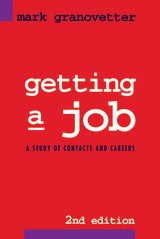
This classic study of how 282 men in the United States found their jobs not only proves "it's not what you know but who you know," but also demonstrates how social activity influences labor markets. Examining the link between job contacts and social structure, Granovetter recognizes networking as the crucial link between economists studies of labor mobility and more focused studies of an individual's motivation to find work.

This second edition is updated with a new Afterword and includes Granovetter's influential article "Economic Action and Social Structure: The Problems of Embeddedness."

"Who would imagine that a book with such a prosaic title as 'getting a job' could pose such provocative questions about social structure and even social policy? In a remarkably ingenious and deceptively simple analysis of data gathered from a carefully designed sample of professional, technical, and managerial employees . . . Granovetter manages to raise a number of critical issues for the economic theory of labor markets as well as for theories of social structure by exploiting the emerging 'social network' perspective."—Edward O. Laumann, American Journal of Sociology

"This short volume has much to offer readers of many disciplines. . . . Granovetter demonstrates ingenuity in his design and collection of data."—Jacob Siegel, Monthly Labor Review

"A fascinating exploration, for Granovetter's principal interest lies in utilizing sociological theory and method to ascertain the nature of the linkages through which labor market information is transmitted by 'friends and relatives.'"—Herbert Parnes, Industrial and Labor Relations Review
[more]
cover of Half A Job: Bad and Good Part-Time Jobs in a Changing Labor Market

Half A Job

Bad and Good Part-Time Jobs in a Changing Labor Market

Chris Tilly

Temple University Press, 1996

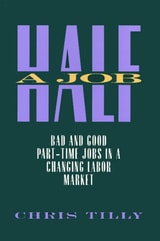
Over 20 million people are working part-time in the United States, more than six million of them involuntarily. Both Time and Fortune magazines have run recent cover stories about this constrained faction of the workforce, who tend to earn on average 40 percent less than full-time workers. Addressing this disturbing trend, Chris Tilly presents a current, in-depth analysis of how U.S. businesses use part-time employment, and why they are using it more and more.

Worker demand for part-time jobs peaked more than twenty years ago, but employers' desires for cheap labor and schedule flexibility have continued to drive the long-term growth of part-time jobs. Tilly argues that this growth is a reaction to the expanding trade and service industries, which, by their nature, depend on part-time workers. Examining the nature and purposes of the different types of part-time employment, he explores the roots of part-time jobs in the organization of work, and the inadequacies of existing public policies on part-time employment.

Using not only statistical analysis but over eighty interviews with employers in the retail and insurance industries, Tilly suggests new approaches to providing flexibility without insecurity.
[more]
cover of Job and the god of Babylon: Theo-politics, the Covenant and the Fall of Marduk

Job and the god of Babylon

Theo-politics, the Covenant and the Fall of Marduk

Jacob Kaaks

Eburon Academic Publishers, 2011
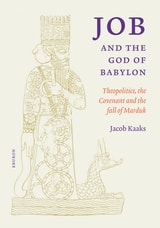
In this new analysis of the Book of Job, Jacob Kaaks looks at the theopolitical motives of the priests who assembled the Old Testament and puts one of the most puzzling books of the bible into the context of Akkadian literature. In this reading, Job is not the long-suffering embodiment of piety, but a figure with the ability to guide an evolving concept of God. Complete with a new translation of the Book of Job that takes into account Kaaks’s scholarship, Job and the god of Babylon is an impressive study that recasts the Old Testament not as a religious text existing in a vacuum, but as a product of its historical era.
[more]
cover of Just the Job: How Trades got their Names

Just the Job

How Trades got their Names

Alexander Tulloch

Bodleian Library Publishing, 2020

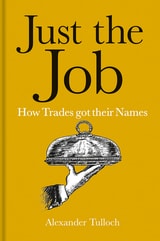
What did a gongfarmer do? How is a chaperone connected to a bird of prey? What is the etymology behind cloud architect? Is there a link between secretaries and secrets?

The story behind these (and many more) job titles is rarely predictable and often fascinating. In this highly original book, linguist Alexander Tulloch examines the etymology behind a selection of trades and professions, unearthing intriguing bits of historical information along the way. Here readers will find explanations of common surnames, such as Spencer, Hayward, and Fletcher; obsolete jobs such as pardoner, cordwainer, or telegraph boy; and roles for the modern era, such as wedding planner, pundit, and sky marshal. Packed with additional etymological information and literary quotations, this book will appeal not only to linguists, but to anyone interested in the quirky twists and turns of meaning that have led to the familiar job titles of today.

[more]
cover of Mothers On The Job: Maternity Policy in the U.S. Workplace

Mothers On The Job

Maternity Policy in the U.S. Workplace

Vogel, Lise

Rutgers University Press, 1993

Women's increasing demands for protection and benefits in the workplace, especially with regard to maternity leave, have sparked more than a century of controversy among feminists on how best to serve the needs of working women. This debate continues to divide the feminist community. One side believes women are better served by emphasizing equality with men--pregnancy should be treated like any other "disability." The other side wants to recognize difference--special provisions should apply only to pregnant women. Lise Vogel examines the evolution of this debate on pregnant women in the workplace, looking at theoretical as well as practical implications.

Vogel begins by assessing the history of the contemporary debate on pregnancy policy in the U.S. Since the middle of the nineteenth-century, American women have been torn by the contradictory demands of motherhood and the workplace. Pregnancy was grounds for dismissal from work and few employers took action to protect pregnant workers. To counter this, early twentieth-century feminists and reformers emphasized female specificity and women's special role.

In the 1960s activists adopted a strategy framed on equality, which moved away from the earlier emphasis on differences. The use of equality strategies to cover the female-specific phenomenon of pregnancy turned out to have problems. Now women's special needs were denied and ignored. These difficulties and a series of court cases in the 1980s triggered debates in the feminist legal community. Vogel looks at the litigation and debates, which pitted advocates of gender-neutral strategies against critics who called for female-specific policies.

Vogel argues that, in terms of practical benefits, women will be served best by a gender-neutral approach to pregnancy policy. She encourages equality advocates to recognize the inherent diversity of individuals, and points out the need to be sensitive to individual factors of race and class, as well as sex.

[more]
cover of Mothers On The Job: Maternity Policy in the U.S. Workplace

Mothers On The Job

Maternity Policy in the U.S. Workplace

Vogel, Lise

Rutgers University Press, 1993

Women's increasing demands for protection and benefits in the workplace, especially with regard to maternity leave, have sparked more than a century of controversy among feminists on how best to serve the needs of working women. This debate continues to divide the feminist community. One side believes women are better served by emphasizing equality with men--pregnancy should be treated like any other "disability." The other side wants to recognize difference--special provisions should apply only to pregnant women. Lise Vogel examines the evolution of this debate on pregnant women in the workplace, looking at theoretical as well as practical implications.

Vogel begins by assessing the history of the contemporary debate on pregnancy policy in the U.S. Since the middle of the nineteenth-century, American women have been torn by the contradictory demands of motherhood and the workplace. Pregnancy was grounds for dismissal from work and few employers took action to protect pregnant workers. To counter this, early twentieth-century feminists and reformers emphasized female specificity and women's special role.

In the 1960s activists adopted a strategy framed on equality, which moved away from the earlier emphasis on differences. The use of equality strategies to cover the female-specific phenomenon of pregnancy turned out to have problems. Now women's special needs were denied and ignored. These difficulties and a series of court cases in the 1980s triggered debates in the feminist legal community. Vogel looks at the litigation and debates, which pitted advocates of gender-neutral strategies against critics who called for female-specific policies.

Vogel argues that, in terms of practical benefits, women will be served best by a gender-neutral approach to pregnancy policy. She encourages equality advocates to recognize the inherent diversity of individuals, and points out the need to be sensitive to individual factors of race and class, as well as sex.
[more]
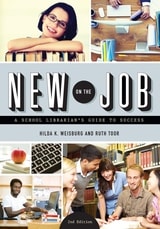
cover of New on the Job: A School Librarian's Guide to Success

New on the Job

A School Librarian's Guide to Success

Hilda K. Weisburg

American Library Association, 2014

[more]
cover of New on the Job: A School Library Media Specialist's Guide to Success

New on the Job

A School Library Media Specialist's Guide to Success

Ruth Toor

American Library Association, 2007

[more]
cover of On Job

On Job

Blind Didymus the Blind

Catholic University of America Press, 0
This volume provides the first full length English translation of the commentary on the Book of Job by Didymus the Blind. One of the earliest line-by-line commentaries on Job to survive from late antiquity, it covers the entirety of the first sixteen chapters of the LXX text of Job with a few unfortunate lacunae. It represents the third commentary of Didymus published in the Fathers of the Church series (preceded by Didymus’ On Genesis and On Zechariah translated by Robert C. Hill) and the last of the commentaries discovered at Tura in 1941 that was edited for circulation in late antiquity, since Didymus’ comments on Ecclesiastes and Psalms are unedited transcripts of his public lectures, replete with student questions. The Book of Job has garnered perpetual attention because of its intriguing dialogues between God and the Devil, Job and his wife, Job and his three friends and inevitably between Job and God. In recent years, it has become the focus of attention among scholars seeking to make sense of the horrors of the Holocaust and other 20th century atrocities where unlimited human cruelty and injustice strained any notions of Providence and the salvific nature of suffering by the righteous. Written at a pivotal time when Christianity and Rabbinic Judaism were emerging as distinct interpretive traditions, Didymus’ commentary on the book of Job offers important insights into the interpretation of Job based on the LXX translation which was a foundational text for early Christian doctrine, spirituality and liturgy. His presentation of Job as the icon of a student-loving teacher stands in contrast to the portrait of a blasphemous Job more familiar to modern audiences that value a bold iconoclastic character who puts God on trial for allowing human injustice. Didymus’ comments on Job hint at the blind teacher’s own mature consideration of his experience as a Christian teacher, concerned to train other potential leaders in the burgeoning post-Constantinian Church, whether as an ecclesiastical minister, monastic abba, governor, or teacher. As such, this early Christian commentary on the Book of Job merits further study because it illustrates an early exegetical trajectory that was already embedded in the Christian tradition prior Jerome’s advocacy of the Hebraica Veritas.
[more]
cover of On Job, Volume 1

On Job, Volume 1

Franklin T. St. Albert The Great

Catholic University of America Press, 2019
Even prior to his death on 15 November 1280, the Dominican master Albert of Lauingen was legendary on account of his erudition. He was widely recognized for the depth and breadth of his learning in the philosophical disciplines as well as in the study of God, earning him the titles Doctor universalis and Doctor expertus. Moreover, his authoritative teaching merited him the moniker Magnus, an appellation bestowed on no other man of the High Middle Ages. This volume contains the first half of Albert the Great’s commentary On Job (on chs. 1-21), translated into English for the first time; a translation of the second half of the work will appear in a subsequent volume of the Fathers of the Church, Mediaeval Continuation series. Albert completed Super Iob in 1272 or 1274, when he was over seventy years old, at the Dominican Kloster of Heilige Kreuz in Cologne, where, as lector emeritus of the Order, he likely lectured on this profound biblical book. Significantly, Albert may have been inspired to produce On Job by his most famous student, Thomas Aquinas, who had written his own Joban commentary, the Expositio super Iob ad litteram, while serving as conventual lector at San Domenico in Orvieto from 1261 to 1264. Yet Albert occupies a unique position in the history of the interpretation of Job: he is the first and only exegete in history who explicitly reads the whole book as a debate in the mode of an academic or scholastic disputation among Job and his friends about divine providence concerning human affairs. The Introduction to this volume situates Albert’s On Job—its general approach and key exegetical features—in the broad context of Dominican theological education and pastoral formation in the thirteenth century.
[more]
cover of On Job, Volume 2

On Job, Volume 2

Franklin T. St. Albert the Great

Catholic University of America Press, 2025
Even prior to his death on 15 November 1280, the Dominican master Albert of Lauingen was legendary for his erudition. He was widely recognized for the depth and breadth of his learning in the philosophical disciplines as well as in the study of God, earning him the titles Doctor universalis and Doctor expertus. Moreover, his authoritative teaching merited him the moniker Magnus, an appellation bestowed on no other man of the High Middle Ages. This volume contains the second half of Albert the Great’s commentary On Job (on chs. 22-42), translated into English for the first time; a translation of the first half of the work appeared in an earlier volume of the Fathers of the Church, Mediaeval Continuation series (vol. 19, 2019). Albert completed Super Iob in 1272 or 1274, when he was over seventy years old, at the Dominican Kloster of Heilige Kreuz in Cologne, where, as lector emeritus of the Order, he likely lectured on this profound biblical book. Significantly, Albert may have been inspired to produce On Job by his most famous student, Thomas Aquinas, who had written his own Joban commentary, the Expositio super Iob ad litteram, while serving as conventual lector at San Domenico in Orvieto from 1261 to 1264. Yet Albert occupies a unique position in the history of the interpretation of Job: he is the first and only exegete in history who explicitly reads the whole book as a debate in the mode of an academic or scholastic disputation among Job and his friends about divine providence concerning human affairs. Albert understands God, in the final chapters of Job, to determine the disputed question in favor of Job and against his friends, namely declaring that He (i.e., God) rules human life with no consideration of human works, but rather that divine governance is dissimilar to every mode of human rule.
[more]
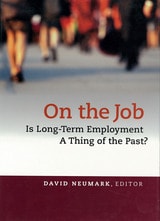
cover of On the Job: Is Long-Term Employment a Thing of the Past?

On the Job

Is Long-Term Employment a Thing of the Past?

David, editor Neumark

Russell Sage Foundation, 2000
In recent years, a flurry of reports on downsizing, outsourcing, and flexible staffing have created the impression that stable, long-term jobs are a thing of the past. According to conventional wisdom, workers can no longer count on building a career with a single employer, and job security is a rare prize. While there is no shortage of striking anecdotes to fuel these popular beliefs, reliable evidence is harder to come by. Researchers have yet to determine whether we are witnessing a sustained, economy-wide decline in the stability of American jobs, or merely a momentary rupture confined to a few industries and a few classes of workers. On the Job launches a concerted effort to reconcile the conflicting evidence about job stability and security. The book examines the labor force as a whole, not merely the ousted middle managers who have attracted the most publicity. It looks at the situation of women as well as men, young workers as well as old, and workers on part-time, non-standard, or temporary work schedules. The evidence suggests that long-serving managers and professionals suffered an unaccustomed loss of job security in the 1990s, but there is less evidence of change for younger, newer recruits. The authors bring our knowledge of the labor market up to date, connecting current conditions in the labor market with longer-term trends that have evolved over the past two decades. They find that  layoffs in the early 1990s disrupted the implicit contract between employers and staff, but it is too soon to declare a permanent revolution in the employment relationship. Having identified the trends, the authors seek to explain  them and to examine their possible consequences. If the bonds between employee and employer are weakening, who stands to benefit? Frequent job-switching can be a sign of success for a worker, if each job provides a stepping stone to something better, but research in this book shows that workers gained less from changing jobs in the 1980s and 1990s than in earlier decades. The authors also evaluate the third-party intermediaries, such as temporary help agencies, which profit from the new flexibility in the matching of workers and employers. Besides opening up new angles on the evidence, the authors mark out common ground and pin-point those areas where gaps in our knowledge remain and popular belief runs ahead of reliable evidence. On the Job provides an authoritative basis for spotting the trends and interpreting the fall-out as U.S. employers and employees rethink the terms of their relationship.
[more]
cover of Reading Job with St. Thomas Aquinas

Reading Job with St. Thomas Aquinas

Matthew Levering

Catholic University of America Press, 2020
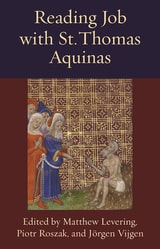
Reading Job with St. Thomas Aquinas is a scholarly contribution to Thomistic studies, specifically to the study of Aquinas’s biblical exegesis in relation to his philosophy and theology. Each of the thirteen chapters has a different focus, within the shared concentration of the book on Aquinas’s Literal Exposition on Job. The essays are arranged in three Parts: “Job and Sacra Doctrina”; “Providence and Suffering”; and “Job and the Moral Life”. Boyle’s opening essay argues that Aquinas’s commentary seeks to show what is required in the “Magister” (namely, Job and God) for the effective communication of wisdom. Mansini’s essay argues that by speaking, God reveals the virtue of Job and its value in God’s providence; without the personal revelation or speech of God, Job could not have known the value of his suffering. Vijgen’s essay explores the commentary’s use of Aristotle for reflecting upon divine providence, sorrow and anger, resurrection, and the new heavens and new earth. Levering’s essay explores the commentary’s citations of the Gospel of John and argues that these pertain especially to divine speech and to light/darkness. Bonino’s essay explains why divine incomprehensibility does not mean that Job is wrong to seek to understand God’s ways. Te Velde’s essay explores how Aquinas’s commentary draws upon the reasoning of his Summa contra gentiles with regard to the good order of the universe. Goris’s essay reflects upon how, according to Aquinas’s commentary, sin is and is not related to suffering. Knasas’s essay argues that Aquinas does not hold that the resurrection of the body is a necessary philosophical corollary of the human desire for happiness. Wawrykow’s essay explores merit, in relation to the connection between sin and punishment/affliction as well as to the connection between good actions and flourishing. Spezzano’s essay shows that Job’s hope and filial fear transform his suffering, making him an exemplar of the consolation they provide to the just. Mullady’s essay reflects upon the moral problems and opportunities posed by the passions, along with the ordering of the virtues to the reward of human happiness. Flood’s essay shows how Aquinas defends Job’s possession of the qualities needed for true friendship (including friendship with God), such as patience, delight in the presence of the friend, and compassion. Lastly, Kromholtz’s essay argues that although Aquinas’s Literal Exposition on Job never extensively engages eschatology, Aquinas depends throughout upon the reasonableness of hoping for the resurrection of the body and the final judgment.
[more]
cover of The Book of Job and the Immanent Genesis of Transcendence

The Book of Job and the Immanent Genesis of Transcendence

Davis Hankins

Northwestern University Press, 2014

Winner of the 2017 Manfred Lautenschlaeger Award for Theological Promise

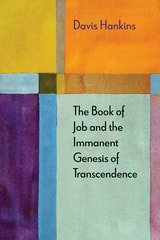
Recent philosophical reexaminations of sacred texts have focused almost exclusively on the Christian New Testament, and Paul in particular. The Book of Job and the Immanent Genesis of Transcendence revives the enduring philosophical relevance and political urgency of the book of Job and thus contributes to the recent “turn toward religion” among philosophers such as Slavoj Žižek and Alain Badiou.

Job is often understood to be a trite folktale about human limitation in the face of confounding and absolute transcendence. On the contrary, Hankins demonstrates that Job is a drama about the struggle to create a just and viable life in a material world that is ontologically incomplete and consequently open to radical, unpredictable transformation. Job’s abiding legacy for any future materialist theology becomes clear as Hankins analyzes Job’s dramatizations of a transcendence that is not externally opposed to but that emerges from an ontologically incomplete material world.
[more]
cover of The Chicago Guide to Landing a Job in Academic Biology

The Chicago Guide to Landing a Job in Academic Biology

C. Ray Chandler, Lorne M. Wolfe, and Daniel E. L. Promislow

University of Chicago Press, 2007

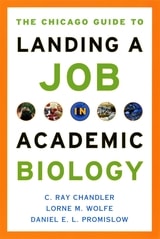
The Chicago Guide to Landing a Job in Academic Biology is an indispensable guide for graduate students and post-docs as they enter that domain red in tooth and claw: the job market.

An academic career in the biological sciences typically demands well over a decade of technical training. So it’s ironic that when a scholar reaches the most critical stage in that career—the search for a job following graduate work—he or she receives little or no formal preparation. Instead, students are thrown into the job market with only cursory guidance on how to search for and land a position.
Now there’s help. Carefully, clearly, and with a welcome sense of humor, The Chicago Guide to Landing a Job in Academic Biology leads graduate students and postdoctoral fellows through the perils and rewards of their first job search. The authors—who collectively have for decades mentored students and served on hiring committees—have honed their advice in workshops at biology meetings across the country. The resulting guide covers everything from how to pack an overnight bag without wrinkling a suit to selecting the right job to apply for in the first place. The authors have taken care to make their advice useful to all areas of academic biology—from cell biology and molecular genetics to evolution and ecology—and they give tips  on how applicants can tailor their approaches to different institutions from major research universities to small private colleges.

With jobs in the sciences ever more difficult to come by, The Chicago Guide to Landing a Job in Academic Biology is designed to help students and post-docs navigate the tricky terrain of an academic job search—from the first year of a graduate program to the final negotiations of a job offer.
[more]
cover of The Labor of Job: The Biblical Text as a Parable of Human Labor

The Labor of Job

The Biblical Text as a Parable of Human Labor

Antonio Negri

Duke University Press, 2009

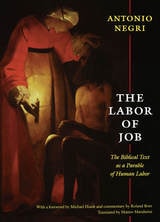
In The Labor of Job, the renowned Marxist political philosopher Antonio Negri develops an unorthodox interpretation of the Old Testament book of Job, a canonical text of Judeo-Christian thought. In the biblical narrative, the pious Job is made to suffer for no apparent reason. The story revolves around his quest to understand why he must bear, and why God would allow, such misery. Conventional readings explain the tale as an affirmation of divine transcendence. When God finally speaks to Job, it is to assert his sovereignty and establish that it is not Job’s place to question what God allows. In Negri’s materialist reading, Job does not recognize God’s transcendence. He denies it, and in so doing becomes a co-creator of himself and the world.

The Labor of Job was first published in Italy in 1990. Negri began writing it in the early 1980s, while he was a political prisoner in Italy, and it was the first book he completed during his exile in France (1983–97). As he writes in the preface, understanding suffering was for him in the early 1980s “an essential element of resistance. . . . It was the problem of liberation, in prison and in exile, from within the absoluteness of Power.” Negri presents a Marxist interpretation of Job’s story. He describes it as a parable of human labor, one that illustrates the impossibility of systems of measure, whether of divine justice (in Job’s case) or the value of labor (in the case of late-twentieth-century Marxism). In the foreword, Michael Hardt elaborates on this interpretation. In his commentary, Roland Boer considers Negri’s reading of the book of Job in relation to the Bible and biblical exegesis. The Labor of Job provides an intriguing and accessible entry into the thought of one of today’s most important political philosophers.
[more]
cover of Where Shall Wisdom be Found?: Calvin's Exegesis of Job from Medieval and Modern Perspectives

Where Shall Wisdom be Found?

Calvin's Exegesis of Job from Medieval and Modern Perspectives

Susan E. Schreiner

University of Chicago Press, 1994

Through countless retellings, from the Talmud to Archibald MacLeish and since, the story of Job has become a fixture in the cultural imagination of the West. In this study, Susan E. Schreiner analyzes interpretations of the Book of Job by Gregory the Great, Maimonides, Thomas Aquinas, and particularly John Calvin. Reading Calvin's interpretation of Job against the background of his most important medieval predecessors, Schreiner shows how central Job is to Calvin's struggles with issues of creation, the problem of evil, the meaning of history, and the doctrine of providence.

For Calvin and his predecessors, Schreiner argues, the concept of intellectual perception is the key to an understanding of Job. The texts she examines constantly raise questions about the human capacity for knowledge: What can the sufferer who stands within history perceive about the self, God, and reality? Can humans truly perceive the workings of providence in their personal lives or in the tumult of history? Are evil and injustice a reality that we must confront before finding wisdom?

In her final chapter, Schreiner turns to the wide array of twentieth-century interpretations of Job, including modern biblical commentaries, the work of Carl Jung, and literary transfigurations by Wells, MacLeish, Wiesel, and Kafka. The result is a compelling demonstration of how the history of exegesis can yield vital insights for contemporary culture.
[more]