
 A SCHOLARLY BOOK REPOSITORY
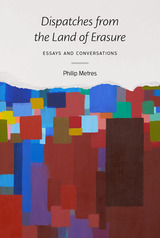
With keen insight into the lived experience of Arab Americans and other historically marginalized communities, the book explores the struggle for a just peace through reading Palestinian Arab and Israeli Jewish writers of conscience who contend with the wall of silence around the issue of Palestine. Further, Dispatches illuminates how to write a poetry of peace and justice, and how poetic activism and activist poets situate themselves in communities seeking change. Divided into four sections—Erasing the Erasures: Writing While Arab, The Poetics of Palestine, The Poetics of Justice, and The Poetics of Peacebuilding—Dispatches weaves personal essays, cultural criticism, group chats, interviews, literary analysis, reviews, and roundtables that include luminaries like Mosab Abu Toha, Hayan Charara, Sahar Khalifeh, Marwa Helal, Erika Meitner, Naomi Shihab Nye, Craig Santos Perez, and M. NourbeSe Philip. Together, the book models the crucial need for robust dialogue to overcome the echo chamber that limits the growth and reach of social movements and to dream of a future beyond the land of erasure.
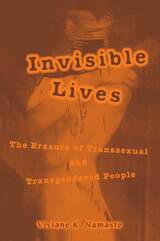
Invisible Lives is the first scholarly study of transgendered people—cross-dressers, drag queens and transsexuals—and their everyday lives.
Through combined theoretical and empirical study, Viviane K. Namaste argues that transgendered people are not so much produced by medicine or psychiatry as they are erased, or made invisible, in a variety of institutional and cultural settings. Namaste begins her work by analyzing two theoretical perspectives on transgendered people—queer theory and the social sciences—displaying how neither of these has adequately addressed the issues most relevant to sex change: everything from employment to health care to identity papers. Namaste then examines some of the rhetorical and semiotic inscriptions of transgendered figures in culture, including studies of early punk and glam rock subcultures, to illustrate how the effacement of transgendered people is organized in different cultural sites. Invisible Lives concludes with new research on some of the day-to-day concerns of transgendered people, offering case studies in violence, health care, gender identity clinics, and the law.

The untold stories of resilience in Hmong American education
Re-membering Culture is a deep exploration of the intricate dynamics of cultural memory and education, centering the experiences of Hmong American students and educators. Arguing that the school, as a product of coloniality, perpetuates the marginalization and erasure of non-Western epistemologies, author Bic Ngo sheds light on the subtle yet impactful process of structured forgetting within the American education system. This politics of forgetting, in turn, contributes to the fragmentation of Hmong cultural heritage, identity, and community.
Based on a high school in an urban center with a considerable Hmong immigrant community, Ngo’s work draws on extensive ethnographic research with Hmong American community leaders, school administrators, parents, teachers, staff, and high school students to understand how they navigate the terrain of Western pedagogy while attempting to retain and preserve Hmong knowledge systems. Exploring a range of school experiences, Ngo traverses students’ challenges in balancing school with family life and the everyday cultural racism encountered in the classroom as well as grassroots efforts to preserve culture, including the establishment of a Hmong Cultural Club.
Highlighting these experiences and voices, Ngo provides a nuanced understanding of the challenges Hmong Americans face within an assimilationist society while contesting the dominant anti-immigrant narratives of refugee suffering and poverty. Through these practices of (re)storytelling, resurgence, and refusal, she underscores the agency of the Hmong American community, illuminating how the critical consciousness fostered by re-membering serves as a powerful tool in confronting white hegemonic ideologies in education.
Retail e-book files for this title are screen-reader friendly.
READERS
Browse our collection.
PUBLISHERS
See BiblioVault's publisher services.
STUDENT SERVICES
Files for college accessibility offices.
RECENTLY PUBLISHED




UChicago Accessibility Resources
home | accessibility | search | about | contact us
BiblioVault ® 2001 - 2026
The University of Chicago Press