logo for University of Michigan Press
Second in Command
Reevaluating the Role of Vice Presidents and Running Mates in Modern American Politics
Edited by Karine Prémont and Christopher J. Devine
University of Michigan Press, 2026
In recent years, the office of the vice president has become a focal point of presidential politics and governance. From the emergence of the modern vice presidency under Walter Mondale to Mike Pence’s and Kamala Harris’s dramatic influence on the outcome of the 2020 election, Second in Command explores how vice presidents and vice-presidential candidates have shaped the direction of the country and changed American politics. The frenzy of speculation surrounding the “veepstakes” every four years and extensive media coverage of the vice-presidential debate may seem odd, given the vice presidency’s limited constitutional powers and dismal public reputation. 

Dispelling the myth that the vice presidency is a powerless or merely ceremonial role, Second in Command draws on the multidisciplinary expertise of more than a dozen leading vice-presidential scholars to reveal the complex, consequential, and often misunderstood nature of the office. With accessible language and vivid examples, it traces the transformation of vice-presidential power over the past half-century, the evolving electoral significance of vice-presidential running mates, and highlights the need for a deeper public understanding of these pivotal figures. Chapters employ a range of qualitative and quantitative methodologies, including elite interviews, archival research, case studies, and advanced statistical modeling to cover topics such as gender and media effects in running mate selection and the representation of vice presidents in popular culture. This book offers a fresh, engaging, and essential perspective on a vital institution at the heart of American democracy.
[more]

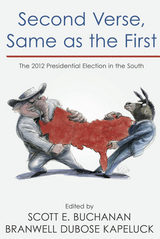
front cover of Second Verse, Same as the First
Second Verse, Same as the First
The 2012 Presidential Election in the South
Scott E. Buchanan
University of Arkansas Press, 2014
Second Verse, Same as the First is a volume of essays covering the 2012 election as it played out in the eleven former states of the Confederacy. The essays are organized by state and emphasize the presidential campaign, but each state chapter also includes analysis on notable congressional races and important patterns at the state level. Interesting patterns in the South and their implications for the balance of power between the two major parties are analyzed. Additional chapters cover the issues that dominated voter decision making and the nomination process. Second Verse, Same as the First is a necessity for academics, journalists, and political enthusiasts seeking a deeper understanding of contemporary changes in southern electoral politics.
[more]


front cover of The Silent Guns of Two Octobers
The Silent Guns of Two Octobers
Kennedy and Khrushchev Play the Double Game
Theodore Voorhees, Jr.
University of Michigan Press, 2020

The Silent Guns of Two Octobers uses new as well as previously under-appreciated documentary evidence to link the Cuban Missile Crisis to the Checkpoint Charlie tank standoff to achieve the impossible—craft a new, thoughtful, original analysis of a political showdown everyone thought they knew everything about. Ultimately the book concludes that much of the Cold War rhetoric the leaders employed was mere posturing; in reality neither had any intention of starting a nuclear war. Theodore Voorhees reexamines Khrushchev’s and Kennedy’s leadership, decision, and rhetoric in light of the new documentary evidence available. Voorhees examines the impact of John F. Kennedy's domestic political concerns about his upcoming first midterm elections on his handling of the Cuban Missile Crisis through his use of back-channel dealings with Khrushchev during the lead-up to the crisis and in the closing days when the two leaders managed to reach a settlement.

[more]

logo for University of Illinois Press
Spaceflight and the Myth of Presidential Leadership
Edited by Roger D. Launius and Howard E. McCurdy
University of Illinois Press, 1997

Setting the tone for the collection, NASA chief historian Roger D. Launius and Howard McCurdy maintain that the nation's presidency had become imperial by the mid-1970s and that supporters of the space program had grown to find relief in such a presidency, which they believed could help them obtain greater political support and funding. Subsequent chapters explore the roles and political leadership, vis-à-vis government policy, of presidents Eisenhower, Kennedy, Johnson, Nixon, Ford, Carter, and Reagan.

[more]


Send via email Share on Facebook Share on Twitter