
 A SCHOLARLY BOOK REPOSITORY

A profound memoir of coming to terms with a lost racial identity
David Mura was well into his twenties when he began to explore his Asian American identity. His Japanese American parents had been incarcerated in internment camps during World War II, and in response to their traumatic experience, they abandoned their Japanese roots to try to assimilate into white, middle-class America. As a result, Mura was raised to consider himself as a white person, and his journey toward understanding and accepting his Asianness was a fraught road—one that left many fractured relationships in its wake. In Exit, Miss Saigon, Mura writes with frank openness about his personal experiences and the irrevocable ways they are rooted in the internalized, systemic racism that permeates American culture.
Starting out as a young poet in Minneapolis working toward a PhD, Mura avoided reading “minority literature,” yearning instead to be like famed poets in their ivory towers—Robert Lowell, Randall Jarrell, John Berryman, artists tortured by their families and personal demons rather than by politics or race. As Mura began to read more widely, his conceptions of race and its societal construction began to broaden. When the Ordway Theater in St. Paul, Minnesota, staged a presentation of Miss Saigon in 1992, Mura published “Secrets and Anger” in Mother Jones, a scathing critique of the play’s racist undertones and the arguments he’d been having with white artist friends about it. As a result, Mura was ostracized from the local, dominantly white writing community, yet in its place he found a deeper connection with other BIPOC writers and eventually started an Asian American arts organization in the Twin Cities.
Far more than a personal memoir, Exit, Miss Saigon is a clear-eyed examination of issues affecting Asian Americans: anti-Asian hate crimes during the pandemic, affirmative action, racial and sexual stereotypes in the media, interracial relationships and raising mixed-race children, the legacy of Japanese American internment, and the shortfalls of therapy in addressing race. Mura excavates the deep-seated racist stereotypes thrust on those perceived as “other” (read: nonwhite people) and works to uncover a more authentic, liberatory path to defining personal identity.
Retail e-book files for this title are screen-reader friendly.
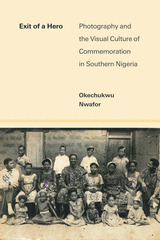
In Exit of a Hero, Okechukwu Nwafor explores the cultural, political, and socioeconomic implications of photography in commemorative practices in southern Nigeria from the nineteenth century to the present. Focusing on obituary and commemorative photographs of late nineteenth and early twentieth-century Lagos to contemporary funeral posters, booklets, and social media posts, Nwafor tracks the historical evolution of the iconic and heroic image. He argues that the quest to produce an ideal memorial body is not just a personal aesthetic choice but a deliberate photographic project that resonates with the Igbo aspirations for heroic achievement.
Exit of a Hero asserts that the visual canonization transforms the deceased from a fallible being to an unimpeachable character who transcends underachievement, imperfection, and failed social performance to emerge as a saintly icon of the Igbo public sphere. In seeking an alternative, hyper-visible public self, social media reclaims the lost hero image of the deceased, reconstituting the contested Igbo public space as a lived reality where heroes and icons are actively and eternally commemorated. Nwafor unveils the creative imaginations of colonial subjects and postcolonial citizens as memorialization has become entangled within the intersecting discursive spaces of print culture and the public sphere.
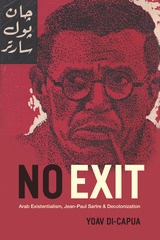
By closely following the remarkable career of Arab existentialism, Yoav Di-Capua reconstructs the cosmopolitan milieu of the generation that tried to articulate a political and philosophical vision for an egalitarian postcolonial world. He tells this story by touring a fascinating selection of Arabic and Hebrew archives, including unpublished diaries and interviews. Tragically, the warm and hopeful relationships forged between Arab intellectuals, Sartre, Simone de Beauvoir, and others ended when, on the eve of the 1967 war, Sartre failed to embrace the Palestinian cause. Today, when the prospect of global ethical engagement seems to be slipping ever farther out of reach, No Exit provides a timely, humanistic account of the intellectual hopes, struggles, and victories that shaped the Arab experience of decolonization and a delightfully wide-ranging excavation of existentialism’s non-Western history.
READERS
Browse our collection.
PUBLISHERS
See BiblioVault's publisher services.
STUDENT SERVICES
Files for college accessibility offices.
RECENTLY PUBLISHED






UChicago Accessibility Resources
home | accessibility | search | about | contact us
BiblioVault ® 2001 - 2026
The University of Chicago Press