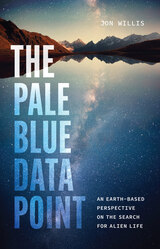
front cover of The Pale Blue Data Point
The Pale Blue Data Point
An Earth-Based Perspective on the Search for Alien Life
Jon Willis
University of Chicago Press, 2025

“Here is Willis’s fundamental argument: The more we learn about Earth—our one ‘pale blue data point’ for a planet on which life has definitively arisen—the more qualified we will be to recognize signs of life elsewhere. . . . [A] joyful account.”—Steven Poole, The Wall Street Journal
 
A thrilling tour of Earth that shows the search for extraterrestrial life starts in our own backyard.
 
Is there life off Earth? Bound by the limitations of spaceflight, a growing number of astrobiologists investigate the question by studying life on our planet. Astronomer and author Jon Willis shows us how it’s done, allowing readers to envision extraterrestrial landscapes by exploring their closest Earth analogs. With Willis, we dive into the Pacific Ocean from the submersible-equipped E/V Nautilus to ponder the uncharted seas of Saturn’s and Jupiter’s moons; search the Australian desert for some of Earth’s oldest fossils and consider the prospects for a Martian fossil hunt; visit mountaintop observatories in Chile to search for the telltale twinkle of extrasolar planets; and eavesdrop on dolphins in the Bahamas to imagine alien minds.
 
With investigations ranging from meteorite hunting to exoplanet detection, Willis conjures up alien worlds and unthought-of biological possibilities, speculating what life might look like on other planets by extrapolating from what we can see on Earth, our single “pale blue dot”—as Carl Sagan famously called it—or, in Willis’s reframing, scientists’ “pale blue data point.”
[more]

front cover of Plants, Animals, People, Aliens
Plants, Animals, People, Aliens
An Aristotelian-Thomist Perspective on Life in the Universe
Marie I. George
Catholic University of America Press, 2026
Aristotle famously maintains in his treatise On the Soul that there are three kinds of living things-- plants, animals, and humans--and he speaks of each kind as having a soul. St. Thomas Aquinas adopts these same views. Nowadays, however, many thinkers reject them on the grounds that they are incompatible with modern science. Molecular biology is seen as affording a superior way of categorizing life forms. Evolutionary biology appears to have established that humans are simply primates with adaptations somewhat different from other primates. Plant physiology, uncovering plants’ directional responses to a wide variety of different stimuli, provides reason to think that plants sense light, pressure, odor, pathogens, etc., in which case plants are simply non-mobile animals, similar to coral. Neuroscience, by showing the dependency of thought, choice, perception, and emotion on the central nervous system, especially on the brain, seems to have eliminated any need to posit a soul. Plants, Animals, People, Aliens addresses these and a variety of other science-based claims about living things by bringing Aristotelian-Thomistic teachings to bear upon them. While not a systematic work, it both treats some of the most hotly debated philosophical questions concerning living things, such as what it means to be alive, as well as treating questions less often raised by philosophers, such as whether animals have a theory of mind. Though geared primarily to those conversant with the Aristotelian-Thomistic tradition, many of its key concepts are traced back to experiences that we all share in common, thus rendering these concepts intelligible, if not convincing, to those with scientific and other backgrounds who are curious about this philosophical approach to living things. The author strives to show how Aristotelian-Thomistic philosophy and science complement one another by sketching out the fuller understanding of the living realm that the two together provide. The book’s final section considers the possibility and the likelihood that embodied rational beings exist elsewhere in our universe. Here, theological arguments drawn from the Christian faith are presented alongside philosophical and scientific arguments. This section closes with a theological discussion of the disputed question of whether extraterrestrials, were they to exist, should be baptized.
[more]


Send via email Share on Facebook Share on Twitter