
 A SCHOLARLY BOOK REPOSITORY
Feminine Feminists was first published in 1994. Minnesota Archive Editions uses digital technology to make long-unavailable books once again accessible, and are published unaltered from the original University of Minnesota Press editions.
What does it mean to be a woman today in Italy, a country with the lowest birthrate in the world and the heaviest maternal stereotype? Does being a feminist exclude practices of cultural femininity? What are Italian women's cultural productions? These questions are at the center of this volume, which looks at how feminism and femininity are embedded in a broad spectrum of Italian cultural practices.
In recent years, several books have introduced the American public to Italian women's voices. This volume goes beyond others in its range of theoretical topics and modes, considering cultural practices not only in their popular, material appearance, but also in the disciplines and forms of knowledge that order information and circumscribe behavior.The essays, all by well-known scholars in Italian studies, reflect the authors' specific critical interests in cinema, fashion, literary texts, feminist theory, and popular culture, past and present. Some address the culture of everyday life, while others examine feminism and femininity in the context of philosophy, ethics, or national identity within a global culture. Some begin with the conviction that performing "femininity"—whether in appearance or in nurturing practices—can be culturally liberating. Others put this notion to the critical test. By situating the problem of femininity within the discussion of feminism, this volume takes on larger issues within feminist discourse. Its bold examination of the component of femininity within the context of women's experiences offers readers rare insight into Italian women's culture and into the multicultural possibilities of feminism.Contributors: Beverly Allen,
Serena Anderlini-D'Onofrio, Lucia Chiavola Birnbaum, Renate Holub, Carol Lazzaro-Weis, Maria Marotti, Áine O'Healy, Graziella Parati, Eugenia Paulicelli, Robin Pickering-Iazzi, Maurizio Viano.Giovanna Miceli Jeffries is a lecturer in the department of French and Italian at the University of Wisconsin, Madison.

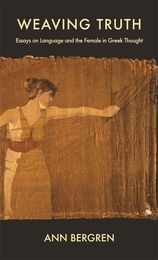
"What if truth were a woman?" asked Nietzsche. In ancient Greek thought, truth in language has a special relation to the female by virtue of her pre-eminent art-form—the one Freud believed was even invented by women—weaving. The essays in this book explore the implications of this nexus: language, the female, weaving, and the construction of truth.
The Homeric bard—male, to be sure—inherits from Indo-European culture the designation of his poetry as a weaving, the female's art. Like her tapestries, his "texts" can suspend, reverse, and re-order time. He can weave the content from one world into the interstices of another.
The male poet shares the ambiguous power of the female Muses whose speech he channels. "We can say false things like to real things, and whenever we wish, we can utter the truth."
READERS
Browse our collection.
PUBLISHERS
See BiblioVault's publisher services.
STUDENT SERVICES
Files for college accessibility offices.
RECENTLY PUBLISHED



UChicago Accessibility Resources
home | accessibility | search | about | contact us
BiblioVault ® 2001 - 2025
The University of Chicago Press