
 A SCHOLARLY BOOK REPOSITORY
From the first scholarship donated to Harvard in 1643 to today's world of "enrollment management" and federal grants and loans, the author gives a lively social and economic history of the conflicting purposes of student aid and makes proposals for the future. His research for this book is based on archives and interviews at 131 public and private institutions across the United States.
In the words of Joe Paul Case, Dean and Director of Financial Aid, Amherst College, "Wilkinson has mined the archives of dozens of institutions to create a mosaic that details the progress of student assistance from the 17th century to the present. He gives particular attention to the origins of need-based assistance, from the charitable benevolence of early colleges to the regulation-laden policies of the federal government. He gives due consideration to institutional motive--he challenges the egalitarian platitudes of affluent colleges and questions the countervailing market and economic forces that may imperil need-based aid at less competitive institutions. By drawing on scores of personal interviews and exchanges of correspondence with aid practitioners, Wilkinson fleshes out recent decades, helping the reader to understand new trends in the provision of aid."

The secret economics of maximizing college financial aid (and why it’s not as miserable as you think).
In the college admissions process, a terrifying unknown looms large: How much is this really going to cost? For prospective students and their families, there’s no easy answer. While college prices continue to rise, so do their promises of financial aid for qualified students. But who qualifies? And for how much? How can this monumental life decision be so utterly impossible to understand?
Hidden Tuition is an insider’s guide for navigating college financial aid to maximum effect and with (relatively) minimal pain. Economist and financial-aid expert Phillip B. Levine draws on his unique experience—including years of research in higher-education finance and work alongside admissions and financial-aid departments—to help readers first identify, then minimize, what they’ll actually pay for different types of colleges based on their circumstances. With expertise, clarity, and the warmth of someone who’s been through it, Levine details how students can find the hidden tuition costs in the opaque landscape of college pricing and financial aid. He explores topics that include:
- Why college’s “sticker prices” are rarely what students pay—and how some actual prices are even going down
- The best, worst, and most surprising deals for students with different financial resources
- How to navigate financial aid for divorced and multi-residence households
- Who really benefits from early decision
- How the nature of scholarships and merit-based aid is often framed in misleading ways
- The pros and cons of college savings accounts
- When and how to get started on college financing
- Why all student loans aren't the same (or aren't all that bad)
Debunking common myths and offering practical guidance for both families and individual students, Hidden Tuition makes a maddeningly imperfect process more manageable—and gives students a clearer path through one of life’s biggest financial decisions towards collegiate success.
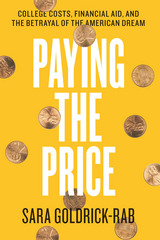
Not necessarily, says Sara Goldrick-Rab, and with Paying the Price, she shows in damning detail exactly why. Quite simply, college is far too expensive for many people today, and the confusing mix of federal, state, institutional, and private financial aid leaves countless students without the resources they need to pay for it.
Drawing on an unprecedented study of 3,000 young adults who entered public colleges and universities in Wisconsin in 2008 with the support of federal aid and Pell Grants, Goldrick-Rab reveals the devastating effect of these shortfalls. Half the students in the study left college without a degree, while less than 20 percent finished within five years. The cause of their problems, time and again, was lack of money. Unable to afford tuition, books, and living expenses, they worked too many hours at outside jobs, dropped classes, took time off to save money, and even went without adequate food or housing. In many heartbreaking cases, they simply left school—not with a degree, but with crippling debt. Goldrick-Rab combines that shocking data with devastating stories of six individual students, whose struggles make clear the horrifying human and financial costs of our convoluted financial aid policies.
America can fix this problem. In the final section of the book, Goldrick-Rab offers a range of possible solutions, from technical improvements to the financial aid application process, to a bold, public sector–focused “first degree free” program. What’s not an option, this powerful book shows, is doing nothing, and continuing to crush the college dreams of a generation of young people.
READERS
Browse our collection.
PUBLISHERS
See BiblioVault's publisher services.
STUDENT SERVICES
Files for college accessibility offices.
RECENTLY PUBLISHED




UChicago Accessibility Resources
home | accessibility | search | about | contact us
BiblioVault ® 2001 - 2026
The University of Chicago Press