
 A SCHOLARLY BOOK REPOSITORY
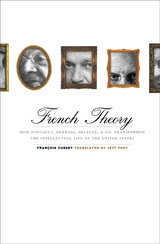
“A great story, full of twists and turns. . . . Careers made and ruined, departments torn apart, writing programs turned into sensitivity seminars, political witch hunts, public opprobrium, ignorant media attacks, the whole ball of wax. Read it and laugh or read it and weep. I can hardly wait for the movie.” —Stanley Fish, Think Again, New York Times
“In such a difficult genre, full of traps and obstacles, French Theory is a success and a remarkable book in every respect: it is fair, balanced, and informed. I am sure this book will become the reference on both sides of the Atlantic.” —Jacques Derrida
“The Atlantic Ocean has two sides, and so does French Theory. Reinvented in America and betrayed in its own country, it has become the most radical intellectual movement in the West with global reach, rewriting Marx in light of late capitalism. Breathtakingly moving back and forth between the two cultures, Francois Cusset takes us through a dazzling intellectual adventure that illuminates the past thirty years, and many more decades to come.” —Sylvere Lotringer
During the last three decades of the twentieth century, a disparate group of radical French thinkers achieved an improbable level of influence and fame in the United States. Compared by at least one journalist to the British rock ‘n’ roll invasion, the arrival of works by Michel Foucault, Jacques Derrida, Jean-François Lyotard, Jean Baudrillard, Gilles Deleuze, and Félix Guattari on American shores in the late 1970s and 1980s caused a sensation.
Outside the academy, “French theory” had a profound impact on the era’s emerging identity politics while also becoming, in the 1980s, the target of right-wing propagandists. At the same time in academic departments across the country, their poststructuralist form of radical suspicion transformed disciplines from literature to anthropology to architecture. By the 1990s, French theory was woven deeply into America’s cultural and intellectual fabric.
French Theory is the first comprehensive account of the American fortunes of these unlikely philosophical celebrities. François Cusset looks at why America proved to be such fertile ground for French theory, how such demanding writings could become so widely influential, and the peculiarly American readings of these works. Reveling in the gossipy history, Cusset also provides a lively exploration of the many provocative critical practices inspired by French theory. Ultimately, he dares to shine a bright light on the exultation of these thinkers to assess the relevance of critical theory to social and political activism today-showing, finally, how French theory has become inextricably bound with American life.
François Cusset, a writer and intellectual historian, teaches contemporary French thought in Paris at the Institut d’Etudes Politiques and at Columbia University’s Reid Hall. His books include Queer Critics and La Décennie.
Jeff Fort is assistant professor of French at the University of California, Davis. He has translated works by Maurice Blanchot, Jean Genet, and Jean-Luc Nancy.
READERS
Browse our collection.
PUBLISHERS
See BiblioVault's publisher services.
STUDENT SERVICES
Files for college accessibility offices.
RECENTLY PUBLISHED






UChicago Accessibility Resources
home | accessibility | search | about | contact us
BiblioVault ® 2001 - 2026
The University of Chicago Press