
 A SCHOLARLY BOOK REPOSITORY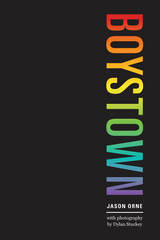
In Boystown, Orne takes readers on a detailed, lively journey through Chicago’s Boystown, which serves as a model for gayborhoods around the country. The neighborhood, he argues, has become an entertainment district—a gay Disneyland—where people get lost in the magic of the night and where straight white women can “go on safari.” In their original form, though, gayborhoods like this one don’t celebrate differences; they create them. By fostering a space outside the mainstream, gay spaces allow people to develop an alternative culture—a queer culture that celebrates sex.
Orne spent three years doing fieldwork in Boystown, searching for ways to ask new questions about the connective power of sex and about what it means to be not just gay, but queer. The result is the striking Boystown, illustrated throughout with street photography by Dylan Stuckey. In the dark backrooms of raunchy clubs where bachelorettes wouldn’t dare tread, people are hooking up and forging “naked intimacy.” Orne is your tour guide to the real Boystown, then, where sex functions as a vital center and an antidote to assimilation.
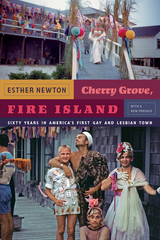
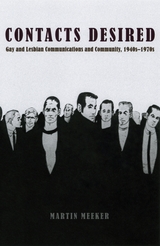
Martin Meeker here argues that over the course of the twentieth century, a series of important innovations occurred in the networks that linked individuals to a larger social knowledge of homosexuality. He points to three key innovations in particular: the emergence of the homophile movement in the 1950s; the mass media treatments of homosexuals in the late 1950s and early 1960s; and the popularization of do-it-yourself publishing from the late 1940s to the 1970s, which offered bar guides, handmade magazines, and other materials that gay men and lesbians could use to seek one another out. In the process, Meeker unearths a treasure trove of archival materials that reveals how homosexuals played a crucial role in transforming the very structure of communications and urban communities since the postwar era.
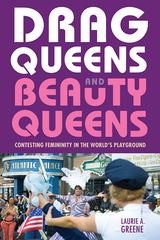
Drag Queens and Beauty Queens presents a vivid ethnography of the Miss’d America pageant and the gay neighborhood from which it emerged in the early 1990s as a moment of campy celebration in the midst of the AIDS crisis. It examines how the pageant strengthened community bonds and activism, as well as how it has changed now that Rupaul’s Drag Race has brought many of its practices into the cultural mainstream. Comparing the Miss’d America pageant with its glitzy cisgender big sister, anthropologist Laurie Greene discovers how the two pageants have influenced each other in unexpected ways.
Drag Queens and Beauty Queens deepens our understanding of how femininity is performed at pageants, exploring the various ways that both the Miss’d America and Miss America pageants have negotiated between embracing and critiquing traditional gender roles. Ultimately, it celebrates the rich tradition of drag performance and the community it engenders.
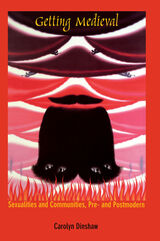
In her pursuit of historical analyses that embrace the heterogeneity and indeterminacy of sex and sexuality, Dinshaw examines canonical Middle English texts such as the Canterbury Tales and The Book of Margery Kempe. She examines polemics around the religious dissidents known as the Lollards as well as accounts of prostitutes in London to address questions of how particular sexual practices and identifications were normalized while others were proscribed. By exploring contemporary (mis)appropriations of medieval tropes in texts ranging from Quentin Tarantino’s Pulp Fiction to recent Congressional debates on U.S. cultural production, Dinshaw demonstrates how such modern media can serve to reinforce constrictive heteronormative values and deny the multifarious nature of history. Finally, she works with and against the theories of Michel Foucault, Homi K. Bhabha, Roland Barthes, and John Boswell to show how deconstructionist impulses as well as historical perspectives can further an understanding of community in both pre- and postmodern societies.
This long-anticipated volume will be indispensible to medieval and queer scholars and will be welcomed by a larger cultural studies audience.
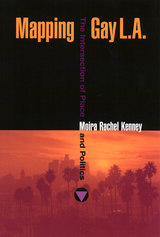
By tracking the terrain of the movement since the beginnings of gay liberation in 1960s Los Angeles, Kenney shows how activists laid claim to streets, buildings, neighborhoods, and, in the example of West Hollywood, an entire city. Exploiting the area's lack of cohesion, they created a movement that maintained a remarkable flexibility and built support networks stretching from Venice Beach to East LA. Taking a different path from San Francisco and New York, gays and lesbians in Los Angeles emphasized social services, decentralized communities (usually within ethnic neighborhoods), and local as well as national politics. Kenney's grounded reading of this history celebrates the public and private forms of activism that shaped a visible and vibrant community.
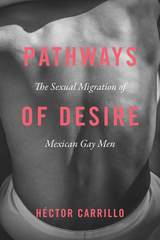
Further, Carrillo shows that sexual globalization must be regarded as a bidirectional, albeit uneven, process of exchange between countries in the global north and the global south. With this approach, Carrillo challenges the view that gay men from countries like Mexico would logically want to migrate to a “more sexually enlightened” country like the United States—a partial and limited understanding, given the dynamic character of sexuality in countries such as Mexico, which are becoming more accepting of sexual diversity. Pathways of Desire also provides a helpful analytical framework for the simultaneous consideration of structural and cultural factors in social scientific studies of sexuality. Carrillo explains the patterns of cross-cultural interaction that sexual migration generates and—at the most practical level—shows how the intricacies of cross-cultural sexual and romantic relations may affect the sexual health and HIV risk of transnational immigrant populations.
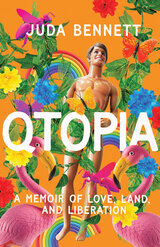
In the 1970s, while communes bloomed like wildflowers across the land, most had no room for queer members. The so-called counterculture still clung to heterosexual norms, even as it preached freedom from traditional gender roles and the nuclear family. Juda Bennett’s engrossing memoir follows his escape from suburbia into the back-to-the-land movement—and chronicles the efforts it took for him to “drop back in” to mainstream society and the ways in which he and his compatriots continued to honor their communal vision.
After enduring the hollow promises of “progressive” communes, Bennett finally found what he didn’t know he was looking for at Lavender Hill, a rural queer commune of visionaries carving out a life beyond heteronormativity, beyond capitalism, beyond shame. They didn’t just survive; they built something messy, luminous, and defiantly alive. And when the commune began to unravel, they didn’t vanish. They evolved. Qtopia is a story of chosen family and radical transformation. It is a reminder that queer utopia isn’t behind us—it’s still out there on the horizon, singing its song of joy, defiance, and fabulousness.
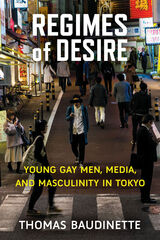
Shinjuku Ni-chōme is a nightlife district in central Tokyo filled with bars and clubs targeting the city’s gay male community. Typically understood as a “safe space” where same-sex attracted men and women from across Japan’s largest city can gather to find support from a relentlessly heteronormative society, Regimes of Desire reveals that the neighborhood may not be as welcoming as previously depicted in prior literature. Through fieldwork observation and interviews with young men who regularly frequent the neighborhood’s many bars, the book reveals that the district is instead a space where only certain performances of gay identity are considered desirable. In fact, the district is highly stratified, with Shinjuku Ni-chōme’s bar culture privileging “hard” masculine identities as the only legitimate expression of gay desire and thus excluding all those men who supposedly “fail” to live up to these hegemonic gendered ideals.
Through careful analysis of media such as pornographic videos, manga comics, lifestyle magazines and online dating services, this book argues that the commercial imperatives of the Japanese gay media landscape and the bar culture of Shinjuku Ni-chōme act together to limit the agency of young gay men so as to better exploit them economically. Exploring the direct impacts of media consumption on the lives of four key informants who frequent the district’s gay bars in search of community, fun and romance, Regimes of Desire reveals the complexity of Tokyo’s most popular “gay town” and intervenes in debates over the changing nature of masculinity in contemporary Japan.


READERS
Browse our collection.
PUBLISHERS
See BiblioVault's publisher services.
STUDENT SERVICES
Files for college accessibility offices.
RECENTLY PUBLISHED




UChicago Accessibility Resources
home | accessibility | search | about | contact us
BiblioVault ® 2001 - 2025
The University of Chicago Press