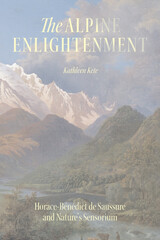
front cover of The Alpine Enlightenment
The Alpine Enlightenment
Horace-Bénédict de Saussure and Nature’s Sensorium
Kathleen Kete
University of Chicago Press, 2024
A study of the experience of nature in the eighteenth century based on the life of Horace-Bénédict de Saussure (174099).
 
In The Alpine Enlightenment, historian Kathleen Kete takes us into the world of the Genevan geologist, physicist, inventor, and mountaineer Horace-Bénédict de Saussure. During his prodigious climbs into the upper ranges of the Alps, Saussure focused intensely on the natural phenomena he encountered—glaciers, crevasses, changes in the weather, and shifts in the color of the sky—and he described with great precision what he saw, heard, and touched. Kete uses Saussure’s evocative writings, which emphasized above all physical engagement with the earth, to uncover not just how people during the Enlightenment thought about nature, but how they experienced it. As Kete shows, Saussure thought with and through his body: he harnessed his senses to understand the forces that shaped the world around him. In so doing, he offered a vision of nature as worthy of respect independent of human needs, anticipating present-day concerns about the environment and our shared place within it.
[more]


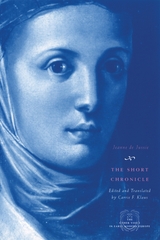
front cover of The Short Chronicle
The Short Chronicle
A Poor Clare's Account of the Reformation of Geneva
Jeanne de Jussie
University of Chicago Press, 2006
Jeanne de Jussie (1503–61) experienced the Protestant Reformation from within the walls of the Convent of Saint Clare in Geneva. In her impassioned and engaging Short Chronicle, she offers a singular account of the Reformation, reporting not only on the larger clashes between Protestants and Catholics but also on events in her convent—devious city councilmen who lied to trusting nuns, lecherous soldiers who tried to kiss them, and iconoclastic intruders who smashed statues and burned paintings. Throughout her tale, Jussie highlights women’s roles on both sides of the conflict, from the Reformed women who came to her convent in an attempt to convert the nuns to the Catholic women who ransacked the shop of a Reformed apothecary. Above all, she stresses the Poor Clares’ faithfulness and the good men and women who came to them in their time of need, ending her story with the nuns’ arduous journey by foot from Reformed Geneva to Catholic Annecy.

First published in French in 1611, Jussie’s Short Chronicle is translated here for an English-speaking audience for the first time, providing a fresh perspective on struggles for religious and political power in sixteenth-century Geneva and a rare glimpse at early modern monastic life.

[more]


Send via email Share on Facebook Share on Twitter