logo for Harvard University Press
The Given and the Made
Strategies of Poetic Redefinition
Helen Vendler
Harvard University Press, 1995

Join Professor Helen Vendler in her course lecture on the Yeats poem "Among School Children". View her insightful and passionate analysis along with a condensed reading and student comments on the course.

How does a poet repeatedly make art over a lifetime out of an arbitrary assignment of fate? By asking this question of the work of four American poets--two men of the postwar generation, two young women writing today--Helen Vendler suggests a fruitful way of looking at a poet's career and a new way of understanding poetic strategies as both mastery of forms and forms of mastery.

Fate hands every poet certain unavoidable "givens." Of the poets Vendler studies, Robert Lowell sprang from a family famous in American and especially New England history; John Berryman found himself an alcoholic manic-depressive; Rita Dove was born black; Jorie Graham grew up trilingual, with three words for every object. In Vendler's readings, we see how these poets return again and again to the problems set out by their givens, and how each invents complex ways, both thematic and formal, of making poetry out of fate.

Compelling for its insights into the work of four notable poets, this book by a leading critic of poetry is also invaluable for what it has to tell us about the poetic process--about how art copes with the obdurate givens of life, and about the conflict in art between the whim of fate and the artist's will to choose.

[more]

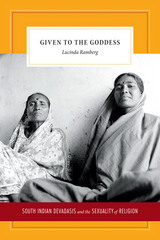
front cover of Given to the Goddess
Given to the Goddess
South Indian Devadasis and the Sexuality of Religion
Lucinda Ramberg
Duke University Press, 2014
Who and what are marriage and sex for? Whose practices and which ways of talking to god can count as religion? Lucinda Ramberg considers these questions based upon two years of ethnographic research on an ongoing South Indian practice of dedication in which girls, and sometimes boys, are married to a goddess. Called devadasis, or jogatis, those dedicated become female and male women who conduct the rites of the goddess outside the walls of her main temple and transact in sex outside the bounds of conjugal matrimony. Marriage to the goddess, as well as the rites that the dedication ceremony authorizes jogatis to perform, have long been seen as illegitimate and criminalized. Kinship with the goddess is productive for the families who dedicate their children, Ramberg argues, and yet it cannot conform to modern conceptions of gender, family, or religion. This nonconformity, she suggests, speaks to the limitations of modern categories, as well as to the possibilities of relations—between and among humans and deities—that exceed such categories.

[more]


Send via email Share on Facebook Share on Twitter