
 A SCHOLARLY BOOK REPOSITORY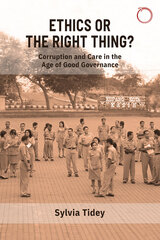
Combining ethnographic fieldwork in the city of Kupang with an acute historical sensibility, Sylvia Tidey shows how good governance initiatives paradoxically perpetuate civil service corruption while also facilitating the emergence of new forms of it. Importing critical insights from the anthropology of ethics to the burgeoning anthropology of corruption, Tidey exposes enduring developmentalist fallacies that treat corruption as endemic to non-Western subjects. In practice, it is often indistinguishable from the ethics of care and exchange, as Indonesian civil servants make worthwhile lives for themselves and their families. This book will be a vital text for anthropologists and other social scientists, particularly scholars of global studies, development studies, and Southeast Asia.
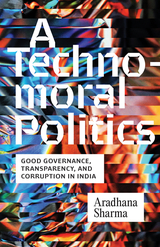
Examining anticorruption battles and transparency laws to ask: what makes for good governance, and can it limit liberal democratic politics as much as encourage it?
Good governance is meant to empower citizens, increase democratic participation, and make states transparent and accountable, yet this liberal democratic imperative can also promote populist authoritarian rule. Bringing together discourses on ethical goodness with the technicalities of governance as expressed in laws and policies, Aradhana Sharma develops the concept of “technomoral politics” to navigate this fraught topic. With a focus on the work of activists, citizens, and state officials, she offers an ethnographic account of the contradictions and dangers of good-governance politics in twenty-first-century India.
A Technomoral Politics follows the evolution of a group of activists in New Delhi led by Arvind Kejriwal from 2008 to 2014 as they morphed from a protransparency NGO to a mass movement against state corruption to a populist party that promised to change the political system through laws and policies. Sharma explores the technomoral framing of state opacity and corruption as well as the limits of the law in resolving these issues, probing such themes as the contradictory relationship between transparency and bureaucracy and the classed and gendered nature of democratic state institutions.
By examining scalar dimensions of good-governance politics, from the hyperlocal work of activists to global trends, A Technomoral Politics illuminates the paradoxes, limits, and risks of a system that is meant to spread liberal democratic principles but that also ends up promoting antidemocratic, populist-authoritarian forms of rule.
Retail e-book files for this title are screen-reader friendly.

The chapters in the volume capture the widest possible variety of political and administrative systems in the region. Transylvanian towns were structured and governed similarly to other small Central European urban centers, however significant diversity can be discerned following the Reformation. Moldavian and Wallachian towns in the 18th and 19th century are little known to international scholarship, and the chapters in this volume will fill this gap.
READERS
Browse our collection.
PUBLISHERS
See BiblioVault's publisher services.
STUDENT SERVICES
Files for college accessibility offices.
RECENTLY PUBLISHED






UChicago Accessibility Resources
home | accessibility | search | about | contact us
BiblioVault ® 2001 - 2026
The University of Chicago Press