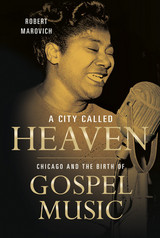
front cover of A City Called Heaven
A City Called Heaven
Chicago and the Birth of Gospel Music
Robert Marovich
University of Illinois Press, 2015
In A City Called Heaven, Robert M. Marovich follows gospel music from early hymns and camp meetings through its growth into the sanctified soundtrack of the city's mainline black Protestant churches. Marovich mines print media, ephemera, and hours of interviews with artists, ministers, and historians--as well as relatives and friends of gospel pioneers--to recover forgotten singers, musicians, songwriters, and industry leaders. He also examines the entrepreneurial spirit that fueled gospel music's rise to popularity and granted social mobility to a number of its practitioners. As Marovich shows, the music expressed a yearning for freedom from earthly pains, racial prejudice, and life's hardships. Yet it also helped give voice to a people--and lift a nation.

A City Called Heaven celebrates a sound too mighty and too joyous for even church walls to hold.
[more]

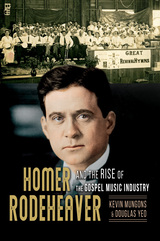
front cover of Homer Rodeheaver and the Rise of the Gospel Music Industry
Homer Rodeheaver and the Rise of the Gospel Music Industry
Kevin Mungons and Douglas Yeo
University of Illinois Press, 2021
From tent revivals to radio and records with a gospel music innovator

Homer Rodeheaver merged evangelical hymns and African American spirituals with popular music to create a potent gospel style. Kevin Mungons and Douglas Yeo examine his enormous influence on gospel music against the backdrop of Christian music history and Rodeheaver's impact as a cultural and business figure. Rodeheaver rose to fame as the trombone-playing song leader for evangelist Billy Sunday. As revivalism declined after World War I, Rodeheaver leveraged his place in America's newborn celebrity culture to start the first gospel record label and launch a nationwide radio program. His groundbreaking combination of hymnal publishing and recording technology helped define the early Christian music industry. In his later years, he influenced figures like Billy Graham and witnessed the music's split into southern gospel and black gospel.

Clear-eyed and revealing, Homer Rodeheaver and the Rise of the Gospel Music Industry is an overdue consideration of a pioneering figure in American music.
[more]

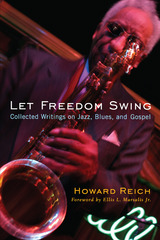
front cover of Let Freedom Swing
Let Freedom Swing
Collected Writings on Jazz, Blues, and Gospel
Howard Reich
Northwestern University Press, 2010
A swing note is, to the listener of the rhythm, an unexpected note, and it is the spark of life in jazz and its relatives. Whether playing the standards or the most experimental piece, it is how a musician handles these notes—fearlessly or safely—that determines the fate of the performance. Howard Reich’s critical writing is similarly unexpected and fearless, and Let Freedom Swing is a collection of the articles from the past three decades that best capture this spirit.

Each section of Let Freedom Swing composes a suite, focusing on either a person, place, or scene. Reich gives new life to the standards with his profiles and elegies for such giants as Gershwin, Ellington, and Sinatra. A profile of Louis Armstrong brings out the often angry side of Satchmo but also reveals a more remarkable musician and human being.

His open-mindedness makes Reich a particularly astute observer of the experimental and new, from Ornette Coleman to Chicago experimentalist Ken Vandermark. And his observations about street music open our ears to the songs of everyday life. Reich’s fearlessness is evident in his writing about daunting subjects, such as the New Orleans music scene after Katrina, the lost legacy of jazz in Panama, and the complicated legacy of "race music" in America.

Howard Reich combines a deep enthusiasm for music, a breadth of knowledge, and an ability to share his world with his readers, and Let Freedom Swing is essential reading for anyone interested in the continuing vitality of jazz, gospel, blues, and American music in general.
[more]

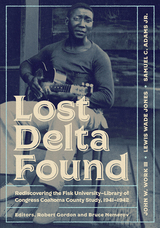
front cover of Lost Delta Found
Lost Delta Found
Rediscovering the Fisk University-Library of Congress Coahoma County Study, 1941-1942
John W. Work
Vanderbilt University Press, 2005
Blues Hall of Fame Inductee—Named a "Classic of Blues Literature" by the Blues Foundation, 2019

This remarkable book recovers three invaluable perspectives, long thought to have been lost, on the culture and music of the Mississippi Delta.

In 1941 and ’42 African American schol-ars from Fisk University—among them the noted composer and musicologist John W. Work III, sociologist Lewis Wade Jones, and graduate student Samuel C. Adams Jr.—joined folklorist Alan Lomax of the Library of Congress on research trips to Coahoma County, Mississippi. Their mis­sion was “to document adequately the cul­tural and social backgrounds for music in the community.” Among the fruits of the project were the earliest recordings by the legendary blues singer and guitar­ist Muddy Waters.

The hallmark of the study was to have been a joint publica­tion of its findings by Fisk and the Library of Congress. While this publication was never completed, Lost Delta Found is com­posed of the writings, interviews, notes, and musical transcriptions produced by Work, Jones, and Adams in the Coahoma County study. Their work captures, with compelling immediacy, a place, a people, a way of life, and a set of rich musical tra­ditions as they existed in the 1940s.


Illustrated with photos and more than 160 musical transcriptions.
[more]

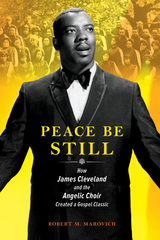
front cover of Peace Be Still
Peace Be Still
How James Cleveland and the Angelic Choir Created a Gospel Classic
Robert M. Marovich
University of Illinois Press, 2021
A Choice Outstanding Academic Title for 2022

In September of 1963, Reverend Lawrence Roberts and the Angelic Choir of the First Baptist Church of Nutley, New Jersey, teamed with rising gospel star James Cleveland to record Peace Be Still. The LP and its haunting title track became a phenomenon. Robert M. Marovich draws on extensive oral interviews and archival research to chart the history of Peace Be Still and the people who created it. Emerging from an established gospel music milieu, Peace Be Still spent several years as the bestselling gospel album of all time. As such, it forged a template for live recordings of services that transformed the gospel music business and Black worship. Marovich also delves into the music's connection to fans and churchgoers, its enormous popularity then and now, and the influence of the Civil Rights Movement on the music's message and reception.

The first in-depth history of a foundational recording, Peace Be Still shines a spotlight on the people and times that created a gospel music touchstone.
[more]

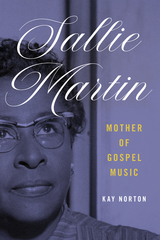
front cover of Sallie Martin, Mother of Gospel Music
Sallie Martin, Mother of Gospel Music
Kay Norton
University of Illinois Press, 2026
Sallie Martin combined fame as a performer with a far-sighted business acumen that brought Black gospel music to a national audience and laid the foundation for the industry that followed. Kay Norton’s biography follows Martin’s parallel careers from her early plans to grow the genre through her celebrity in the 1960s–1970s and eventful retirement. “Same old Sallie Martin, same old Jesus,” she once told audiences, a reflection of both her musical style and unapologetic approach to life. Cofounder of the National Conference of Gospel Choirs and Choruses, Martin also co-established the pioneering Black music publisher Martin and Morris Music Studio. Her group the Sallie Martin Singers took Chicago gospel to all points of the compass and Martin mentored and employed dozens of aspiring vocalists and instrumentalists. Norton looks at Martin’s important relationships and the challenges she faced, while placing her accomplishments and legacy on the arc of gospel music history. In-depth and powerful, Sallie Martin, Mother of Gospel Music tells the story of one woman’s role in shaping the music and business of Black gospel.
[more]

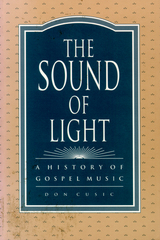
front cover of The Sound of Light
The Sound of Light
A History of Gospel Music
Don Cusic
University of Wisconsin Press, 1990
Don Cusic presents gospel music as part of the history of contemporary Christianity. From the psalms of the early Puritans through the hymns of Isaac Watts and the social activism of the Wesleys, gospel music was established in eighteenth-century America. With the camp meetings songs of the Kentucky Revival and the spirituals and hymns that stemmed from the Civil War and beyond, gospel music grew through the nineteenth century and expanded through new technologies in the twentieth century.
[more]

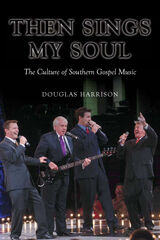
front cover of Then Sings My Soul
Then Sings My Soul
The Culture of Southern Gospel Music
Douglas Harrison
University of Illinois Press, 2012
In this ambitious book on southern gospel music, Douglas Harrison reexamines the music's historical emergence and its function as a modern cultural phenomenon. Rather than a single rhetoric focusing on the afterlife as compensation for worldly sacrifice, Harrison presents southern gospel as a network of interconnected messages that evangelical Christians use to make individual sense of both Protestant theological doctrines and their own lived experiences. Harrison explores how listeners and consumers of southern gospel integrate its lyrics and music into their own religious experience, building up individual--and potentially subversive--meanings beneath a surface of evangelical consensus.
 
Reassessing the contributions of such figures as Aldine Kieffer, James D. Vaughan, and Bill and Gloria Gaither, Then Sings My Soul traces an alternative history of southern gospel in the twentieth century, one that emphasizes the music's interaction with broader shifts in American life beyond the narrow confines of southern gospel's borders. His discussion includes the "gay-gospel paradox"--the experience of non-heterosexuals in gospel music--as a cipher for fundamentalism's conflict with the postmodern world.
[more]

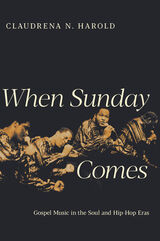
front cover of When Sunday Comes
When Sunday Comes
Gospel Music in the Soul and Hip-Hop Eras
Claudrena N. Harold
University of Illinois Press, 2020
Gospel music evolved in often surprising directions during the post-Civil Rights era. Claudrena N. Harold's in-depth look at late-century gospel focuses on musicians like Yolanda Adams, Andraé Crouch, the Clark Sisters, Al Green, Take 6, and the Winans, and on the network of black record shops, churches, and businesses that nurtured the music. Harold details the creative shifts, sonic innovations, theological tensions, and political assertions that transformed the music, and revisits the debates within the community over groundbreaking recordings and gospel's incorporation of rhythm and blues, funk, hip-hop, and other popular forms. At the same time, she details how sociopolitical and cultural developments like the Black Power Movement and the emergence of the Christian Right shaped both the art and attitudes of African American performers.

Weaving insightful analysis into a collective biography of gospel icons, When Sunday Comes explores the music's essential place as an outlet for African Americans to express their spiritual and cultural selves.

[more]


Send via email Share on Facebook Share on Twitter