front cover of Darwin's Footprint
Darwin's Footprint
Cultural Perspectives on Evolution in Greece (1880–1930s)
Maria Zarimis
Central European University Press, 2015

Darwin’s Footprint examines the impact of Darwinism in Greece, investigating how it has shaped Greece in terms of its cultural and intellectual history, and in particular its literature.

The book demonstrates that in the late 19th to early 20th centuries Darwinism and associated science strongly influenced celebrated Greek literary writers and other influential intellectuals, which fueled debate in various areas such as ‘man’s place in nature’, eugenics, the nature-nurture controversy, religion, as well as class, race and gender.

In addition, the study reveals that many of these individuals were also considering alternative approaches to these issues based on Darwinian and associated biological post-Darwinian ideas. Their concerns included the Greek “race” or nation, its culture, language and identity; also politics and gender equality.

Zarimis’s monograph devotes considerable space to Xenopoulos (1867-1951), notable novelist, journalist and playwright.


[more]

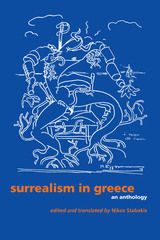
front cover of Surrealism in Greece
Surrealism in Greece
An Anthology
Edited and translated by Nikos Stabakis
University of Texas Press, 2008

In the decades between the two World Wars, Greek writers and artists adopted surrealism both as an avant-garde means of overturning the stifling traditions of their classical heritage and also as a way of responding to the extremely unstable political situation in their country. Despite producing much first-rate work throughout the rest of the twentieth century, Greek surrealists have not been widely read outside of Greece. This volume seeks to remedy that omission by offering authoritative translations of the major works of the most important Greek surrealist writers.

Nikos Stabakis groups the Greek surrealists into three generations: the founders (such as Andreas Embirikos, Nikos Engonopoulos, and Nicolas Calas), the second generation, and the Pali Group, which formed around the magazine Pali. For each generation, he provides a very helpful introduction to the themes and concerns that animate their work, as well as concise biographies of each writer. Stabakis anthologizes translations of all the key surrealist works of each generation—poetry, prose, letters, and other documents—as well as a selection of rarer texts. His introduction to the volume places Greek surrealism within the context of the international movement, showing how Greek writers and artists used surrealism to express their own cultural and political realities.

[more]


Send via email Share on Facebook Share on Twitter