
 A SCHOLARLY BOOK REPOSITORY
Results by Title
3 books about Hazard mitigation
3 books about Hazard mitigation
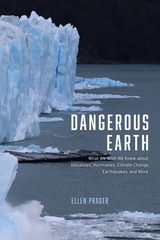
Dangerous Earth
What We Wish We Knew about Volcanoes, Hurricanes, Climate Change, Earthquakes, and More
Ellen Prager
University of Chicago Press, 2020
The Earth is a beautiful and wondrous planet, but also frustratingly complex and, at times, violent: much of what has made it livable can also cause catastrophe. Volcanic eruptions create land and produce fertile, nutrient-rich soil, but they can also bury forests, fields, and entire towns under ash, mud, lava, and debris. The very forces that create and recycle Earth’s crust also spawn destructive earthquakes and tsunamis. Water and wind bring and spread life, but in hurricanes they can leave devastation in their wake. And while it is the planet’s warmth that enables life to thrive, rapidly increasing temperatures are causing sea levels to rise and weather events to become more extreme.
Today, we know more than ever before about the powerful forces that can cause catastrophe, but significant questions remain. Why can’t we better predict some natural disasters? What do scientists know about them already? What do they wish they knew? In Dangerous Earth, marine scientist and science communicator Ellen Prager explores the science of investigating volcanoes, earthquakes, tsunamis, hurricanes, landslides, rip currents, and—maybe the most perilous hazard of all—climate change. Each chapter considers a specific hazard, begins with a game-changing historical event (like the 1980 eruption of Mt. St. Helens or the landfall and impacts of Hurricane Harvey), and highlights what remains unknown about these dynamic phenomena. Along the way, we hear from scientists trying to read Earth’s warning signs, pass its messages along to the rest of us, and prevent catastrophic loss.
A sweeping tour of some of the most awesome forces on our planet—many tragic, yet nonetheless awe-inspiring—Dangerous Earth is an illuminating journey through the undiscovered, unresolved, and in some cases unimagined mysteries that continue to frustrate and fascinate the world’s leading scientists: the “wish-we-knews” that ignite both our curiosity and global change.
Today, we know more than ever before about the powerful forces that can cause catastrophe, but significant questions remain. Why can’t we better predict some natural disasters? What do scientists know about them already? What do they wish they knew? In Dangerous Earth, marine scientist and science communicator Ellen Prager explores the science of investigating volcanoes, earthquakes, tsunamis, hurricanes, landslides, rip currents, and—maybe the most perilous hazard of all—climate change. Each chapter considers a specific hazard, begins with a game-changing historical event (like the 1980 eruption of Mt. St. Helens or the landfall and impacts of Hurricane Harvey), and highlights what remains unknown about these dynamic phenomena. Along the way, we hear from scientists trying to read Earth’s warning signs, pass its messages along to the rest of us, and prevent catastrophic loss.
A sweeping tour of some of the most awesome forces on our planet—many tragic, yet nonetheless awe-inspiring—Dangerous Earth is an illuminating journey through the undiscovered, unresolved, and in some cases unimagined mysteries that continue to frustrate and fascinate the world’s leading scientists: the “wish-we-knews” that ignite both our curiosity and global change.
[more]

Disaster Nationalism
Tsunami and Civil War in Sri Lanka
Vivian Y. Choi
Duke University Press, 2025
In Disaster Nationalism, Vivian Y. Choi examines how the 2004 Indian Ocean tsunami fostered new forms of governance and militarization during Sri Lanka’s decades-long civil war that led to enduring forms of precarity and insecurity. Tracing the development of disaster management projects following the tsunami, Choi demonstrates how these projects rest on a logic that treats natural disasters and terrorism as inevitable risks in need of management. The tsunami’s destruction foreclosed the possibility of political resolution to the war, as the state leveraged these projects to justify its militarized aggression in the war against the Tamil Tigers and a new construction of the Sri Lankan nation. Choi reveals how, paradoxically, state-sponsored disaster management projects—from new buffer and border zones to early warning systems—created more insecurity. Choi amplifies the experiences of those affected by the tsunami, particularly Tamil and Muslim communities. In so doing, Choi shows how life perseveres against perpetual uncertainty and danger—caused by natural disasters and state-sanctioned violence alike.
[more]
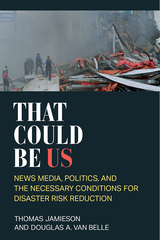
That Could Be Us
News Media, Politics, and the Necessary Conditions for Disaster Risk Reduction
Thomas Jamieson and Douglas A. Van Belle
University of Michigan Press, 2022
The evidence presented in this book suggests that when the necessary conditions for disaster risk reduction (DRR) are in place, it is possible for elected officials to pursue DRR policies in their rational self-interest. As such, when the media makes it possible through lesson-drawing coverage of distant disasters, DRR policies become much more likely in observing communities because elected officials can seize the opportunity to both make political gains and protect their constituents. Authors Thomas Jamieson and Douglas A. Van Belle provide reasons for optimism about the prospect of DRR in at-risk communities around the world—observing communities are able to learn from the experiences of stricken areas and pursue policies that ultimately save lives and reduce economic damage from disasters.
In That Could Be Us, Jamieson and Van Belle find that the news media delivers information to observing communities in a form that enables learning from other disasters. Experimental evidence shows that people react to this information in a way that would punish leaders who do not back DRR efforts. Case studies, interviews, experiments, and illustrative examples suggest that leaders and political entrepreneurs heed this public demand, react to news media coverage, and act accordingly. Taken as a whole, this suggests that the policy and research implications derived from this book’s theoretical model are worthy of further exploration, particularly in terms of how they might resolve the puzzle presented by the variations in DRR policy uptake around the world that do not seem to be driven by developmental differences across communities.
In That Could Be Us, Jamieson and Van Belle find that the news media delivers information to observing communities in a form that enables learning from other disasters. Experimental evidence shows that people react to this information in a way that would punish leaders who do not back DRR efforts. Case studies, interviews, experiments, and illustrative examples suggest that leaders and political entrepreneurs heed this public demand, react to news media coverage, and act accordingly. Taken as a whole, this suggests that the policy and research implications derived from this book’s theoretical model are worthy of further exploration, particularly in terms of how they might resolve the puzzle presented by the variations in DRR policy uptake around the world that do not seem to be driven by developmental differences across communities.
[more]
READERS
Browse our collection.
PUBLISHERS
See BiblioVault's publisher services.
STUDENT SERVICES
Files for college accessibility offices.
RECENTLY PUBLISHED



UChicago Accessibility Resources
home | accessibility | search | about | contact us
BiblioVault ® 2001 - 2026
The University of Chicago Press