
 A SCHOLARLY BOOK REPOSITORY
What does it feel like to live helplessly in a world that is coming undone? Nathan Hensley turns to Victorian literature to uncover a prehistory of this deeply contemporary sense of powerlessness. For many in nineteenth-century Britain, their world seemed so scarred by human rapacity that restoring it seemed beyond the powers of any one individual. Like George Eliot’s characters in Middlemarch or the doomed lovers of Wuthering Heights, observers of the gathering carbon economy felt themselves ensnared by interlocked and broken systems. In the face of damage so vast and apparently irreversible, what could possibly be done?
To answer this question, Hensley shows that nineteenth-century writers and artists devised new ways to understand action—and hope. They rescaled action away from the grandly heroic and toward minor adjustments and collaborative interventions. They turned away from logical proofs and direct argumentation and instead called on aesthetic technologies like sonnets and fractured lyrics, watercolor sketches, and vast, multiplot novels, finding scope for action not at the level of the theme or the thesis but in gestures and details. Ranging from J. M. W. Turner’s painterly technique to Emily Brontë’s dreamlike fragments (and reading along the way works by Alfred, Lord Tennyson, H. G. Wells, Lewis Carroll, Gerard Manley Hopkins, William Berryman, Charlotte Brontë, George Eliot, and Christina Rossetti), Hensley’s study makes an important contribution to Victorian studies and the environmental humanities.
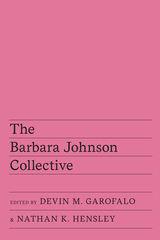
Collaboratively reassesses Barbara Johnson’s legacy as a reader and thinker with an eye to contemporary conditions
Across an archive of essays on abortion and race, Mallarmé and Melville, feminist philosophy, rhetorical device, and pedagogical method, Barbara Johnson built a legacy of thought whose energies reverberate into the present. This collected volume gathers writers and critics from a range of North American higher educational settings to engage with this essential but still often underappreciated critic in a time of renewed and deepening crisis.
In Zoom meetings and shared essays, across a virtualized map of today’s academic and para-academic worlds, the group assessed how the rolling catastrophes of late neoliberalism continue to stage the sort of analogy Johnson herself would highlight between patriarchy, capitalism, ecocide, and other forms of structural violence. Emerging from that assemblage, this experimental collection tracks Johnson’s efforts to link literary reading with concrete matters of personhood and care at a moment when the very system of higher education that enabled Johnson’s work in the 1980s and 1990s faces existential threat. The frozen record of a live experience, the book is an impure procedure, tangled in the idiom of its own unfolding: a temporary culmination of an ongoing collaborative undertaking that will always remain unfinished.
READERS
Browse our collection.
PUBLISHERS
See BiblioVault's publisher services.
STUDENT SERVICES
Files for college accessibility offices.
RECENTLY PUBLISHED




UChicago Accessibility Resources
home | accessibility | search | about | contact us
BiblioVault ® 2001 - 2026
The University of Chicago Press