
 A SCHOLARLY BOOK REPOSITORY
Results by Title
3 books about Hispanic American art
3 books about Hispanic American art
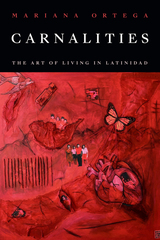
Carnalities
The Art of Living in Latinidad
Mariana Ortega
Duke University Press, 2025
In Carnalities, Mariana Ortega presents a phenomenological study of aesthetics grounded in the work of primarily Latinx artists. She introduces the idea of carnal aesthetics informed by carnalities, creative practices shaped by the self’s affective attunement to the material, cultural, historical, communal, and spiritual. For Ortega, carnal aesthetics offers a way to think about the affective and bodily experiences of racialized selves. Drawing on Gloria Anzaldúa, Chela Sandoval, José Esteban Muñoz, Alia Al-Saji, Helen Ngo, Maurice Merleau-Ponty, Roland Barthes, and others, Ortega examines photographic works on Latinx subjects. She analyzes the photography of Laura Aguilar, Verónica Gabriela Cárdenas, and Susan Meiselas, among others, theorizing photography as a carnal, affective medium that is crucial for processes of self-formation, resistance, and mourning in Latinx life. She ends with an intimate reading of photography through a reflection of her own crossing from Nicaragua to the United States in 1979. Motivated by her experience of loss and exile, Ortega argues for the importance of carnal aesthetics in destabilizing and transforming normative, colonial, and decolonial subjects, imaginaries, and structures.
[more]

Dimensions of the Americas
Art and Social Change in Latin America and the United States
Shifra M. Goldman
University of Chicago Press, 1994
Acclaimed art historian Shifra Goldman here provides the first overview of the social history of modern and contemporary Latin American and Latino art. Long needed in the field of art history, this collection of thirty-three essays focuses on Latin American artists throughout Mexico, Central and South America, the Caribbean, and the United States.
Goldman's extensive introduction provides an up-to-date chronology of modern Latin American art; a history of "social art history" in the United States; and synopses of recent theoretical and historical writings by major scholars from Mexico, Cuba, Brazil, Peru, Uruguay, Chile, and the United States. In her essays, Goldman discusses a vast array of topics including: the influence of the Mexican muralists on the American continent; the political and artistic significance of poster art and printmaking in Cuba, Puerto Rico, and among Chicanos; the role of women artists such as Guatemalan painter Isabel Ruiz; and the increasingly important role of politics and multinational businesses in the art world of the 1970s and 1980s. She explores the reception of Latin American and Latino art in the United States, focusing on major historical exhibits as well as on exhibits by artists such as Chilean Alfredo Jaar and Argentinian Leandro Katz. Finally, she examines the significance of nationalist and ethnic themes in Latin American and Latino art.
Written in a straightforward style equally accessible to specialists, students, and general audiences, this book will become essential reading for anyone interested in understanding the importance of Latin American art and the complex dynamic shaping it.
Goldman's extensive introduction provides an up-to-date chronology of modern Latin American art; a history of "social art history" in the United States; and synopses of recent theoretical and historical writings by major scholars from Mexico, Cuba, Brazil, Peru, Uruguay, Chile, and the United States. In her essays, Goldman discusses a vast array of topics including: the influence of the Mexican muralists on the American continent; the political and artistic significance of poster art and printmaking in Cuba, Puerto Rico, and among Chicanos; the role of women artists such as Guatemalan painter Isabel Ruiz; and the increasingly important role of politics and multinational businesses in the art world of the 1970s and 1980s. She explores the reception of Latin American and Latino art in the United States, focusing on major historical exhibits as well as on exhibits by artists such as Chilean Alfredo Jaar and Argentinian Leandro Katz. Finally, she examines the significance of nationalist and ethnic themes in Latin American and Latino art.
Written in a straightforward style equally accessible to specialists, students, and general audiences, this book will become essential reading for anyone interested in understanding the importance of Latin American art and the complex dynamic shaping it.
[more]

Scarred Landscapes
Place, Trauma, and Memory in Caribbean Latinx Art
Stephanie Lewthwaite
University of Arizona Press, 2025
Scarred Landscapes is a groundbreaking exploration of the rich and complex works of Caribbean Latinx artists. Scholar Stephanie Lewthwaite documents the work of ten influential artists of Cuban, Dominican, and Puerto Rican descent, based in New York City from the 1970s to the present. Through their diverse practices, including painting, printmaking, photography, sculpture, installation, video, and performance art, these artists confront the legacies of colonial trauma and their own experiences of diasporic unbelonging and artworld marginality.
The book combines formal analysis with artist testimony, exhibition histories, and theoretical frameworks from trauma, memory, and archipelagic studies, to offer a multifaceted examination of Caribbean Latinx art. Lewthwaite explores how these artists practice “archipelagic memory,” a generative, decolonial, and coalitional form of memory work that envisions alternative modes of belonging in difference and solidarity with others. By connecting different people, pasts, and places, Caribbean Latinx artists expose the reverberations of trauma while imagining other worlds beyond it.
This work puts Caribbean Latinx artists at the center of debates about the exclusions of dominant memory narratives and contemporary art worlds, highlighting their contributions to a wider decolonial project of remembrance. By revealing the interconnectedness of traumatic histories and the potential for art to foster empathy and justice, Lewthwaite’s work underscores the importance of relational and decolonial thought for imagining a better society.
The book combines formal analysis with artist testimony, exhibition histories, and theoretical frameworks from trauma, memory, and archipelagic studies, to offer a multifaceted examination of Caribbean Latinx art. Lewthwaite explores how these artists practice “archipelagic memory,” a generative, decolonial, and coalitional form of memory work that envisions alternative modes of belonging in difference and solidarity with others. By connecting different people, pasts, and places, Caribbean Latinx artists expose the reverberations of trauma while imagining other worlds beyond it.
This work puts Caribbean Latinx artists at the center of debates about the exclusions of dominant memory narratives and contemporary art worlds, highlighting their contributions to a wider decolonial project of remembrance. By revealing the interconnectedness of traumatic histories and the potential for art to foster empathy and justice, Lewthwaite’s work underscores the importance of relational and decolonial thought for imagining a better society.
[more]
READERS
Browse our collection.
PUBLISHERS
See BiblioVault's publisher services.
STUDENT SERVICES
Files for college accessibility offices.
RECENTLY PUBLISHED




UChicago Accessibility Resources
home | accessibility | search | about | contact us
BiblioVault ® 2001 - 2026
The University of Chicago Press