
 A SCHOLARLY BOOK REPOSITORY
A readable analysis of postmodernity that provides a cultural context for its rise.
Though the term “postmodern” looms large on our cultural landscape, rarely do we find a systematic and impartial discussion of the circumstances of its ascendance. Identity Crises offers just such an accounting. In this book, Robert G. Dunn situates the intellectual currency of “the postmodern” within the larger context of social and cultural change shaping the movement over the past several decades. Along the way, he offers a necessary corrective to both the sociological and historical shortcomings of cultural criticism and the cultural myopia of social science in considering the postmodern world.
Dunn explains contemporary culture and contemporary cultural criticism as part of a distinct historical moment, one that entails new social relations as a consequence of new means of production. In place of prevailing cultural and political constructions, Dunn proposes a “social relational” approach that explicitly recognizes the structural and situational contexts of identity formation. He conceptualizes issues of identity and difference in terms of social, cultural, and political transformations in the transition from modern to postmodern society. This provides a socio-historical perspective through which to consider the impact of consumption, mass media, globalization, and new social movements on identity-forming processes. Unique to this undertaking and crucial to Dunn’s critique of poststructuralist and postmodern theories is his application of the theory of George Herbert Mead as a more effective means of theorizing identity and difference. Dunn’s focus on postmodernity as opposed to postmodernism serves to ground the analysis of identity and difference materially and socially. Learned, evenhanded, and enlightening, Identity Crises is an essential demonstration of the connections between cultural theory and criticism, contemporary culture, and sociological analysis. ISBN 0-8166-3072-0 Cloth $49.95xxISBN 0-8166-3073-9 Paper $19.95x304 pages 5 7/8 x 9 MarchTranslation inquiries: University of Minnesota Press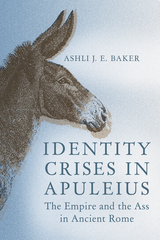
In the second century CE, the multiethnic, multilingual, and religiously diverse Roman Empire grew to its greatest extent. To maintain order, Rome relied heavily on strict social hierarchies, established not only through legal frameworks like citizenship but also through cultural markers (such as clothing and language) and personal traits (such as educational achievement). Even as Rome grew into one of the world’s most powerful empires, however, its social systems strained under the stresses caused by that very growth, which encouraged cultural interaction, long-distance travel, and social mobility—all of which threatened the hierarchies that underpinned Roman order.
It was during this time that the North African–born, Latin-speaking, Greek-educated Apuleius—whose own background showcases the multiplicity of identities available then to Roman individuals—flourished. He remains one of the ancient world’s best-known authors today, thanks particularly to his famous novel, Metamorphoses, known also as The Golden Ass. Taking a bird’s-eye view of his work, Ashli J. E. Baker proffers a bold new reading of Apuleius, proposing that across his writings there is a consistent focus on the theme of identity and its instability. By placing close readings in conversation with sociocultural and material contexts, she shows that because the structures of Roman power depended on inherently unreliable markers of identity, Apuleius’ work can be read as a biting critique of the fraught relationship between the individual, society, and the state in his contemporary Rome.

READERS
Browse our collection.
PUBLISHERS
See BiblioVault's publisher services.
STUDENT SERVICES
Files for college accessibility offices.
RECENTLY PUBLISHED






UChicago Accessibility Resources
home | accessibility | search | about | contact us
BiblioVault ® 2001 - 2026
The University of Chicago Press