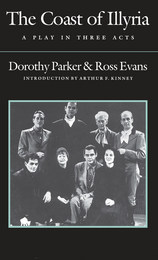
front cover of The Coast of Illyria
The Coast of Illyria
A Play in Three Acts
Dorothy Parker
University of Iowa Press, 1990
Dorothy Parker is a figure of legendary literary reputation, a fabled member of the Algonquin Round Table, and a highly visible literary personality of the twenties and thirties. Brendan Gill called her "a writer whose robust and acid lucidities were much feared and admired." This play, long forgotten and unpublished until now, will bring new attention to her stirring work.
The Coast of Illyria may represent Parker's most mature writing. Based on the story of Charles and Mary Lamb, this play shares the deeply felt theme of abandonment which gives Parker's poetry its haunting quality, along with the rich understanding of despair that characterizes her stories and other plays. Here these issues are explored with a depth, a sensibility, and a subtlety unlike anything else she wrote.
As Arthur Kinney describes in his detailed introduction, when Parker and her putative coauthor, Ross Evans, sat through rehearsals revising the script, it was generally felt that Parker saw herself, at least potentially, as the tragic Mary Lamb. "I am Mary Lamb," she told the actress who played the role, "do you see that?"

[more]

front cover of Fare Well, Illyria
Fare Well, Illyria
David Binder
Central European University Press, 2014
As a reporter for the prestigious New York Times the author interviewed many of the leading political figures of the Balkans (Illyria). He also sought out the area's intellectuals, many of them critical of their leaders, and everyday people who provide a sense of daily life. He devotes a chapter to each ethnic group from Vlachs to Serbs, talks about their differences and similarities, and does so without giving offense. He also provides a short historical account of the various places he visits, which deepens our understanding of the local cultures. The reader meets people from all walks of life: politicians, poets, literary and art critics, journalists, handymen, car mechanics, fishermen and farmers. From Milovan Djilas and Nicolae Ceausescu to Markos Vafiadis and Sali Berisha to the Serbian “majstor” Misha and an un-named Bosnian bar singer, Binder's book features a remarkable gallery of people whose presence contributes authenticity and human warmth to the narrative.
[more]


Send via email Share on Facebook Share on Twitter