
 A SCHOLARLY BOOK REPOSITORY
Results by Title
3 books about Institutionalization
3 books about Institutionalization

Bad Medicine
Settler Colonialism and the Institutionalization of American Indians
Sarah A. Whitt
Duke University Press, 2025
In Bad Medicine, Sarah A. Whitt exposes how Native American boarding schools and other settler institutions like asylums, factories, and hospitals during the late nineteenth and early twentieth centuries worked together as a part of an interconnected system of settler domination. In so doing, Whitt centers the experiences of Indigenous youth and adults alike at the Carlisle Indian School, Canton Asylum for Insane Indians, Ford Motor Company Factory, House of the Good Shepherd, and other Progressive Era facilities. She demonstrates that in the administration of these institutions, which involved moving Indigenous people from one location to another, everyday white Americans became deputized as agents of the settler order. Bringing together Native American history, settler colonial studies, and the history of medicine, Whitt breaks new ground by showing how the confinement of Indigenous people across interlocking institutional sites helped concretize networks of white racial power—a regime that Native nations and communities continue to negotiate and actively resist today.
[more]
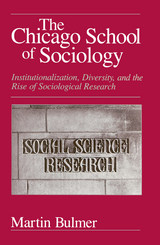
The Chicago School of Sociology
Institutionalization, Diversity, and the Rise of Sociological Research
Martin Bulmer
University of Chicago Press, 1984
From 1915 to 1935 the inventive community of social scientists at the University of Chicago pioneered empirical research and a variety of qualitative and quantitative methods, shaping the future of twentieth-century American sociology and related fields as well. Martin Bulmer's history of the Chicago school of sociology describes the university's role in creating research-based and publication-oriented graduate schools of social science.
"This is an important piece of work on the history of sociology, but it is more than merely historical: Martin Bulmer's undertaking is also to explain why historical events occurred as they did, using potentially general theoretical ideas. He has studied what he sees as the period, from 1915 to 1935, when the 'Chicago School' most flourished, and defines the nature of its achievements and what made them possible . . . It is likely to become the indispensible historical source for its topic."—Jennifer Platt, Sociology
"This is an important piece of work on the history of sociology, but it is more than merely historical: Martin Bulmer's undertaking is also to explain why historical events occurred as they did, using potentially general theoretical ideas. He has studied what he sees as the period, from 1915 to 1935, when the 'Chicago School' most flourished, and defines the nature of its achievements and what made them possible . . . It is likely to become the indispensible historical source for its topic."—Jennifer Platt, Sociology
[more]

The Institutionalization of Islam in Southern Senegal
Intermarriage, Qur'anic Education, and Jihad
Aly Dramé
University of Michigan Press, 2025
Weaving together oral and written sources, The Institutionalization of Islam in Southern Senegal investigates previously overlooked dimensions of Islamization in Senegambia through the processes of intermarriage, Qur’anic education, and jihãd. Due to its geographic location at the point where Senegal, The Gambia, and Guinea-Bissau meet, the Middle Casamance has historically been a melting pot where centralized and decentralized societies have coexisted for generations. In the past, historians have failed to consider the contributions of the Middle Casamance region and Mandinka Muslim settlements to the development of Islam, despite centers for Islamic education having existed in the region centuries before the emergence of the Sufi and jihãd movements of the eighteenth and nineteenth centuries. Aly Dramé seeks to close this gap by conceptualizing the leading role played by these Mandinka settlements and how religious spaces are negotiated, acquired, and transformed through intermarriage, Qur’anic education, and jihãd when peoples from distinct backgrounds encounter one another.
Drawing on archival documents, oral history and traditions, travelers’ accounts, the Arabic text Pakao al-Qurano (Holy Book of Pakao), and original ethnography, The Institutionalization of Islam in Southern Senegal demonstrates how these communities reframe the debates about the institutionalization of Islam in Senegambia geographically, chronologically, and thematically.
Drawing on archival documents, oral history and traditions, travelers’ accounts, the Arabic text Pakao al-Qurano (Holy Book of Pakao), and original ethnography, The Institutionalization of Islam in Southern Senegal demonstrates how these communities reframe the debates about the institutionalization of Islam in Senegambia geographically, chronologically, and thematically.
[more]
READERS
Browse our collection.
PUBLISHERS
See BiblioVault's publisher services.
STUDENT SERVICES
Files for college accessibility offices.
RECENTLY PUBLISHED



UChicago Accessibility Resources
home | accessibility | search | about | contact us
BiblioVault ® 2001 - 2025
The University of Chicago Press