
 A SCHOLARLY BOOK REPOSITORY
Results by Title
3 books about Integrating
3 books about Integrating
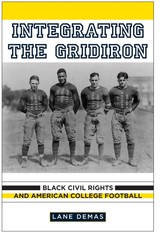
Integrating the Gridiron
Black Civil Rights and American College Football
Demas, Lane
Rutgers University Press, 2011
Even the most casual sports fans celebrate the achievements of professional athletes, among them Jackie Robinson, Muhammad Ali, and Joe Louis. Yet before and after these heroes staked a claim for African Americans in professional sports, dozens of college athletes asserted their own civil rights on the amateur playing field, and continue to do so today.
Integrating the Gridiron, the first book devoted to exploring the racial politics of college athletics, examines the history of African Americans on predominantly white college football teams from the nineteenth century through today. Lane Demas compares the acceptance and treatment of black student athletes by presenting compelling stories of those who integrated teams nationwide, and illuminates race relations in a number of regions, including the South, Midwest, West Coast, and Northeast. Focused case studies examine the University of California, Los Angeles in the late 1930s; integrated football in the Midwest and the 1951 Johnny Bright incident; the southern response to black players and the 1955 integration of the Sugar Bowl; and black protest in college football and the 1969 University of Wyoming "Black 14." Each of these issues drew national media attention and transcended the world of sports, revealing how fans—and non-fans—used college football to shape their understanding of the larger civil rights movement.
Integrating the Gridiron, the first book devoted to exploring the racial politics of college athletics, examines the history of African Americans on predominantly white college football teams from the nineteenth century through today. Lane Demas compares the acceptance and treatment of black student athletes by presenting compelling stories of those who integrated teams nationwide, and illuminates race relations in a number of regions, including the South, Midwest, West Coast, and Northeast. Focused case studies examine the University of California, Los Angeles in the late 1930s; integrated football in the Midwest and the 1951 Johnny Bright incident; the southern response to black players and the 1955 integration of the Sugar Bowl; and black protest in college football and the 1969 University of Wyoming "Black 14." Each of these issues drew national media attention and transcended the world of sports, revealing how fans—and non-fans—used college football to shape their understanding of the larger civil rights movement.
[more]
Integrating the Inner City
The Promise and Perils of Mixed-Income Public Housing Transformation
Robert J. Chaskin and Mark L. Joseph
University of Chicago Press, 2015
For many years Chicago’s looming large-scale housing projects defined the city, and their demolition and redevelopment—via the Chicago Housing Authority’s Plan for Transformation—has been perhaps the most startling change in the city’s urban landscape in the last twenty years. The Plan, which reflects a broader policy effort to remake public housing in cities across the country, seeks to deconcentrate poverty by transforming high-poverty public housing complexes into mixed-income developments and thereby integrating once-isolated public housing residents into the social and economic fabric of the city. But is the Plan an ambitious example of urban regeneration or a not-so-veiled effort at gentrification?
In the most thorough examination of mixed-income public housing redevelopment to date, Robert J. Chaskin and Mark L. Joseph draw on five years of field research, in-depth interviews, and volumes of data to demonstrate that while considerable progress has been made in transforming the complexes physically, the integrationist goals of the policy have not been met. They provide a highly textured investigation into what it takes to design, finance, build, and populate a mixed-income development, and they illuminate the many challenges and limitations of the policy as a solution to urban poverty. Timely and relevant, Chaskin and Joseph’s findings raise concerns about the increased privatization of housing for the poor while providing a wide range of recommendations for a better way forward.
In the most thorough examination of mixed-income public housing redevelopment to date, Robert J. Chaskin and Mark L. Joseph draw on five years of field research, in-depth interviews, and volumes of data to demonstrate that while considerable progress has been made in transforming the complexes physically, the integrationist goals of the policy have not been met. They provide a highly textured investigation into what it takes to design, finance, build, and populate a mixed-income development, and they illuminate the many challenges and limitations of the policy as a solution to urban poverty. Timely and relevant, Chaskin and Joseph’s findings raise concerns about the increased privatization of housing for the poor while providing a wide range of recommendations for a better way forward.
[more]

Integrating the Rural World
Economy, Society and Politics in Central and South-Eastern Europe, 1848-1939
Sorin Radu
Central European University Press, 2026
This volume focuses on how the national elites in Central and South-Eastern Europe perceived the peasantry during the process of building the modern state and democratic political systems. The central theme of the discussion is the integration of peasants into the political system, with the aim of transforming them from the dependent subjects of various public figures to active citizens. The politicization of the rural world, in terms of increasing peasants’ participation in public affairs and their identification with ideas concerning the “common good,” was integral to the modern transformation of societies in these regions. The studies in this volume examine the relationship between the peasantry and central and local state institutions, such as the administration, schools and the army; associations of all kinds; and social figures, including intellectuals, teachers, local notables and priests, who sought to uplift the rural world as part of the modernization agenda.
[more]
READERS
Browse our collection.
PUBLISHERS
See BiblioVault's publisher services.
STUDENT SERVICES
Files for college accessibility offices.
RECENTLY PUBLISHED




UChicago Accessibility Resources
home | accessibility | search | about | contact us
BiblioVault ® 2001 - 2026
The University of Chicago Press