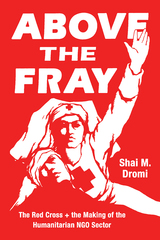
front cover of Above the Fray
Above the Fray
The Red Cross and the Making of the Humanitarian NGO Sector
Shai M. Dromi
University of Chicago Press, 2020
From Lake Chad to Iraq, nongovernmental organizations (NGOs) provide relief around the globe, and their scope is growing every year. Policy makers and activists often assume that humanitarian aid is best provided by these organizations, which are generally seen as impartial and neutral. In Above the Fray, Shai M. Dromi investigates why the international community overwhelmingly trusts humanitarian NGOs by looking at the historical development of their culture. With a particular focus on the Red Cross, Dromi reveals that NGOs arose because of the efforts of orthodox Calvinists, demonstrating for the first time the origins of the unusual moral culture that has supported NGOs for the past 150 years.

Drawing on archival research, Dromi traces the genesis of the Red Cross to a Calvinist movement working in mid-nineteenth-century Geneva. He shows how global humanitarian policies emerged from the Red Cross founding members’ faith that an international volunteer program not beholden to the state was the only ethical way to provide relief to victims of armed conflict. By illustrating how Calvinism shaped the humanitarian field, Dromi argues for the key role belief systems play in establishing social fields and institutions. Ultimately, Dromi shows the immeasurable social good that NGOs have achieved, but also points to their limitations and suggests that alternative models of humanitarian relief need to be considered.
[more]

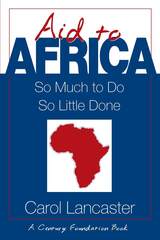
front cover of Aid to Africa
Aid to Africa
So Much To Do, So Little Done
Carol Lancaster
University of Chicago Press, 1999
Why, despite decades of high levels of foreign aid, has development been so disappointing in most of Sub-Saharan Africa, leading to rising numbers of poor and fueling political instabilities? While not ignoring the culpability of Africans in these problems, Carol Lancaster finds that much of the responsibility is in the hands of the governments and international aid agencies that provide assistance to the region. The first examination of its kind, Aid to Africa investigates the impact of bureaucratic politics, special interest groups, and public opinion in aid-giving countries and agencies. She finds that aid agencies in Africa often misdiagnosed problems, had difficulty designing appropriate programs that addressed the local political environment, and failed to coordinate their efforts effectively.

This balanced but tough-minded analysis does not reject the potential usefulness of foreign aid but does offer recommendations for fundamental changes in how governments and multilateral aid agencies can operate more effectively.
[more]

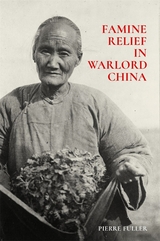
front cover of Famine Relief in Warlord China
Famine Relief in Warlord China
Pierre Fuller
Harvard University Press, 2019

Famine Relief in Warlord China is a reexamination of disaster responses during the greatest ecological crisis of the pre-Nationalist Chinese republic. In 1920–1921, drought and ensuing famine devastated more than 300 counties in five northern provinces, leading to some 500,000 deaths. Long credited to international intervention, the relief effort, Pierre Fuller shows, actually began from within Chinese social circles. Indigenous action from the household to the national level, modeled after Qing-era relief protocol, sustained the lives of millions of the destitute in Beijing, in the surrounding districts of Zhili (Hebei) Province, and along the migrant and refugee trail in Manchuria, all before joint foreign-Chinese international relief groups became a force of any significance.

Using district gazetteers, stele inscriptions, and the era’s vibrant Chinese press, Fuller reveals how a hybrid civic sphere of military authorities working with the public mobilized aid and coordinated migrant movement within stricken communities and across military domains. Ultimately, the book’s spotlight on disaster governance in northern China in 1920 offers new insights into the social landscape just before the region’s descent, over the next decade, into incessant warfare, political struggle, and finally the normalization of disaster itself.
[more]

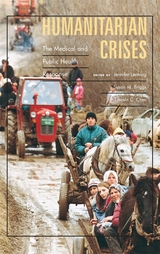
front cover of Humanitarian Crises
Humanitarian Crises
The Medical and Public Health Response
Jennifer Leaning M.D.
Harvard University Press, 1999
Since the late 1980s the international relief community has seen its resources and personnel stressed beyond capacity by humanitarian crises--large-scale, man-made catastrophes such as the conflicts in Somalia, Bosnia, Rwanda, Chechnya, Zaire, and elsewhere. Waged within collapsing states, political and ethnic strife targets civilians, causes mass population dislocation and widespread human rights abuses, and impedes the efforts of relief organizations to respond effectively. Covering topics ranging from emergency public health measures to the psychological trauma of relief workers, this volume presents both a seasoned assessment of current practice and proposals for improving operational efforts in the future. The discussion also raises important questions relating to the definition and direction of the overall humanitarian mission.
[more]

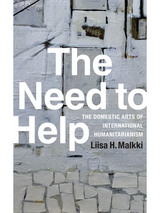
front cover of The Need to Help
The Need to Help
The Domestic Arts of International Humanitarianism
Liisa H. Malkki
Duke University Press, 2015
In The Need to Help Liisa H. Malkki shifts the focus of the study of humanitarian intervention from aid recipients to aid workers themselves. The anthropological commitment to understand the motivations and desires of these professionals and how they imagine themselves in the world "out there," led Malkki to spend more than a decade interviewing members of the international Finnish Red Cross, as well as observing Finns who volunteered from their homes through gifts of handwork. The need to help, she shows, can come from a profound neediness—the need for aid workers and volunteers to be part of the lively world and something greater than themselves, and, in the case of the elderly who knit "trauma teddies" and "aid bunnies" for "needy children," the need to fight loneliness and loss of personhood. In seriously examining aspects of humanitarian aid often dismissed as sentimental, or trivial, Malkki complicates notions of what constitutes real political work. She traces how the international is always entangled in the domestic, whether in the shape of the need to leave home or handmade gifts that are an aid to sociality and to the imagination of the world.
[more]

front cover of Revolving Door
Revolving Door
Katja Lange-Müller
Seagull Books, 2022
The English debut of an idiosyncratic narrative voice.

“What now?” wonders Asta, a nurse who has returned to Germany after a final assignment in Nicaragua. After over twenty years working for international aid organizations, her services are no longer needed. No one is waiting for her. She has nowhere to go. Even the language has lost its familiarity. She stands next to a revolving door at Munich airport, observing the other travelers as she smokes one duty-free cigarette after another. Some of these strangers resemble figures from her past, bringing memories of an adventurous life flooding back. Her catalog of tragicomic attempts at assistance in Germany, Nicaragua, India, Mongolia, and Tunisia raises questions about what it takes to help and whom we are really helping. Katja Lange-Müller’s works have been critically acclaimed for their dark humor and affectionate, nuanced portrayals of characters wrestling with knotty situations and relationships. Revolving Door marks a fitting English debut of this most idiosyncratic of narrative voices.
[more]


Send via email Share on Facebook Share on Twitter