
 A SCHOLARLY BOOK REPOSITORY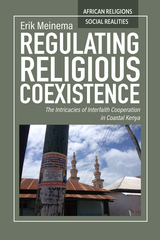
Regulating Religious Coexistence offers a compelling ethnographic analysis of how Muslims, Christians, and practitioners of indigenous African religions negotiate coexistence in Kenya’s coastal region. The book conceptualizes religious diversity as a dynamic field shaped by multiple partly intersecting and partly conflicting models of interaction. These include the political secularism promoted by the Kenyan state and civil society organizations focused on interfaith harmony, forms of competition between religious groups, and pluralistic practices in which individuals draw on multiple traditions to meet spiritual needs.
Through a close examination of civil society initiatives funded by Western donors to foster peacebuilding and to counter violent extremism, the book investigates how these models for coexistence are negotiated and contested and how they intersect with historical and contemporary patterns. It demonstrates that modes of religious coexistence in coastal Kenya have been shaped by colonial and postcolonial governance, transregional connections, and interactions between Christians, Muslims, and Traditionalists across time.
As one of the few monographs on political secularism in an African context, Regulating Religious Coexistence makes a significant contribution to scholarship on religious diversity and coexistence. It situates Christianity, Islam, and indigenous African traditions within a single conceptual framework, broadening earlier studies that mostly treated them in isolation. This book is essential reading for scholars of religion, anthropology, African studies, and political theory, offering fresh insights into the complex realities of religious diversity in Africa and beyond.
“Signed language interpreting is about access,” states author Jeremy L. Brunson at the outset of his new book, and no manifestation of access for deaf people can be considered more complex than video relay services (VRS). In Video Relay Service Interpreters: Intricacies of Sign Language Access, Brunson delineates exactly how complicated the service can be, first by analyzing sign language interpreting as a profession and its relation to both hearing and deaf clients. He describes how sign language interpreters function in Deaf communities and how regulatory processes imposed by VRS providers can constrain communication access based on each individual’s needs.
Brunson proceeds by acclimating readers to the environment of VRS and how the layout of the typical physical plant alters the practice of interpreting. The focus then falls upon intended VRS users, providing insights into their expectations. Interpreters shared their experiences with Brunson in 21 formal interviews and discussions. Many remarked on the differences between face-to-face interpreting and VRS training, which often runs counter to the concept of relating informally with deaf clients as a way to expand access. This thoughtful, sociological study outlines texts that originate between users and interpreters and how they can be used to develop VRS access. Video Relay Service Interpreters concludes with the implications of VRS interpreting for sign language interpreting in general and suggests where scholarship will lead in the future.
READERS
Browse our collection.
PUBLISHERS
See BiblioVault's publisher services.
STUDENT SERVICES
Files for college accessibility offices.
RECENTLY PUBLISHED




UChicago Accessibility Resources
home | accessibility | search | about | contact us
BiblioVault ® 2001 - 2026
The University of Chicago Press