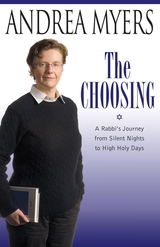
front cover of The Choosing
The Choosing
A Rabbi's Journey from Silent Nights to High Holy Days
Myers, Andrea
Rutgers University Press, 2011

A young Lutheran girl grows up on Long Island, New York. She aspires to be a doctor, and is on the fast track to marriage and the conventional happily-ever-after. But, as the Yiddish saying goes, "Man plans, and God laughs." Meet Andrea Myers, whose coming-of-age at Brandeis, conversion to Judaism, and awakening sexual identity make for a rich and well-timed life in the rabbinate.

In The Choosing, Myers fuses heartwarming anecdotes with rabbinic insights and generous dollops of humor to describe what it means to survive and flourish on your own terms. Portioned around the cycle of the Jewish year, with stories connected to each of the holidays, Myers draws on her unique path to the rabbinate--leaving behind her Christian upbringing, coming out as a lesbian, discovering Judaism in college, moving to Israel, converting, and returning to New York to become a rabbi, partner, and parent.

Myers relates tales of new beginnings, of reinventing oneself, and finding oneself. Whether it's a Sicilian grandmother attempting to bake hamantaschen on Purim for her Jewish granddaughter, or an American in Jerusalem saving a chicken from slaughter during a Rosh Hashanah ritual, Myers keeps readers entertained as she reflects that spirituality, goodness, and morality can and do take many forms. Readers will enthusiastically embrace stories of doors closing and windows opening, of family and community, of integration and transformation. These captivating narratives will resonate and, in the author's words, "reach across coasts, continents, and generations."


[more]

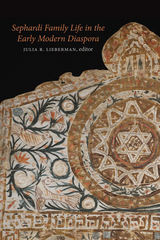
front cover of Sephardi Family Life in the Early Modern Diaspora
Sephardi Family Life in the Early Modern Diaspora
Edited by Julia R. Lieberman
Brandeis University Press, 2010
This collection of essays examines an important and under-studied topic in early modern Jewish social history”—the family life of Sephardi Jewish families in the Ottoman Empire as well as in communities in Western Europe. At the height of its power in the sixteenth and seventeenth centuries, the Ottoman Empire spanned three continents, controlling much of southeastern Europe, western Asia, and North Africa. Thousands of Jewish families that had been expelled from Spain and Portugal at the end of the fifteenth century created communities in these far-flung locations. Later emigrants from Iberia, who converted to Christianity at the time of the expulsion or before, created communities in Western European cities such as Amsterdam, Hamburg, and Livorno. Sephardi communities were very different from those of Ashkenazi Jews in the same period. The authors of these essays use the lens of domestic life to illuminate the diversity of the post-Inquisition Sephardi Jewish experience, enabling readers to enter into little-known and little-studied Jewish historical episodes. Contributors include: Tirtsah Levie Bernfeld, Hannah Davidson, Cristina Galasso, David Graizbord, Ruth Lamdan, and Julia Lieberman
[more]


Send via email Share on Facebook Share on Twitter