logo for University of Illinois Press
Assemblies of Sorrow
Performances of Black Endangerment in the Jim Crow Era
Samuel Galen Ng
University of Illinois Press, 2026
During the Jim Crow era, Black activists appealed to a diverse population of migrating Black Americans by making them viscerally feel that the threat of anti-Black violence continued to afflict them as a group and to undergird blackness itself. To this end, they organized public gatherings, mostly comprised of Black people, that fostered fears of looming physical harm.

Samuel Galen Ng illuminates this Black consciousness as it emanated from feelings of collective endangerment. The dissemination and intensification of such feelings became a pivotal way of solidifying a national Black consciousness on the eve of the Civil Rights Movement. Ng examines how performances of Black endangerment performed political work that provided Black people with important means of political organizing and insurgency. As Ng shows, the grief and mourning that took place at the performances provided public spaces for individuals and communities to observe specific losses capable of impacting Americans across the country.

Ambitious and interdisciplinary, Assemblies of Sorrow explores an overlooked facet of Black organizing and protest and traces how activists shaped fear and grief into political action.
[more]

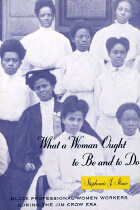
front cover of What a Woman Ought to Be and to Do
What a Woman Ought to Be and to Do
Black Professional Women Workers during the Jim Crow Era
Stephanie J. Shaw
University of Chicago Press, 1996
Stephanie J. Shaw takes us into the inner world of American black professional women during the Jim Crow era. This is a story of struggle and empowerment, of the strength of a group of women who worked against daunting odds to improve the world for themselves and their people. Shaw's remarkable research into the lives of social workers, librarians, nurses, and teachers from the 1870s through the 1950s allows us to hear these women's voices for the first time. The women tell us, in their own words, about their families, their values, their expectations. We learn of the forces and factors that made them exceptional, and of the choices and commitments that made them leaders in their communities.

What a Woman Ought to Be and to Do brings to life a world in which African-American families, communities, and schools worked to encourage the self-confidence, individual initiative, and social responsibility of girls. Shaw shows us how, in a society that denied black women full professional status, these girls embraced and in turn defined an ideal of "socially responsible individualism" that balanced private and public sphere responsibilities. A collective portrait of character shaped in the toughest circumstances, this book is more than a study of the socialization of these women as children and the organization of their work as adults. It is also a study of leadership—of how African American communities gave their daughters the power to succeed in and change a hostile world.

[more]


Send via email Share on Facebook Share on Twitter