front cover of Administering Justice
Administering Justice
Placing the Chief Justice in American State Politics
Richard L. Vining Jr. and Teena Wilhelm
University of Michigan Press, 2023

Administering Justice examines the leadership role of chief justices in the American states, including how those duties require chief justices to be part of the broader state political environment. Vining and Wilhelm focus extensively on the power of chief justices as public spokespersons, legislative liaisons, and reform leaders. In contrast to much existing research on chief justices in the states, this study weighs their extrajudicial responsibilities rather than intracourt leadership. By assessing the content of State of the Judiciary remarks delivered over a period of sixty years, Vining and Wilhelm are able to analyze the reform agendas advanced by chief justices and determine what factors influence the likelihood of success. These analyses confirm that chief justices engage with state politics in meaningful ways and that reactions to their proposals are influenced by ideological congruence with other political elites and the scope of their requests. Administering Justice also examines the chief justice position as an institution, provides a collective profile of its occupants, and surveys growing diversity among court leaders.

[more]

front cover of Albert A. Peña Jr.
Albert A. Peña Jr.
Dean of Chicano Politics
José Angel Gutiérrez
Michigan State University Press, 2017
The political and social impact that Albert A. Peña Jr. had on the lives of Mexican Americans, and later Chicanos, is by all counts immeasurable. However, in part because Chicano biography has traditionally been a neglected research area among academics generally and Chicano Studies scholars specifically, his life’s work has not featured prominently in any biographical work to date, making this volume the first of its kind. It provides a richly detailed documentation of Peña’s life and career, from blue collar worker to judge and essay writer, spanning nearly ninety years. Readers will find that at the heart of his story is a focus on grassroots organizing and politics, sharing leadership, and a commitment to social justice.
[more]

front cover of Appointment of Judges
Appointment of Judges
The Johnson Presidency
By Neil D. McFeeley
University of Texas Press, 1987

The selection of federal judges constitutes one of the more significant legacies of any president; the choices of Lyndon Baines Johnson affected important social policies for decades. This book explores the process of making judicial appointments, examining how judges were selected during Johnson's administration and the president's own participation in the process. Appointment of Judges: The Johnson Presidency is the first in-depth study of the judicial selection process in the Johnson years and is one of the few books that has analyzed any individual president's process.

Based on sources in the archives of the Lyndon Baines Johnson Library and correspondence from senators, party officials, Justice Department officers, the American Bar Association, Supreme Court justices, and the candidates themselves, the book is an important exploration of a significant aspect of presidential power. The author shows that Johnson recognized the great impact for social and economic policy the judiciary could have in America and sought out judges who shared his vision of the Great Society. More than any previous president since William Howard Taft, Johnson took an active personal role in setting up the criteria for choosing judges and in many cases participated in decisions on individual nominees. The president utilized the resources of the White House, the Department of Justice, other agencies, and private individuals to identify judicial candidates who met criteria of compatible policy perspective, excellent legal qualifications, political or judicial experience, youth, and ethnic diversity. The book notes how the criteria and judicial selection process evolved over time and how it operated during the transitions between Kennedy and Johnson and between Johnson and Nixon.

[more]

front cover of Battleground New Jersey
Battleground New Jersey
Vanderbilt, Hague, and Their Fight for Justice
Johnson, Nelson
Rutgers University Press, 2014
New Jersey’s legal system was plagued with injustices from the time the system was established through the mid-twentieth century. In Battleground New Jersey, historian and author of Boardwalk Empire, Nelson Johnson chronicles reforms to the system through the dramatic stories of Arthur T. Vanderbilt—the first chief justice of the state’s modern-era Supreme Court—and Frank Hague—legendary mayor of Jersey City. Two of the most powerful politicians in twentieth-century America, Vanderbilt and Hague clashed on matters of public policy and over the need to reform New Jersey’s antiquated and corrupt court system. Their battles made headlines and eventually led to legal reform, transforming New Jersey’s court system into one of the most highly regarded in America.

Vanderbilt’s power came through mastering the law, serving as dean of New York University Law School, preaching court reform as president of the American Bar Association, and organizing suburban voters before other politicians recognized their importance. Hague, a remarkably successful sixth-grade dropout, amassed his power by exploiting people’s foibles, crushing his rivals, accumulating a fortune through extortion, subverting the law, and taking care of business in his own backyard. They were different ethnically, culturally, and temperamentally, but they shared the goals of power.

 
Relying upon previously unexamined personal files of Vanderbilt, Johnson’s engaging chronicle reveals the hatred the lawyer had for the mayor and the lengths Vanderbilt went to in an effort to destroy Hague. Battleground New Jersey illustrates the difficulty in adapting government to a changing world, and the vital role of independent courts in American society. 
[more]

front cover of Biggest Damned Hat
Biggest Damned Hat
Tales from Alaska's Territorial Lawyers and Judges
Pamela Cravez
University of Alaska Press, 2017
Alaska history from the days before statehood is rich in stories of colorful characters—prospectors, settlers, heroes, and criminals. And right alongside them were judges and lawyers, working first to establish the rule of law in the territory, then, later, laying the groundwork for statehood.
 
The Biggest Damned Hat presents a fascinating collection of stories ranging from the gold rush to the 1950s. Built on interviews and oral histories from more than fifty lawyers who worked in Alaska before 1959, and buttressed by research into legal history, the book offers a brilliantly multifaceted portrait of law in the territory—from laying the groundwork for strong civil and criminal law to helping to secure mining and fishing rights to the Alaska Court-Bar fight, which pitted Alaska’s community of lawyers against its nascent Supreme Court. Bringing to life a time long past—when some of the best lawyers had little formal legal education—The Biggest Damned Hat fills in a crucial part of the story of Alaska’s history.
 
[more]

front cover of Call Him Mac
Call Him Mac
Ernest W. McFarland, the Arizona Years
Gary L. Stuart; Foreword by Michael Daly Hawkins
University of Arizona Press, 2018
The political life of Ernest W. McFarland—lawyer, judge, senator, governor, Arizona Supreme Court justice, and businessman—is well documented. Less known is his life as a family man, country lawyer, rural judge, and visionary.

In Call Him Mac, Gary L. Stuart renders a nuanced portrait of a young, ambitious, restless, and smiling man on the verge of becoming a political force headed for the highest levels of governance in Arizona and America. Stuart reveals how Mac became an expert on water law and a visionary in Arizona’s agricultural future. Using interviews with friends and family and extensive primary source research, Stuart spotlights Mac’s unerring focus as a loving husband, father, and grandfather, even in times of great personal tragedy. Mac’s commitments to his family mirrored his sense of fiduciary duty in public life. His enormous political successes were answers to how he dealt with threats to his own life in 1919, the loss of his first wife and three children in the 1930s, and a political loss in 1952 that no one saw coming.

Stuart writes the little-known story of how Arizona’s culture and citizens shaped this energetic, determined, likable lawyer. The fame Mac created was not for himself but for those he served in Arizona and beyond. Mac’s unparalleled political success was fermented during his early Arizona years, the bridge that brought him to his future as an approachable and likable elder statesman of Arizona politics.
[more]

front cover of Cardozo
Cardozo
A Study in Reputation
Richard A. Posner
University of Chicago Press, 1993
What makes a great judge? How are reputations forged? Why do some reputations endure, while others crumble? And how can we know whether a reputation is fairly deserved? In this ambitious book, Richard Posner confronts these questions in the case of Benjamin Cardozo. The result is both a revealing portrait of one of the most influential legal minds of our century and a model for a new kind of study—a balanced, objective, critical assessment of a judicial career.

"The present compact and unflaggingly interesting volume . . . is a full-bodied scholarly biography. . . .It is illuminating in itself, and will serve as a significant contribution."—Paul A. Freund, New York Times Book Review

[more]

logo for University of Chicago Press
The Chinese Bell Murders
Robert van Gulik
University of Chicago Press, 1977
The Chinese Bell Murders describes the Judge's exploits in the tribunal of Poo-yang early in his career. He has one case left over from his predecessor—the brutal rape-murder of Pure Jade, the daughter of Butcher Hsai who lived on Half Moon Street. Her lover has been accused and is on the verge of being convicted, but Judge Dee senses that all is not right and sets out with his lieutenants to find the real murderer.

"So scrupulously in the classic Chinese manner yet so nicely equipped with everything to satisfy the modern reader."—New York Times

Robert Van Gulik (1910-67) was a Dutch diplomat and an authority on Chinese history and culture. He drew his plots from the whole body of Chinese literature, especially from the popular detective novels that first appeared in the seventeenth century.
[more]

logo for University of Chicago Press
The Chinese Lake Murders
Robert van Gulik
University of Chicago Press, 1979
The Chinese Lake Murders describes how Judge Dee solves three difficult cases in A.D. 666, shortly after he has been appointed magistrate of Han-yuan.

"[Robert van Gulik] deftly interweaves three criminal cases involving exotic yet universally recognizable characters, then has his Judge Dee provide a surprising yet most plausible solution."—New York Times Book Review
[more]

front cover of The Chinese Maze Murders
The Chinese Maze Murders
A Judge Dee Mystery
Robert van Gulik
University of Chicago Press, 1997
The very first mystery in the beloved series starring Judge Dee, a detective whom the Los Angeles Times ranked with Sherlock Holmes!

Join the T'ang Dynasty detective Judge Dee on his very first full-length mystery! Poisoned plums, a cryptic scroll picture, passionate love letters, and a hidden murderer with a penchant for torturing and killing women lead Judge Dee to the heart of the Governor’s garden maze and the answers to three interwoven mysteries. This book kicked off Robert van Gulik's long-running series and introduced countless readers to a cozy, clever series and the incredible detective at its center. Read this one and you'll quickly find yourself seeking out the whole series.

 
[more]

logo for University of Chicago Press
The Chinese Nail Murders
Robert van Gulik
University of Chicago Press, 1977
Judge Dee and his four helpers solve the murders of an honored merchant, a kindly boxing master, and a paper merchant's wife, whose corpse has no head. They succeed in spite of strong pressure on Judge Dee from higher-ups to bring his investigation, which has temporarily generated unrest among the populace, rapidly to an end or face dismissal and serious punishment. The case of the headless corpse is based on a thirteenth-century Chinese casebook; the nail murder, one of the most famous motifs in Chinese crime literature, is first described in the same text.

"So scrupulously in the classic Chinese manner yet so nicely equipped with everything to satisfy the modern reader."—New York Times

Robert Van Gulik (1910-67) was a Dutch diplomat and an authority on Chinese history and culture. He drew his plots from the whole body of Chinese literature, especially from the popular detective novels that first appeared in the seventeenth century.
[more]

front cover of Choosing State Supreme Court Justices
Choosing State Supreme Court Justices
Merit Selection and the Consequences of Institutional Reform
Greg Goelzhauser
Temple University Press, 2016

Since 1940, more than half of all states have switched at least in part from popular election or elite appointment to experiment with merit selection in choosing some or all of their state supreme court justices. Under merit selection, a commission—often comprising some combination of judges, attorneys, and the general public—is tasked with considering applications from candidates vying to fill a judicial vacancy. Ostensibly, the commission forwards the best candidates to the governor, who ultimately appoints them. Presently, numerous states are debating whether to adopt or abolish merit selection. 

In his short, sharp book, Choosing State Supreme Court Justices, Greg Goelzhauser utilizes new data on more than 1,500 state supreme court justices seated from 1960 through 2014 to answer the question, Does merit selection produce better types of judges? He traces the rise of merit selection and explores whether certain judicial selection institutions favor candidates who have better qualifications, are more diverse, and have different types of professional experience.

Goelzhauser’s results ultimately contribute to the broader debate concerning comparative institutional performance with respect to state judicial selection.

[more]

front cover of Clean Hands and Rough Justice
Clean Hands and Rough Justice
An Investigating Magistrate in Renaissance Italy
David S. Chambers and Trevor Dean
University of Michigan Press, 1997
It is rarely possible to write biographies of lay people who lived in the Middles Ages. While accounts of clerical, royal, and military life are many, the wider populace has remained in relative obscurity. In Clean Hands and Rough Justice: An Investigating Magistrate in Renaissance Italy, David S. Chambers and Trevor Dean present an extraordinary and previously unknown character from Renaissance Italy, Beltramino Cusadri (ca. 1425-1500). This judge was known as the "terrible commissioner," and he spent most of his professional life acting as criminal investigator and legal adviser to two princely dynasties -- the Gonzaga of Mantua and the Este of Ferrara. The authors investigate and compare the judicial institutions and social conditions in which Beltramino Cusadri worked, the criminal cases that he investigated, and his successes and failures. Their combined presentation of the figure and mentality of Cusadri amounts to something unprecedented in Italian Renaissance historiography: the portrait of a professional man, employed to combat rising crime, but accused of corruption and tyranny by the entrenched interests that he faced. The book follows the major phases of Beltramino's career and offers a broader exploration of the legal history of Renaissance Italy. In his long life Beltramino Cusadri wrote hundreds of letters to his employers and it is upon these letters that this book is based. These letters with their wry, colorfully worded expressions are liberally quoted and provide unique insight into the career, activity, and attitudes of a major Renaissance bureaucrat. The letters of his employers in return are also drawn upon to examine a variety of themes, from the progress of law-making and the pattern of criminality, to the problems of policing and the changing forms of punishment. These provide an extraordinarily vivid picture of face-to-face realities that make an important contribution to the history of crime, law, policing, and punishment.
[more]

front cover of Constance Baker Motley
Constance Baker Motley
One Woman's Fight for Civil Rights and Equal Justice under Law
Gary L. Ford Jr.
University of Alabama Press, 2017

The story of NAACP’s sole female attorney. She shaped civil rights history as lead strategist and litigator from 1946–1964, arguing landmark desegregation cases and defending Martin Luther King Jr. and countless freedom fighters.

Constance Baker Motley was an African American woman; the daughter of immigrants from Nevis, British West Indies; a wife; and a mother who became a pioneer and trailblazer in the legal profession. She broke down barriers, overcame gender constraints, and operated outside the boundaries placed on black women by society and the civil rights movement. In Constance Baker Motley: One Woman’s Fight for Civil Rights and Equal Justice under Law, Gary L. Ford Jr. explores the key role Motley played in the legal fight to desegregate public schools as well as colleges, universities, housing, transportation, lunch counters, museums, libraries, parks, and other public accommodations.
 
The only female attorney at the NAACP Legal Defense and Educational Fund, Inc., Motley was also the only woman who argued desegregation cases in court during much of the civil rights movement. From 1946 through 1964, she was a key litigator and legal strategist for landmark civil rights cases including the Montgomery Bus Boycott and represented Martin Luther King Jr. as well as other protesters arrested and jailed as a result of their participation in sit-ins, marches, and freedom rides.
 
Motley was a leader who exhibited a leadership style that reflected her personality traits, skills, and strengths. She was a visionary who formed alliances and inspired local counsel to work with her to achieve the goals of the civil rights movement. As a leader and agent of change, she was committed to the cause of justice and she performed important work in the trenches in the South and behind the scene in courts that helped make the civil rights movement successful.

"Highly recommended."
CHOICE

[more]

front cover of Constitutional Conscience
Constitutional Conscience
The Moral Dimension of Judicial Decision
H. Jefferson Powell
University of Chicago Press, 2008
While many recent observers have accused American judges—especially Supreme Court justices—of being too driven by politics and ideology, others have argued that judges are justified in using their positions to advance personal views. Advocating a different approach—one that eschews ideology but still values personal perspective—H. Jefferson Powell makes a compelling case for the centrality of individual conscience in constitutional decision making.
            Powell argues that almost every controversial decision has more than one constitutionally defensible resolution. In such cases, he goes on to contend, the language and ideals of the Constitution require judges to decide in good faith, exercising what Powell calls the constitutional virtues: candor, intellectual honesty, humility about the limits of constitutional adjudication, and willingness to admit that they do not have all the answers. Constitutional Conscience concludes that the need for these qualities in judges—as well as lawyers and citizens—is implicit in our constitutional practices, and that without them judicial review would forfeit both its own integrity and the credibility of the courts themselves.      
 
[more]

front cover of Continuity and Change on the United States Courts of Appeals
Continuity and Change on the United States Courts of Appeals
Donald R. Songer, Reginald S. Sheehan, and Susan B. Haire
University of Michigan Press, 2000
While many fine works of scholarship examine the role of the Supreme Court in American politics, there has been a dearth of scholarly books that focus on the Courts of Appeals. Continuity and Change on the United States Courts of Appeals is unique both in its focus on this level of the judiciary and its approach that examines major trends over the twentieth century. Since the Supreme Court has the discretion to refuse to hear almost all cases appealed to it, the Courts of Appeals are usually the final option for litigants in the federal system. Unless overturned by the Supreme Court or, in cases decided on the basis of statute, by Congressional action, the rulings can have a significant impact on government policy.
The authors present the first comprehensive examination of the shifting role of the Courts of Appeals, investigating changes over time and presenting the first systematic analyses of those changes. Their work is the first book to utilize the database of the U.S. Courts of Appeals, analyzing over 15,000 cases to examine trends between 1925 and 1988. The book answers questions such as who are the judges? What are their decisional tendencies? What has been the role of region and partisan politics? Who are the litigants? And who has won and who has lost throughout the twentieth century? It is the only current, up-to-date book on the Courts of Appeals and an essential read for all scholars and students interested in American politics and judicial behavior.
Donald R. Songer is Professor of Political Science, University of South Carolina. Reginald S. Sheehan is Associate Professor of Political Science and Director of the Program for Law and Juridical Politics, Michigan State University. Susan B. Haire is Assistant Professor of Political Science, University of Georgia
[more]

front cover of David Davis, Abraham Lincoln's Favorite Judge
David Davis, Abraham Lincoln's Favorite Judge
Raymond J. McKoski
University of Illinois Press, 2025

One of Abraham Lincoln’s staunchest and most effective allies, Judge David Davis masterminded the floor fight that gave Lincoln the presidential nomination at the 1860 Republican National Convention. This history-changing event emerged from a long friendship between the two men. It also altered the course of Davis’s career, as Lincoln named him to the U.S. Supreme Court in 1862.

Raymond J. McKoski offers a biography of Davis’s public life, his impact on the presidency and judiciary, and his personal, professional, and political relationships with Lincoln. Davis lent his vast network of connections, organizational and leadership abilities, and personal persuasiveness to help Lincoln’s political rise. When Davis became a judge, he honed an ability to hear each case with complete impartiality, a practice that endeared him to Lincoln but one day put him at odds with the president over important Civil War–era rulings. McKoski details these cases while providing an in-depth account of Davis’s role in Lincoln’s two unsuccessful campaigns for U.S. Senate and the fateful run for the presidency.

[more]

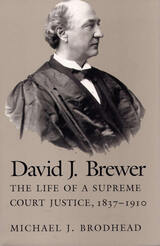
front cover of David J Brewer
David J Brewer
The Life of a Supreme Court Justice, 1837-1910
Michael J. Brodhead
Southern Illinois University Press, 1994

This is the first biography of David J. Brewer, an Associate Justice of the United States Supreme Court from 1889 to 1910.

Prior to rising to the nation’s highest tribunal, Brewer served as a county probate judge, a state district judge, a Kansas State Supreme Court justice, and a federal circuit court judge. He was known not only for his long tenure on the Supreme Court but also for his numerous off-the-bench statements as an orator and writer.

Many of Brewer’s judicial opinions and nonjudicial utterances created controversy, particularly when he confronted the reform issues of his day. The court, then presided over by Chief Justice Melville W. Fuller, has been seen as reactionary, determined to infuse the law with social Darwinism and laissez-faire ideology. Yet, contrary to this assessment of the Fuller Court as a whole, Brewer accepted most of his generation’s reform goals. He championed many forms of social legislation, the regulation of business, the rights of women and minorities, the support of charities, educational reform, and world peace.

Michael J. Brodhead contends that until recently historians have carelessly and inaccurately created a false image of Brewer, partly by citing a small sample of his opinions and public statements as representative of his alleged conservatism. They have also assumed that the disputable decisions of Brewer and his contemporaries were based on ideological predilections and that precedent and recognized legal principles played no role.

During his term, Brewer was the author of such notable court opinions as In re Debs, Muller v. Oregon, and Kansas v. Colorado. He supported property rights, admired honest entrepreneurial activity, and opposed the concentration of power in any form. Brewer favored the individual in all instances, whether that individual was the initiator of a great economic enterprise or a farmer struggling to extend agriculture into the western plains.
[more]

front cover of Death and Dissymmetry
Death and Dissymmetry
The Politics of Coherence in the Book of Judges
Mieke Bal
University of Chicago Press, 1988
Combining literary criticism and feminist analysis, Death and Dissymmetry radically reinterprets not only the Book of Judges but also the tradition of its reception and understanding in the West. In Mieke Bal's account, Judges documents the Israelite culture learning to articulate itself in a decisive period of transition.

Counter to standard readings of Judges, Bal's interpretation demonstrates that the book has a political and ideological coherence in which the treatment of women plays a pivotal role. Bal concentrates here not on the assassinations and battles that rage through Judges but on the violence in the domestic lives of individual characters, particularly sexual violence directed at women. Her skillful reading reveals that murder, in this text, relates to gender and reflects a social structure that is inherently contradictory. By foregrounding the stories of women and subjecting them to subtle narrative analysis, she is able to expose a set of preoccupations that are essential to the sense of these stories but are not articulated in them. Bal thereby develops a "countercoherence" in conflict with the apparent emphases of Judges—the politics, wars, and historiography that have been the constant focus of commentators on the book.

Death and Dissymmetry makes an important contribution to the development of a feminist method of interpreting ancient texts, with consequences for religious studies, ancient history, literary theory, and gender studies.
[more]

front cover of Electing Judges
Electing Judges
The Surprising Effects of Campaigning on Judicial Legitimacy
James L. Gibson
University of Chicago Press, 2012
In Electing Judges, leading judicial politics scholar James L. Gibson responds tothe growing chorus of critics who fear that the politics of running for office undermine judicial independence and even the rule of law. While many people have opinions on the topic, few have supported them with actual empirical evidence. Gibson rectifies this situation, offering the most systematic and comprehensive study to date of the impact of campaigns on public perceptions of fairness, impartiality, and the legitimacy of elected state courts—and his findings are both counterintuitive and controversial.
 
Gibson finds that ordinary Americans do not conclude from campaign promises that judges are incapable of making impartial decisions. Instead, he shows, they understand the process of deciding cases to be an exercise in policy making, rather than of simply applying laws to individual cases—and consequently think it’s important for candidates to reveal where they stand on important issues. Negative advertising also turns out to have a limited effect on perceptions of judicial legitimacy, though the same cannot be said for widely hated campaign contributions.
 
Taking both the good and bad into consideration, Gibson argues persuasively that elections are ultimately beneficial in boosting the institutional legitimacy of courts, despite the slight negative effects of some campaign activities. Electing Judges will initiate a lively debate inside both the halls of justice and the academy.
[more]

front cover of The Emperor's Pearl
The Emperor's Pearl
A Judge Dee Mystery
Robert van Gulik
University of Chicago Press, 1963
A fiendishly clever mystery that can only be unraveled by the unflappable Judge Dee, whom the Los Angeles Times ranked with Sherlock Holmes

The latest puzzling mystery facing Jude Dee begins on the night of the Poo-yang dragonboat races in 699 A.D.: a drummer in the leading boat collapses, and the body of a beautiful young woman turns up in a deserted country mansion. There, Judge Dee—tribunal magistrate, inquisitor, and public avenger—steps in to investigate the murders and return order to the Tang Dynasty.

In The Emperor’s Pearl, the judge discovers that these two deaths are connected by an ancient tragedy involving a near-legendary treasure stolen from the Imperial Harem one hundred years earlier. The terrifying figure of the White Lady, a river goddess enshrined on a bloodstained altar, looms in the background of the investigation. Clues are few and elusive, but under the expert hand of Robert van Gulik, this mythic jigsaw puzzle assembles itself into a taut mystery.
 
[more]

logo for Oregon State University Press
The Environmental Justice
William O. Douglass and American Conservation
Adam M. Sowards
Oregon State University Press, 2009

front cover of Fifty-Eight Lonely Men
Fifty-Eight Lonely Men
Southern Federal Judges and School Desegregation
J. W. Peltason
University of Illinois Press, 1971
Originally published in 1961, this still timely book illustrates the role of the judiciary in the solution of a social and political problem. It is unequaled in its description of the plight of federal judges who are charged with carrying out the decisions of the Supreme Court against segregation but who are under constant pressure--social, political, and personal--to speak for the white South. Some have been ostracized by their communities as traitors; others have joined their state legislatures and local school boards in developing elaborate delay strategy to circumvent the Supreme Court's decisions. In his introduction to the first edition former Senator Paul H. Douglas wrote: ". . . a clear and comprehensive account of the legal struggles in the federal courts over segregation and desegregation in the public schools of the nation. It gets behind the newspaper headlines and gives a play-by-play account. . . . This book is indeed full proof of the delays and difficulties of the law and the pressures of local public opinion."
[more]

front cover of Frank Murphy
Frank Murphy
The Detroit Years
Sidney Fine
University of Michigan Press, 1975
The second son of a close-knit Irish-American family, a charismatic politician who championed the underdog yet enjoyed the company of the rich, Frank Murphy was for thirty years an influential figure on the American scene. As Recorder’s Court judge, mayor of Detroit during the Great Depression, governor-general of and high commissioner to the Philippines, governor of Michigan, United States attorney general, and justice of the United States Supreme Court, he played a dramatic role in some of the most significant events of our era. This first volume of what will surely be the definitive account of the life and times of Frank Murphy focuses on the Detroit years, when Murphy brought his courtroom skills to bear on landmark legal battles of the period, forged a New Deal type of coalition that altered the structure of political power in Detroit, and led the city through the darkest days of the Depression. By stressing the interaction between the man and his times, the book presents not only a fully rounded portrait of a fascinating personality but also provides the first detailed coverage of the work of the Detroit Recorder’s Court and an unequaled account of the Depression years in Detroit and the state of Michigan.
[more]

front cover of From Ballot to Bench
From Ballot to Bench
Judicial Elections and the Quest for Accountability
By Philip L. Dubois
University of Texas Press, 1980

Over several decades, many U.S. states abandoned the practice of selecting their judges by direct popular election and adopted the Missouri Plan of judicial selection. In From Ballot to Bench, Philip L. Dubois subjects the various criticisms raised against judicial elections to a more searching scrutiny than previously has been attempted.

Dubois carefully reviews the three central counts on which judicial elections have been faulted: for lowering the quality of the bench, for impairing judicial independence, and for failing to secure judicial accountability. After concluding that the potential for judicial elections to hold judges popularly accountable is what might commend them over alternative selection methods, Dubois concentrates on the analysis of empirical evidence to evaluate judicial elections as mechanisms of accountability.

The study examines all the statewide partisan and nonpartisan elections for state supreme court justices in non-southern states from 1948 to 1974. Included is a detailed examination of voter participation, electoral competition, the behavior of judicial electorates, and the patterns of gubernatorial vacancy appointments. An analysis of decision making on eight state supreme courts also tests the relationship between different selection systems and judicial behavior.

Dubois finds that partisan elections maximize voter participation, meaningfully structure voter choices, minimize accession to the bench by appointment, and allow popular control over gubernatorial appointments. Additional evidence on the extent of partisan voting by judges selected under different methods leads Dubois to conclude that partisan elections are superior to both nonpartisan elections and nonelective selection methods as instruments of accountability.

The importance of the questions addressed, the breadth of the data collected, and the unorthodox conclusions offered make this a significant book for political scientists, judges, lawyers, and public officials.

[more]

front cover of Governor Henry Horner, Chicago Politics, and the Great Depression
Governor Henry Horner, Chicago Politics, and the Great Depression
Charles J. Masters
Southern Illinois University Press, 2007
Many have never heard of Governor Henry Horner of Illinois, yet his story is remarkable. Governor Henry Horner, Chicago Politics, and the Great Depression focuses on Horner’s career in law and politics from 1915 to 1940, while examining the economic and political dynamics of Illinois during the darkest period in American history. This principled governor managed to maintain his political integrity in a climate where honesty was a liability, says author Charles J. Masters, but the few historians who include Horner in their narratives offer contradictory and dismissive characterizations of him. Masters corrects the public record and reintroduces Horner to political lore as a man who brazenly fought both the Chicago Democratic machine that worked to plot his downfall and Roosevelt’s White House to steadfastly do right by the people of Illinois.
In this first book-length treatment of Horner in over thirty-five years, Masters traces the politician’s career, the history and politics of Chicago, and the effects of the Great Depression in Illinois. The volume details Horner’s life as a lawyer, probate judge, and two-term Democratic governor of Illinois. Horner’s relationships with President Franklin D. Roosevelt and such political players as Michael “Hinky Dink” Kenna, “Bathhouse” John Coughlin, and Chicago mayors Carter Harrison, Anton Cermak, and Ed Kelly are set against a backdrop of assassination, political sniping, court-packing schemes, Prohibition, and the New Deal.
Governor Henry Horner, Chicago Politics, and the Great Depression examines the governor’s management of the political and economic challenges of the state when millions of Americans were jobless, homeless, and hungry. The severely divergent economic and political positions of the state’s northern industrial and southern agrarian interests made the period even darker. Masters shows how Horner stemmed foreclosures, dealt with bank closings, placated unpaid teachers, soothed massive labor unrest, fed the hungry, and confronted the ever-present threat of revolution. While Hitler’s Germany was spreading Nazism throughout Europe, some Americans were questioning the fundamental order of their own political system, suggesting that socialism, communism, or Nazism could offer a better way. Masters addresses how Horner, Illinois’ first Jewish governor, dealt with these challenges to the U.S. political system.
A story long absent from the historical record, GovernorHenry Horner, Chicago Politics, and the Great Depression offers a portrait of the man, his style of governance, his successes, and his failures. The volume, with eight illustrations, effectively reevaluates Horner’s historical reputation and role in Illinois politics in the midst of the worst economic depression in our nation’s history.
[more]

front cover of The Great Justices, 1941-54
The Great Justices, 1941-54
Black, Douglas, Frankfurter, and Jackson in Chambers
William Domnarski
University of Michigan Press, 2006
The Great Justices offers a revealing glimpse of a judicial universe in which titanic egos often clash, and comes as close as any book ever has to getting inside the minds of Supreme Court jurists.

This is rare and little-examined territory: in the public consciousness the Supreme Court is usually seen as an establishment whose main actors, the justices, remain above emotion, vitriol, and gossip, the better to interpret our nation of laws. Yet the Court's work is always an interchange of ideas and individuals, and the men and women who make up the Court, despite or because of their best intentions, are as human as the rest of us. Appreciating that human dimension helps us to discover some of the Court's secrets, and a new way to understand the Court and its role.

Comparing four brilliant but very different jurists of the Roosevelt Court-Hugo Black, William O. Douglas, Felix Frankfurter, and Robert Jackson-William Domnarski paints a startling picture of the often deeply ambiguous relationship between ideas and reality, between the law and the justices who interpret and create it. By pulling aside the veil of decorous tradition, Domnarski brings to light the personalities that shaped one of the greatest Courts of our time-one whose decisions continue to affect judicial thinking today.

William Domnarski is the author of In the Opinion of the Court (1996), a study of the history and nature of federal court judicial opinions. He holds a J.D. from the University of Connecticut and a Ph.D. in English from the University of California. Domnarski currently practices law in California, where he is also working on a forthcoming biography of legendary Hollywood lawyer Bert Fields.
[more]

front cover of The Haunted Monastery
The Haunted Monastery
A Judge Dee Mystery
Robert van Gulik
University of Chicago Press, 1961

A delightfully clever and cozy mystery starring the beloved detective Judge Dee, whom the Los Angeles Times ranked with Sherlock Holmes

Judge Dee and his entourage, seeking refuge from a mountain storm, become trapped in a Taoist monastery, where the Abbott Jade mysteriously dies after delivering an ecstatic sermon. The monks call it a supernatural experience, but the judge calls it murder. Recalling the allegedly accidental deaths of three young women in the same monastery, Judge Dee seeks clues in the eyes of a cat to solve cases of impersonation and murder. A painting by one of the victims reveals the truth about the killings, propelling the judge on a quest for justice and revenge.

[more]

front cover of Homilies on Judges
Homilies on Judges
Origen
Catholic University of America Press, 2010
No description available
[more]

front cover of The Impossible Machine
The Impossible Machine
A Genealogy of South Africa's Truth and Reconciliation Commission
Adam Sitze
University of Michigan Press, 2016

Adam Sitze meticulously traces the origins of South Africa’s Truth and Reconciliation Commission back to two well-established instruments of colonial and imperial governance: the jurisprudence of indemnity and the commission of inquiry. This genealogy provides a fresh, though counterintuitive, understanding of the TRC’s legal, political, and cultural importance. The TRC’s genius, Sitze contends, is not the substitution of “forgiving” restorative justice for “strict” legal justice but rather the innovative adaptation of colonial law, sovereignty, and government. However, this approach also contains a potential liability: if the TRC’s origins are forgotten, the very enterprise intended to overturn the jurisprudence of colonial rule may perpetuate it. In sum, Sitze proposes a provocative new means by which South Africa’s Truth and Reconciliation Commission should be understood and evaluated.

[more]

front cover of It's Not Personal
It's Not Personal
Politics and Policy in Lower Court Confirmation Hearings
Logan Dancey, Kjersten R. Nelson, and Eve M. Ringsmuth
University of Michigan Press, 2020

In order to be confirmed to a lifetime appointment on the federal bench, all district and circuit court nominees must appear before the Senate Judiciary Committee for a confirmation hearing. Despite their relatively low profile, these lower court judges make up 99 percent of permanent federal judgeships and decide cases that relate to a wide variety of policy areas. To uncover why senators hold confirmation hearings for lower federal court nominees and the value of these proceedings more generally, the authors analyzed transcripts for all district and circuit court confirmation hearings between 1993 and 2012, the largest systematic analysis of lower court confirmation hearings to date. The book finds that the time-consuming practice of confirmation hearings for district and circuit court nominees provides an important venue for senators to advocate on behalf of their policy preferences and bolster their chances of being re-elected. The wide variation in lower court nominees’ experiences before the Judiciary Committee exists because senators pursue these goals in different ways, depending on the level of controversy surrounding a nominee. Ultimately, the findings inform a (re)assessment of the role hearings play in ensuring quality judges, providing advice and consent, and advancing the democratic values of transparency and accountability.

[more]

front cover of The Jacksonian Conservatism of Rufus P. Ranney
The Jacksonian Conservatism of Rufus P. Ranney
The Politics and Jurisprudence of a Northern Democrat from the Age of Jackson to the Gilded Age
David M. Gold
Ohio University Press, 2016

Ohio’s Rufus P. Ranney embodied many of the most intriguing social and political tensions of his time. He was an anticorporate campaigner who became John D. Rockefeller’s favorite lawyer. A student and law partner of abolitionist Benjamin F. Wade, Ranney acquired an antislavery reputation and recruited troops for the Union army; but as a Democratic candidate for governor he denied the power of Congress to restrict slavery in the territories, and during the Civil War and Reconstruction he condemned Republican policies.

Ranney was a key delegate at Ohio’s second constitutional convention and a two-time justice of the Ohio Supreme Court. He advocated equality and limited government as understood by radical Jacksonian Democrats. Scholarly discussions of Jacksonian jurisprudence have primarily focused on a handful of United States Supreme Court cases, but Ranney’s opinions, taken as a whole, outline a broader approach to judicial decision making.

A founder of the Ohio State Bar Association, Ranney was immensely influential but has been understudied until now. He left no private papers, even destroying his own correspondence. In The Jacksonian Conservatism of Rufus P. Ranney, David M. Gold works with the public record to reveal the contours of Ranney’s life and work. The result is a new look at how Jacksonian principles crossed the divide of the Civil War and became part of the fabric of American law and at how radical antebellum Democrats transformed themselves into Gilded Age conservatives.

[more]

front cover of John Archibald Campbell
John Archibald Campbell
Southern Moderate, 1811–1889
Robert Saunders Jr.
University of Alabama Press, 1997

The first full biography of the southern U.S. Supreme Court justice who championed both the U.S. Constitution and states’ rights.
 
The life of John Archibald Campbell reflects nearly every major development of 19th-century American history. He participated either directly or indirectly in events ranging from the Indian removal process of the 1830s, to sectionalism and the Civil War, to Reconstruction and redemption. Although not a defender of slavery, he feared that abrupt abolition would produce severe economic and social dislocation. He urged southerners to reform their labor system and to prepare for the eventual abolition of slavery. In the early 1850s he proposed a series of reforms to strengthen slave families and to educate the slaves to prepare them for assimilation into society as productive citizens. These views distinguished him from many southerners who steadfastly maintained the sanctity of the peculiar institution.
 
Born and schooled in Georgia, Campbell moved to Montgomery, Alabama, in the early 1830s, where he joined a successful law practice. He served in the Alabama legislature for a brief period and then moved with his family to Mobile to establish a law practice. In 1853 Campbell was appointed an associate justice of the U.S. Supreme Court. His concurring opinion in the Dred Scott case in 1857 derived not from the standpoint of protecting slavery but from an attempt to return political power to the states. As the sectional crisis gathered heat, Campbell counseled moderation. He became widely detested in the North because of his defense of states’ rights, and he was distrusted in the South because of his moderate views on slavery and secession. In May 1861 Campbell resigned from the Court and later became the Confederacy's assistant secretary of war. After the war, Campbell moved his law practice to New Orleans. Upon his death in 1889, memorial speakers in Washington, D.C., and New Orleans recognized him as one of the nation's most gifted lawyers and praised his vast learning and mastery of both the common law and the civil law.
 
In this first full biography of Campbell, Robert Saunders, Jr., reveals the prevalence of anti-secession views prior to the Civil War and covers both the judicial aspects and the political history of this crucial period in southern history.
 

[more]

front cover of John McKinley and the Antebellum Supreme Court
John McKinley and the Antebellum Supreme Court
Circuit Riding in the Old Southwest
Steven P. Brown
University of Alabama Press, 2012

A Southern voice on a national bench—McKinley’s legacy in antebellum law.

John McKinley and the Antebellum Supreme Court offers the first comprehensive biography of Justice John McKinley (1780–1852), a largely forgotten figure in American legal history who played a pivotal role during a formative period of the U.S. Supreme Court. Steven P. Brown rescues McKinley from historical obscurity, presenting a compelling portrait of a man deeply embedded in the political, legal, and financial life of the early 19th-century South.

Born in Kentucky and later settling in northern Alabama, McKinley served in both the U.S. Senate and House of Representatives before being appointed to the Supreme Court by President Martin Van Buren in 1837. His tenure on the bench coincided with the creation of the Ninth Circuit, a vast and challenging judicial territory encompassing Alabama, Arkansas, Louisiana, and Mississippi. Brown details McKinley’s arduous circuit-riding duties, which required extensive travel and exposed him to the legal complexities of a rapidly expanding frontier.

More than a biography, the book provides a penetrating analysis of antebellum legal culture, Alabama state politics, and the internal workings of the Supreme Court during a time of national transformation. Brown challenges the prevailing view of McKinley as a mediocre jurist, arguing instead that his contributions—particularly his dissents defending states’ rights—deserve renewed scholarly attention. With rich historical context and meticulous research, John McKinley and the Antebellum Supreme Court sheds light on the burdens of justice in a divided nation and the legacy of a justice whose career mirrored the tensions of his time.
 

[more]

front cover of Judge Dee at Work
Judge Dee at Work
Eight Chinese Detective Stories
Robert van Gulik
University of Chicago Press, 1992
A delectable collection of cozy puzzle mysteries starring the wonderful Chinese sleuth Judge Dee, whom the Los Angeles Times ranked with Sherlock Holmes

The eight short stories in Judge Dee at Work cover a decade during which the judge served in four different provinces of the T’ang Empire. From the suspected treason of a general in the Chinese army to the murder of a lonely poet in his garden pavilion, the cases here are among the most memorable in the Judge Dee series.
[more]

front cover of Judge Frank Johnson and Human Rights in Alabama
Judge Frank Johnson and Human Rights in Alabama
Tinsley E. Yarbrough
University of Alabama Press, 1981

Where courage meets the gavel: One judge’s relentless fight for justice and human rights in Alabama.

Judge Frank M. Johnson, Jr., Chief Judge of the United States District Court for the Middle District of Alabama until his elevation to the Court of Appeals for the Fifth Circuit in 1979, was perhaps President Dwight D. Eisenhower’s most significant appointment to a lower court. His selection to the bench in 1955 followed by only a few months the Supreme Court’s historic decision in Brown vs. Board of Education.

During Judge Johnson’s tenure, his court invalidated segregation and other forms of racial discrimination in Alabama’s transportation facilities, voter registration processes, school and colleges, administrative agencies, system of jury selection, prisons, mental institutions, political parties, and government grant programs. In fact, most of the state’s major racial crises were resolved in his courtroom. However, his impact on human rights policy in Alabama was not confined to a racial context. Among other significant developments, the Middle District Court ordered reapportionment of the state’s governing bodies and invalidated its grossly inequitable property tax systems.

Judge Johnson’s decisions made him one of the most widely respected and controversial trial judges in the country. Until recently, however, his name was anathema to many white Alabamians, and he and his family were subject to ostracism, threats, violence, and verbal abuse.

Yarbrough examines Judge Johnson’s life through the end of the Wallace era and the Judge’s appointment to the Fifth Circuit Court. More broadly, the book is a history of modern human rights reform in Alabama, cast in the biographical idiom. For, in a real sense, the history of the reform and of Judge Johnson’s judicial career have been synonymous.


[more]

logo for University of Chicago Press
Judges and the Cities
Interpreting Local Autonomy
Gordon L. Clark
University of Chicago Press, 1985
In this remarkable inquiry into the bases of social theory, Gordon L. Clark argues that the heterogeneous nature of our society, with its pluralism of values, causes the rules of social conduct to be constantly made and remade. Examining the role of the courts in structuring and achieving social discourse, he contends that legal doctrine is no different from other social theories: judicial interpretations are constructed out of specific circumstances and conflicting values, not deduced from neutral and logical principles. There is, he asserts, no final arbiter somehow unaffected by our controversies and schisms.

As concrete examples, Clark analyzes four court disputes in depth, showing that the concept of local autonomy has very different meanings and implications in each of them. These cases—Boston's defense of resident-preference hiring policies, conflict over urban land-use zoning in Toronto, a Chicago's suburb's fight against a sewage treatment plant, and the evolution of the City of Denver's power since 1900—demonstrate that legal reasoning is not impervious to other kinds of reasoning, and the solutions provided by the courts are not unique. To ground his explorations, Clark investigates both liberalism and structuralism, showing that both are inadequate bases for determining social policy. He mounts provocative critiques of the works of de Tocqueville, Nozick, Tiebout, and Posner on the one hand and Castells and Poulantzas on the other. 

This ambitious and important work will command the interest of geographers, political scientists, economists, sociologists, and legal scholars.
[more]

front cover of Judges and Unjust Laws
Judges and Unjust Laws
Common Law Constitutionalism and the Foundations of Judicial Review
Douglas E. Edlin
University of Michigan Press, 2010

"With keen insight into the common law mind, Edlin argues that there are rich resources within the law for judges to ground their opposition to morally outrageous laws, and a legal obligation on them to overturn it, consequent on the general common law obligation to develop the law. Thus, seriously unjust laws pose for common law judges a dilemma within the law, not just a moral challenge to the law, a conflict of obligations, not just a crisis of conscience. While rooted firmly in the history of common law jurisprudence, Edlin offers an entirely fresh perspective on an age-old jurisprudential conundrum. Edlin's case for his thesis is compelling."
---Gerald J. Postema, Cary C. Boshamer Professor of Philosophy and Professor of Law, University of North Carolina at Chapel Hill, and author of Bentham and the Common Law Tradition

"Douglas Edlin builds a powerful historical, conceptual, and moral case for the proposition that judges on common law grounds should refuse to enforce unjust legislation. This is sure to be controversial in an age in which critics already excoriate judges for excessive activism when conducting constitutional judicial review. Edlin's challenge to conventional views is bold and compelling."
---Brian Z. Tamanaha, Chief Judge Benjamin N. Cardozo Professor of Law, St. John's University, and author of Law as a Means to an End: Threat to the Rule of Law

"Professor Edlin's fascinating and well-researched distinction between constitutional review and common law review should influence substantially both scholarship on the history of judicial power in the United States and contemporary jurisprudential debates on the appropriate use of that power."
---Mark Graber, Professor of Law and Government, University of Maryland, and author of Dred Scott and the Problem of Constitutional Evil

Is a judge legally obligated to enforce an unjust law?

In Judges and Unjust Laws, Douglas E. Edlin uses case law analysis, legal theory, constitutional history, and political philosophy to examine the power of judicial review in the common law tradition. He finds that common law tradition gives judges a dual mandate: to apply the law and to develop it. There is no conflict between their official duty and their moral responsibility. Consequently, judges have the authority---perhaps even the obligation---to refuse to enforce laws that they determine unjust. As Edlin demonstrates, exploring the problems posed by unjust laws helps to illuminate the institutional role and responsibilities of common law judges.

Douglas E. Edlin is Associate Professor of Political Science at Dickinson College.

[more]

front cover of Judicial Merit Selection
Judicial Merit Selection
Institutional Design and Performance for State Courts
Greg Goelzhauser
Temple University Press, 2019

The judicial selection debate continues. Merit selection is used by a majority of states but remains the least well understood method for choosing judges. Proponents claim that it emphasizes qualifications and diversity over politics, but there is little empirical evidence regarding its performance. 

In Judicial Merit Selection, Greg Goelzhauser amasses a wealth of data to examine merit selection’s institutional performance from an internal perspective. While his previous book, Choosing State Supreme Court Justices, compares outcomes across selection mechanisms, here he delves into what makes merit selection unique—its use of nominating commissions to winnow applicants prior to gubernatorial appointment.    

Goelzhauser’s analyses include a rich case study from inside a nominating commission’s proceedings as it works to choose nominees; the use of public records to examine which applicants commissions choose and which nominees governors choose; evaluation of which attorneys apply for consideration and which judges apply for promotion; and examination of whether design differences across systems impact performance in the seating of qualified and diverse judges.

The results have critical public policy implications.

[more]

front cover of Judicial Reputation
Judicial Reputation
A Comparative Theory
Nuno Garoupa and Tom Ginsburg
University of Chicago Press, 2015
Judges are society’s elders and experts, our masters and mediators. We depend on them to dispense justice with integrity, deliberation, and efficiency. Yet judges, as Alexander Hamilton famously noted, lack the power of the purse or the sword. They must rely almost entirely on their reputations to secure compliance with their decisions, obtain resources, and maintain their political influence.

In Judicial Reputation, Nuno Garoupa and Tom Ginsburg explain how reputation is not only an essential quality of the judiciary as a whole, but also of individual judges. Perceptions of judicial systems around the world range from widespread admiration to utter contempt, and as judges participate within these institutions some earn respect, while others are scorned. Judicial Reputation explores how judges respond to the reputational incentives provided by the different audiences they interact with—lawyers, politicians, the media, and the public itself—and how institutional structures mediate these interactions. The judicial structure is best understood not through the lens of legal culture or tradition, but through the economics of information and reputation. Transcending those conventional lenses, Garoupa and Ginsburg employ their long-standing research on the latter to examine the fascinating effects that governmental interactions, multicourt systems, extrajudicial work, and the international rule-of-law movement have had on the reputations of judges in this era.
[more]

front cover of Justice and Faith
Justice and Faith
The Frank Murphy Story
Greg Zipes
University of Michigan Press, 2021
Frank Murphy was a Michigan man unafraid to speak truth to power. Born in 1890, he grew up in a small town on the shores of Lake Huron and rose to become Mayor of Detroit, Governor of Michigan, and finally a U.S. Supreme Court Justice. One of the most important politicians in Michigan’s history, Murphy was known for his passionate defense of the common man, earning him the pun “tempering justice with Murphy.”

Murphy is best remembered for his immense legal contributions supporting individual liberty and fighting discrimination, particularly discrimination against the most vulnerable. Despite being a loyal ally of Franklin Delano Roosevelt, when FDR ordered the removal of Japanese Americans during World War II, Supreme Court Justice Murphy condemned the policy as “racist” in a scathing dissent to the Korematsu v. United States decision—the first use of the word in a Supreme Court opinion. Every American, whether arriving by first class or in chains in the galley of a slave ship, fell under Murphy’s definition of those entitled to the full benefits of the American dream.

Justice and Faith explores Murphy’s life and times by incorporating troves of archive materials not available to previous biographers, including local newspaper records from across the country. Frank Murphy is proof that even in dark times, the United States has extraordinary resilience and an ability to produce leaders of morality and courage.
 
[more]

front cover of Justice Hugo Black and Modern America
Justice Hugo Black and Modern America
Tony Freyer
University of Alabama Press, 1990

            The struggle to accommodate both individual freedom and community welfare shaped modern America. American have disagreed about whether federal protection of national welfare could be reconciled with defense of individual rights; however, no public figure worked longer or more consistently to meet this challenge than Alabama’s Hugo L. Black

            This collection of essays, reprints of the spring 1985 and winter 1987 issues of the Alabama Law Review with a new introduction and minor revisions, suggests that Black’s constitutional principles and personal values provided a means to achieve a balance between majority will and individual freedom. Black’s life and career are reexamined here by leading scholars and jurors in the first major study in twenty years, tracing his relationship to the South, to the development of American liberalism, and to the constitutional revolution in individual rights.
            Contributors include, in addition to the editor, Howard Ball, Justice William Brennan, Jr., Irving Dilliard, Gerald Dunne, Harry Edwards, Arthur Goldberg, Sheldon Hackney, Virginia Van der Veer Hamilton, Jean McCulley Holcomb, Anthony Lewis, Paul L. Murphy, Timothy O’Rourke, Norman Redlich, David Shannon, Abigail Thernstrom, Cherry Thomas, J. Mills Thornton III, and Bertram Wyatt-Brown.


[more]

front cover of Justices of the Indiana Supreme Court
Justices of the Indiana Supreme Court
Linda C. Gugin and James E. St. Clair
Indiana Historical Society Press, 2010
From its inception in 1816 until 2010, 105 Hoosiers have been members of the Indiana Supreme Court. In this multiauthor volume, edited by Linda C. Gugin and James E. St. Clair, authors explore the lives of each justice, unearthing not only standard biographical information but also personal stories that offer additional insight into their lives and times.
[more]

front cover of The Lacquer Screen
The Lacquer Screen
A Chinese Detective Story
Robert van Gulik
University of Chicago Press, 1962
A fiendishly clever, yet cozy entry in the much-loved mystery series starring Judge Dee, whom the Los Angeles Times ranked with Sherlock Holmes

Early in his career, Judge Dee visits a senior magistrate who shows him a beautiful lacquer screen on which a scene of lovers has been mysteriously altered to show the man stabbing his lover. The magistrate fears he is losing his mind and will murder his own wife. Meanwhile, a banker has inexplicably killed himself, and a lovely lady has allowed Dee's lieutenant, Chiao Tai, to believe she is a courtesan. Dee and Chiao Tai go incognito among a gang of robbers to solve this mystery, and find the leader of the robbers is more honorable than the magistrate.

 
[more]

front cover of The Language of Judges
The Language of Judges
Lawrence M. Solan
University of Chicago Press, 1993
Since many legal disputes are battles over the meaning of a statute, contract, testimony, or the Constitution, judges must interpret language in order to decide why one proposed meaning overrides another. And in making their decisions about meaning appear authoritative and fair, judges often write about the nature of linguistic interpretation. In the first book to examine the linguistic analysis of law, Lawrence M. Solan shows that judges sometimes inaccurately portray the way we use language, creating inconsistencies in their decisions and threatening the fairness of the judicial system.

Solan uses a wealth of examples to illustrate the way linguistics enters the process of judicial decision making: a death penalty case that the Supreme Court decided by analyzing the use of adjectives in a jury instruction; criminal cases whose outcomes depend on the Supreme Court's analysis of the relationship between adverbs and prepositional phrases; and cases focused on the meaning of certain words in the Constitution. Solan finds that judges often describe our use of language poorly because there is no clear relationship between the principles of linguistics and the jurisprudential goals that the judge wishes to promote.

A major contribution to the growing interdisciplinary scholarship on law and its social and cultural context, Solan's lucid, engaging book is equally accessible to linguists, lawyers, philosophers, anthropologists, literary theorists, and political scientists.
[more]

front cover of Law Without Values
Law Without Values
The Life, Work, and Legacy of Justice Holmes
Albert W. Alschuler
University of Chicago Press, 2000
In recent decades, Oliver Wendell Holmes has been praised as "the only great American legal thinker" and "the most illustrious figure in the history of American law." But in Albert Alschuler's critique of both Justice Holmes and contemporary legal scholarship, a darker portrait is painted—that of a man who, among other things, espoused Social Darwinism, favored eugenics, and, as he himself acknowledged, came "devilish near to believing that might makes right."
[more]

front cover of The Life and Times of Richard J. Hughes
The Life and Times of Richard J. Hughes
The Politics of Civility
Wefing, John B
Rutgers University Press, 2009
The Life and Times of Richard J. Hughes explores the influential public service of this two-term New Jersey governor. He was the only person in New Jersey history to serve as both governor and chief justice of the New Jersey Supreme Court.

This biography illuminates the governor's accomplishments between 1962 and 1970, including the creation of the Hackensack Meadowlands Commission, formation of the county college system, establishment of stringent antipollution laws, design of the public defender system, and the adoption of a New Jersey sales tax, as well as his pivotal role during the Newark riots. As chief justice, Hughes faced difficult issuesùschool funding, low and moderate income housing needs, freedom of speech, and his decision in the rightto-die case involving Karen Ann Quinlan. With a career characterized by liberal activism, Hughes also contributed nationally and internationally, from serving as host of the 1964 Democratic National Convention to monitoring elections in South Vietnam.

John B. Wefing's research includes interviews with prominent politicians and leaders who worked with Hughes at various points in his career. The result is a rich story of a public servant who possessed a true ability to work with members of both political parties and played a significant role in shaping modern New Jersey.

[more]

front cover of The Making of a Southerner
The Making of a Southerner
William Barclay Napton's Private Civil War
Christopher Phillips
University of Missouri Press, 2008
Christopher Phillips has brought to life a man, a story, and a voice lost in the din of competing post–Civil War narratives that each claim a timeless divide between North and South. William Barclay Napton (1808–1883) was an editor, lawyer, and state supreme court justice who lived in Missouri during the tumultuous American nineteenth century. He was a keen observer of the nation’s sectional politics just as he was a participant in those of his border state, the most divided of any in the nation, in the decades surrounding the Civil War. This book tells the story of one man’s civil war, lived and waged within the broader conflict, and the long shadows both cast.
But Napton’s story moves beyond the Civil War just as it transcends the formal political realm. His is a fascinating tale of identity politics and their shifting currents, by which the highly educated former New Jerseyite became the owner or trustee of nearly fifty slaves and one of the most committed and thoughtful of the nation’s proslavery ideologues. That a “northerner” could make such a life transition in the Border West suggests more than the powerful nature of slavery in antebellum American society. Napton’s story offers provocative insights into the process of southernization, one driven more by sectional ideology and politics than by elements of a distinctive southern culture.
Although Napton’s tragic Civil War experience was a watershed in his southern evolution, that evolution was completed only after he had constructed a politicized memory of the bitter conflict, one that was suffered nowhere worse than in Missouri. This war-driven transformation ultimately defined him and his family, just as it would his border state and region for decades to come. By suffering for the South, losing family and property in his defense of its ideals and principles, he claimed by right what he could not by birth. Napton became a southerner by choice.
Drawn from incomparable personal journals kept for more than fifty years and from voluminous professional and family correspondence, Napton’s life story offers a thoughtful and important perspective on the key issues and events that turned this northerner first into an avowed proslavery ideologue and then into a full southerner. As a prominent jurist who sat on Missouri’s high bench for more than a quarter century, he used his politicized position to give birth to the New South in the Old West. Students, teachers, and general readers of southern history, western history, and Civil War history will find this book of particular interest.
[more]

front cover of Measuring Judicial Independence
Measuring Judicial Independence
The Political Economy of Judging in Japan
J. Mark Ramseyer and Eric B. Rasmusen
University of Chicago Press, 2003
The role of the U.S. Supreme Court in the aftermath of the 2000 presidential election raised questions in the minds of many Americans about the relationships between judges and political influence; the following years saw equally heated debates over the appropriate role of political ideology in selecting federal judges. Legal scholars have always debated these questions—asking, in effect, how much judicial systems operate on merit and principle and how much they are shaped by politics.

The Japanese Constitution, like many others, requires that all judges be "independent in the exercise of their conscience and bound only by this Constitution and its laws." Consistent with this requirement, Japanese courts have long enjoyed a reputation for vigilant independence—an idea challenged only occasionally, and most often anecdotally. But in this book, J. Mark Ramseyer and Eric B. Rasmusen use the latest statistical techniques to examine whether that reputation always holds up to scrutiny—whether, and to what extent, the careers of lower court judges can be manipulated to political advantage.

On the basis of careful econometric analysis of career data for hundreds of judges, Ramseyer and Rasmusen find that Japanese politics do influence judicial careers, discreetly and indirectly: judges who decide politically charged cases in ways favored by the ruling party enjoy better careers after their decisions than might otherwise be expected, while dissenting judges are more likely to find their careers hampered by assignments to less desirable positions.

Ramseyer and Rasmusen's sophisticated yet accessible analysis has much to offer anyone interested in either judicial independence or the application of econometric techniques in the social sciences.
[more]

front cover of Michigan Supreme Court Historical Reference Guide, 2nd Edition
Michigan Supreme Court Historical Reference Guide, 2nd Edition
David Chardavoyne
Michigan State University Press, 2015
This second edition of the Michigan Supreme Court Historical Reference Guide contains the biographies of Michigan Supreme Court’s justices from its territorial beginnings in 1803 through 2015. It includes summaries of twenty top cases of the Michigan Supreme Court, which contextualize the eras in which the justices were on the bench, giving a greater depth of understanding to both who the justices were and the historical significance of the cases they decided. A rich reference for historians and attorneys, this book also includes valuable charts detailing election dates and candidates as well as court compositions (who served with whom); lists of chief justices and the ten longest—and shortest—serving justices with dates of service; and a history of the structural evolution of the Michigan Supreme Court.
[more]

front cover of Miles Lord
Miles Lord
The Maverick Judge Who Brought Corporate America to Justice
Roberta Walburn
University of Minnesota Press, 2017

The life of a crusading federal judge who stood up and fought for “the little guy”

This is the story of Miles Lord (1919–2016), who rose from humble beginnings on Minnesota’s Iron Range to become one of the most colorful and powerful judges in the country, described as “an unabashed Prairie populist” and “a live-wire slayer of corporate behemoths.” He cut a wide swath through history on his path to the bench: coming of age alongside a cadre of young Midwestern social-gospel progressives, including Hubert H. Humphrey, Eugene McCarthy, and Walter Mondale, in the days before they reached national fame; teaming with Bobby Kennedy as a hotshot prosecutor in pursuit of Jimmy Hoffa; and serving as the secret envoy between his friends Hubert and Eugene in their battle for the soul of the Democratic party in the historic 1968 presidential campaign. Later, after donning his black robe, he reshaped jurisprudence with precedent-breaking rulings—on issues ranging from women’s rights to consumer protection to education reform—and breaking trail when he ordered the shutdown of the Reserve Mining Company in northern Minnesota, which was spewing its waste into Lake Superior, in the most sensational trial of the early environmental era.

One of Judge Lord’s landmark cases—and interlaced as a centerpiece narrative of this book—involved the Dalkon Shield intrauterine device, which caused horrific infections in thousands of women, resulting in infertility and sometimes death. Author Roberta Walburn served as the judge’s law clerk during that litigation in 1983–84, and she provides a page-turning account (both an insider’s view and an in-depth chronicle) of what was called “one of the most disastrous episodes of American corporate misconduct.” In the end, more than 200,000 women received nearly $3 billion in compensation, and the Fortune 500 defendant was left in ruins. But Judge Lord was hauled up on judicial misconduct charges for his no-holds-barred actions that were certainly provocative but also stand as a timely reminder, even (or especially) today, of the challenges in balancing the scales of justice for a legal system that too often skews to the rich and powerful.

The author deftly weaves the Dalkon Shield drama into the larger story of the life of a one-of-a-kind man, crafting a sweeping and spirited true-life tale with not only her first-hand experiences as the judge’s law clerk but also with unrestricted access to the judge’s personal files. This is a rare and compelling portrait of a remarkable man and his place in both Minnesota and U.S. history.

[more]

front cover of The Monkey and The Tiger
The Monkey and The Tiger
Judge Dee Mysteries
Robert van Gulik
University of Chicago Press, 1965
A pair of clever, cozy mysteries starring the beloved detective Judge Dee, whom the Los Angeles Times ranked with Sherlock Holmes

The Monkey and The Tiger includes two detective stories, "The Morning of the Monkey" and "The Night of the Tiger." In the first, a gibbon drops an emerald in the open gallery of Dee's official residence, leading the judge to discover a strangely mutilated body in the woods—and how it got there. In the second, Dee is traveling to the imperial capital to assume a new position when he is separated from his escort by a flood. Marooned in a large country house surrounded by fierce bandits, Dee confronts an apparition that helps him solve a mystery.
[more]

front cover of Murder in Canton
Murder in Canton
A Judge Dee Mystery
Robert van Gulik
University of Chicago Press, 1966
A delightfully complicated mystery that could only be unraveled by the beloved detective Judge Dee, whom the Los Angeles Times ranked with Sherlock Holmes

Murder in Canton takes place in the year 680, as Judge Dee, recently promoted to lord chief justice, is sent incognito to Canton to investigate the disappearance of a court censor. With the help of his trusted lieutenants Chiao Tai and Tao Gan, and that of a clever blind girl who collects crickets, Dee solves a complex puzzle of political intrigue and murder through the three separate subplots "the vanished censor," "the Smaragdine dancer," and "the Golden Bell."
[more]

logo for Oregon State University Press
Nature's Justice
Writings of William O. Douglas
James M. O'Fallon
Oregon State University Press, 2000

front cover of Necklace and Calabash
Necklace and Calabash
A Chinese Detective Story
Robert van Gulik
University of Chicago Press, 1967
A fiendishly clever puzzle mystery starring the beloved detective Judge Dee, whom the Los Angeles Times ranked with Sherlock Holmes

Necklace and Calabash finds Judge Dee returning to his district of Poo-yang, where the peaceful town of Riverton promises a few days' fishing and relaxation. Yet a chance meeting with a Taoist recluse, a gruesome body fished out of the river, strange guests at the Kingfisher Inn, and a princess in distress thrust the judge into one of the most intricate and baffling mysteries of his career.
 
[more]

front cover of Nixon's Court
Nixon's Court
His Challenge to Judicial Liberalism and Its Political Consequences
Kevin J. McMahon
University of Chicago Press, 2011

Most analysts have deemed Richard Nixon’s challenge to the judicial liberalism of the Warren Supreme Court a failure—“a counterrevolution that wasn’t.” Nixon’s Court offers an alternative assessment. Kevin J. McMahon reveals a Nixon whose public rhetoric was more conservative than his administration’s actions and whose policy towards the Court was more subtle than previously recognized. Viewing Nixon’s judicial strategy as part political and part legal, McMahon argues that Nixon succeeded substantially on both counts.

Many of the issues dear to social conservatives, such as abortion and school prayer, were not nearly as important to Nixon. Consequently, his nominations for the Supreme Court were chosen primarily to advance his “law and order” and school desegregation agendas—agendas the Court eventually endorsed. But there were also political motivations to Nixon’s approach: he wanted his judicial policy to be conservative enough to attract white southerners and northern white ethnics disgruntled with the Democratic party but not so conservative as to drive away moderates in his own party. In essence, then, he used his criticisms of the Court to speak to members of his “Silent Majority” in hopes of disrupting the long-dominant New Deal Democratic coalition. 


For McMahon, Nixon’s judicial strategy succeeded not only in shaping the course of constitutional law in the areas he most desired but also in laying the foundation of an electoral alliance that would dominate presidential politics for a generation.

[more]

front cover of Noble Purposes
Noble Purposes
Nine Champions of the Rule of Law
Norman Gross
Ohio University Press, 2007
Throughout the history of the United States, the acts of a few have proved to be turning points in the way our legal system has treated the least of us. The nine individuals whose deeds are recounted here have compelling stories, and though they remain unknown to the general public, their commitment to the rule of law has had a lasting impact on our nation. Noble Purposes brings their stories to life. It describes the contributions of such individuals as James Alexander, the guiding and central force in the colonial-era trial of John Peter Zenger, which sowed the seeds for the American Revolution and the constitutional guarantee of a free press. In the 1870s, Hugh Lennox Bond stared down threats as judge in the trials of the South Carolina Ku Klux Klan, while Clara Shortridge Foltz overcame tremendous resistance during her fifty-year law practice, which included advocacy of public defender offices. Early last century, Louis Marshall paved the way for the rights of minorities in America and abroad, while Francis Biddle, FDR’s attorney general, sought to maintain civil liberties during World War II, arguing against the internment of Japanese Americans and later serving as the American judge in the Nuremberg trials. Edited by legal scholar Norman Gross and written by leading legal historians from around the country, the profiles presented in Noble Purposes tell the stories of these and other individuals who stood firmly in support of the rule of law, often against great odds.
[more]

front cover of Not from Here, Not from There/No Soy de Aquí ni de Allá
Not from Here, Not from There/No Soy de Aquí ni de Allá
The Autobiography of Nelson Díaz
Nelson A. Díaz
Temple University Press, 2018

Raised in the squalor of a New York tenement until he was 10 years old, Nelson Díaz saw his life change when his family moved to a brand-new high-rise project in West Harlem in the 1950s. That experience, along with lessons learned as the only Latino law student at Temple University, would drive him throughout his life as a lawyer and activist, fighting for the expansion of rights for all Americans.

“No soy de aquí ni de allá” is a mantra for Puerto Ricans who feel like foreigners wherever they are and who seek a place for themselves. In his inspiring autobiography, Not from Here, Not from There, Díaz tells the story of his struggles and triumphs as his perspective widened from the New York streets and law school classrooms to the halls of power in Philadelphia and Washington, DC. Whether as a leader in economic development, a pioneer in court reform, or a champion of fair housing, Díaz has never stopped advocating for others. Díaz was happy to be the first Latino to “do something,” but he never wanted to be the last. This story of an outsider who worked his way to the inside offers powerful lessons on finding a place in the world by creating spaces where everyone is welcome.

[more]

front cover of Pack the Court!
Pack the Court!
A Defense of Supreme Court Expansion
Stephen M. Feldman
Temple University Press, 2021

The United States Supreme Court has numbered nine justices for the past 150 years. But that number is not fixed. With the Democrats controlling the House and Senate during the Biden presidency, they could add justices to the Supreme Court. But would court packing destroy the Court as an apolitical judicial institution? This is the crucial question Stephen Feldman addresses in his provocative book, Pack the Court! He uses a historical, analytical, and political argument to justify court-packing in general and Democratic court-packing more specifically.

Republicans and Democrats alike profess to worry that court-packing will destroy the legitimacy of the Supreme Court as a judicial institution by injecting politics into a purely legal adjudicative process. But as Feldman’s insightful book shows, law and politics are forever connected in judicial interpretation and decision making. Pack the Court! insists that court packing is not the threat to the Supreme Court’s institutional legitimacy that many fear. Given this, Feldman argues that Democrats should pack the Court while they have the opportunity. Doing so might even strengthen the American people’s faith in the Court.

[more]

front cover of Patterson for Alabama
Patterson for Alabama
The Life and Career of John Patterson
Gene Howard
University of Alabama Press, 2013
John Patterson, Alabama governor from 1959 to 1963, was thrust into the Alabama political arena after the brutal murder of his father, attorney general Albert Patterson in 1954. Allowed by the Democratic Party to take his father’s place and to complete the elder’s goal of cleaning up corruption in his hometown Phenix City, Patterson made a young, attractive, and sympathetic candidate. Patterson for Alabama details his efforts to clean up his hometown, oppose corruption in the administration of Governor Big Jim Folsom, and to resist school desegregation. Popular on all three counts, Patterson went on to defeat rising populist George Wallace for governor.
 
Patterson’s term as governor was marked by rising violence as segregationists violently resisted integration.  His role as a champion of resistance has clouded his reputation to this day. Patterson left office with little to show for f his efforts and opposed for one reason or another by nearly all sectors of Alabama. Stymied in efforts to reclaim the governorship or a seat on the Alabama state Supreme Court, Patterson was appointed by Wallace to the state court of criminal appeals in 1984 and served on that body until retiring in 1997. In 2004, he served as one of the justices who removed the Chief Justice of the Alabama Supreme Court Roy Moore for ignoring a federal court order.
[more]

front cover of The Phantom of the Temple
The Phantom of the Temple
A Judge Dee Mystery
Robert van Gulik
University of Chicago Press, 1966
A diabolically clever puzzle mystery that could only be solved by Judge Dee, a detective the Los Angeles Times ranked with Sherlock Holmes

Judge Dee presided over his imperial Chinese court with a unique brand of Confucian justice. A near mythic figure in China, he distinguished himself as a tribunal magistrate, inquisitor, and public avenger. Long after his death, accounts of his exploits were celebrated in Chinese folklore, and later immortalized by Robert van Gulik in his electrifying mysteries.

In The Phantom of the Temple, three separate puzzles—the disappearance of a wealthy merchant's daughter, twenty missing bars of gold, and a decapitated corpse—are pieced together by the clever judge to solve three murders and one complex, gruesome plot.
[more]

front cover of Philip Pendleton Barbour in Jacksonian America
Philip Pendleton Barbour in Jacksonian America
An Old Republican in King Andrew’s Court
William S. Belko
University of Alabama Press, 2016
William S. Belko’s Philip Pendleton Barbour in Jacksonian America provides the first comprehensive biography of a pivotal yet nearly forgotten statesman who made numerous key contributions to a transformative period of early American history.
 
Barbour, a Virginia lawyer, participated in America’s transition from a mostly republican government to a truer majority democracy, notably while serving as the twelfth Speaker of the United States House of Representatives and later as an associate justice of the United States Supreme Court. After being elected to the US Congress during the War of 1812, Barbour also emerged as one of the foremost champions of states’ rights, consistently and energetically fighting against expansions of federal powers. He, along with other Jeffersonian Old Republicans, opposed federal plans for a national tariff and internal improvements. Later, Barbour became one of the first Jeffersonian politicians to join the Jacksonian Democrats in Jackson’s war against a national bank.
 
Barbour continued to make crucial strides in support of states’ rights after taking his seat on the United States Supreme Court in 1836 under Chief Justice Roger Taney. He contributed to the Charles River Bridge v. Warren Bridge and Briscoe v. Bank of Kentucky decisions, which bolstered states’ rights. He also delivered the opinion of the court in New York v. Miln, which provided the basis for the State Police Powers Doctrine.
 
Expertly interweaving biography, history, political science, and jurisprudence, Philip Pendleton Barbour in Jacksonian America remembers the man whose personal life and career were emblematic of the decades in which the United States moved from the Age of Jefferson to the Age of Jackson, contributing to developments that continue to animate American politics today. 
[more]

front cover of Plea Bargaining
Plea Bargaining
The Experiences of Prosecutors, Judges, and Defense Attorneys
Milton Heumann
University of Chicago Press, 1978
"That relatively few criminal cases in this country are resolved by full Perry Mason-style strials is fairly common knowledge. Most cases are settled by a guilty plea after some form of negotiation over the charge or sentence. But why? The standard explanation is case pressure: the enormous volume of criminal cases, to be processed with limited staff, time and resources. . . . But a large body of new empirical research now demands that we re-examine plea negotiation. Milton Heumann's book, Plea Bargaining, strongly and explicitly attacks the case-pressure argument and suggests an alternative explanation for plea bargaining based on the adaptation of attorneys and judges to the local criminal court. The book is a significant and welcome addition to the literature. Heumann's investigation of case pressure and plea negotiation demonstrates solid research and careful analysis."—Michigan Law Review
[more]

front cover of Poetry of the Law
Poetry of the Law
From Chaucer to the Present
David Kader
University of Iowa Press, 2010

Since the time of Blackstone's "Farewell," poetry has been seen as celestial, pastoral, solitary, and mellifluous; law as venerable, social, urban, and cacophonous. This perception has persisted even to the present, with the bourgeoning field of law and literature focusing almost exclusively on fiction and drama. Poetry of the Law, however, reveals the richness of poetry about the law.

Poetry of the Law is the first serious anthology of law-related poetry ever published in the United States. As the editors make clear, though, serious need not imply solemn. Instead, David Kader and Michael Stanford have assembled a surprisingly capacious collection of 100 poems from the 1300s to the present.

Set in courtrooms, lawyers’ offices, law-school classrooms, and judges’ chambers; peopled with attorneys, the imprisoned (both innocent and guilty), judges, jurors, witnesses, and law-enforcement officers; based on real events (think “Scottsboro”) or exploring the complexity of abstract legal ideas; the poems celebrate justice or decry the lack of it, ranging in tone from witty to wry, sad to celebratory, funny to infuriating. Poetry of the Law is destined to become an authoritative source for years to come.

 
Contributors Include:

W. H. Auden

Robert Burns

Lewis Carroll

John Ciardi

Daniel Defoe

Emily Dickinson

John Donne

Rita Dove

Ralph Waldo Emerson

Martín Espada

Thomas Hardy

Seamus Heaney

A. E. Housman

Langston Hughes

Ben Jonson

X. J. Kennedy

Yusef Komunyakaa

Ted Kooser

D. H. Lawrence

Edgar Lee Masters

W. S. Merwin

Edna St. Vincent Millay

Sir Walter Raleigh

Muriel Rukeyser

Carl Sandburg

William Shakespeare

Jonathan Swift

Mona Van Duyn

Oscar Wilde

William Carlos Williams

from “The Hanging Judge” by Eavan Boland

Come to the country where justice is seen to be done,

Done daily. Come to the country where

Sentence is passed by word of mouth and raw

Boys split like infinitives. Look, here

We hanged our son, our only son

And hang him still and still we call it law.

[more]

front cover of Poets and Murder
Poets and Murder
A Judge Dee Mystery
Robert van Gulik
University of Chicago Press, 1968
A double murder confounds everyone in this mystery--but not the beloved detective Judge Dee, whom the Los Angeles Times ranked with Sherlock Holmes

Judge Dee, the master detective of seventh-century China, sets out to solve a puzzling double murder and discovers complex passions lurking beneath the placid surface of academic life. A mild-mannered student is rumored to have been slain by a fox-demon, while a young dancer meets her death as she dresses to perform for the magistrate's illustrious dinner guests—an obese Zen monk revered for his calligraphy, a beautiful poetess accused of murder, and the past president of the imperial academy. To connect the present crimes with betrayals and adulteries from decades past, the clever judge must visit a high-class brothel and the haunted shrine of the Black Fox. From the moment the young scholar is found dead on the eve of the Autumn Festival, the pace never lets up.
[more]

front cover of Politicians, Judges, and City Schools
Politicians, Judges, and City Schools
Reforming School Finance in New York
Joel S. Berke
Russell Sage Foundation, 1984
During the 1970s, a nationwide school finance reform movement—fueled by litigation challenging the constitutionality of state education funding laws—brought significant changes to the way many states finance their public elementary and secondary school systems. School finance reform poses difficult philosophical questions: what is the meaning of equality in educational opportunity and of equity in the distribution of tax burdens? But it also involves enormous financial complexity (for example, dividing resources among competing special programs) and political risk (such as balancing local control with the need for statewide parity). For those states (like New York) that were slow to make changes a new decade has brought new constraints and complications. Sluggish economic growth, taxpayer revolts, reductions in federal aid, all affect education revenues. And the current concern with educational excellence may obscure the needs of the poor and educationally disadvantaged. This book will provide New York's policy makers and other concerned specialists with a better understanding of the political, economic, and equity issues underlying the school finance reform debate. It details existing inequities, evaluates current financing formulas, and presents options for change. Most important, for all those concerned with education and public policy in New York and elsewhere, it offers a masterful assessment of the trade-offs involved in developing reform programs that balance the conflicting demands of resource equalization, political feasibility, and fiscal responsibility. "Synthesizes the political and fiscal research [on school finance reform] and applies it to the New York Context....A blueprint for how to redesign state school finance....A fine book." —Public Administration Review "This is a book that lucidly discusses the issues in school finance and provides valuable reference material." —American Political Science Review
[more]

front cover of Portraits of Justice
Portraits of Justice
The Wisconsin Supreme Court's First 150 Years
Trina E. Gray
Wisconsin Historical Society Press, 2003
First published in 1998 to commemorate the sesquicentennial of Wisconsin statehood, this book has been updated to mark the Wisconsin Supreme Court's 150th anniversary and the 125th anniversary of the State Bar of Wisconsin, both celebrated in 2003. It contains profiles of all those who have served as Wisconsin Supreme Court justices and a new introduction by Chief Justice Abrahamson summarizing the court's history and its vision for the future. This book is an excellent reference for students, attorneys, and all interested in the state's legal history.
[more]

front cover of Postclassical Greek and Septuagint Lexicography
Postclassical Greek and Septuagint Lexicography
William A. Ross
SBL Press, 2022
A long-standing tradition within biblical scholarship sets the Greek text of the Septuagint constantly in relationship with its supposed Hebrew or Aramaic Vorlage, examining the two together in terms of their grammatical alignment as a standard. Yet another tradition frames the discussion in different terms, preferring instead to address the Septuagint first of all in light of its contemporary Greek linguistic environment and only then attempting to describe its language and style as a text. It is this latter approach that William A. Ross employs in this textually based study of the Greek versions of Judges, a so-called double text in the textual history of the Septuagint. The results of his study offer a window into the Old Greek translation and its later revision, two distinct stages of Greek Judges with numerous instances of divergent vocabulary choices that reflect deliberateness in both the original selection and the subsequent change within the textual development of the book. Ross’s study illustrates the practicalities and payoff of a Greek-oriented lexicographical method that situates the language of the Septuagint squarely within its contemporary historical and linguistic context.

[more]

front cover of The Power of Judges
The Power of Judges
David Neuberger and Peter Riddell
Haus Publishing, 2018
To the vast majority of the English public, the role of the United Kingdom’s Supreme Court has often been distant and incomprehensible, its judges a caste apart from society. The Power of Judges ends this mystery, exploring the fundamental concept of justice and explaining the main functions of the courts, the challenges they face, and the complexity of the judicial system.

In this lucid account of the judiciary, David Neuberger and Peter Riddell lead us through an array of topics both philosophical and logistical, including the relationships between morality and law and between Parliament and the judiciary. They explain the effects of cuts in legal aid and shed light on complex and controversial subjects like assisted dying and the complexities of combating mass terrorism while protecting personal liberty. Given that many of these issues span national borders, the book also compares the United Kingdom’s legal system with its counterparts in the United States and Germany.

Full of insights, The Power of Judges is an informative and accessible account of the United Kingdom’s judicial system, its contribution to running the country, and the challenges it faces—including the many threats to its effectiveness.
[more]

front cover of Profiles in Judicial Excellence
Profiles in Judicial Excellence
Territorial and Supreme Court Justices of Nevada
David A. Hardy
University of Nevada Press, 2025
The Nevada judiciary began with territorial judges appointed by President Abraham Lincoln and transitioned to elected judges after statehood in 1864. The courts officiated by these judges have influenced the evolution of Nevada from a territory created in the chaos of mining litigation; through the expansion of divorce, gaming, and tourism jurisprudence; to what is now a vibrant venue for commercial development and corporate law. Along the way, the state’s judges weighed in on issues of civil liberties, water rights, personal injury, and a variety of other legal subjects affecting all Nevada citizens. The collective work of these courts has solidified the rule of law and allowed Nevadans to live peacefully.

Until the publication of Judge David A. Hardy’s Profiles in Judicial Excellence: Territorial and Supreme Court Justices of Nevada, there has been no single source containing biographies of these influential figures from the state’s history from 1861 to 1997. Hardy curates various sources and presents profiles of these judges in sequential order of their service. He also examines the influence of territorial judges in the 1864 vote for statehood. The Nevada judiciary has played an integral, but often unrecognized, role in shaping the unique character of the Silver State.
 
[more]

front cover of Pursuit of Justices
Pursuit of Justices
Presidential Politics and the Selection of Supreme Court Nominees
David Alistair Yalof
University of Chicago Press, 1999
Although the Senate confirmation of Supreme Court nominees is the most public part of the nomination process, the most critical phase—the initial selection of nominees—is usually hidden from view. In Pursuit of Justices, David Yalof takes the reader behind the scenes of what happens before the Senate hearings to show how presidents go about deciding who will sit on the highest court in the land. As Yalof shows, an intricate web of forces—competing factions within the executive branch, organized interests, and the president's close associates—all vie for influence during this phase of presidential decisionmaking.

Yalof draws on the papers of seven modern presidents, from Truman to Reagan, and firsthand interviews with key figures, such as Ramsey Clark, Edwin Meese, and President Gerald Ford. He documents and analyzes the selection criteria these presidents used, the pool of candidates from which they chose, their strategies, and the political pressures affecting their decisions, both successes and failures. Yalof also disputes much conventional wisdom about the selection process, including the widely held view that presidents choose nominees primarily to influence future decisions of the high court. In a substantial epilogue, Yalof offers insightful observations about the selections of Presidents George Bush and Bill Clinton.

By focusing on a neglected area of presidential politics, Yalof offers a fascinating and unprecedented glimpse into the intricate world of executive branch decisionmaking and the Supreme Court appointment process as a whole.
Winner of the 2000 Richard E. Neustadt Award for Best Book on the American Presidency
[more]

front cover of Reading Gender in Judges
Reading Gender in Judges
An Intertextual Approach
Shelley L. Birdsong
SBL Press, 2023

Much of the content of Judges can be understood only when read together with other parts of the Hebrew Bible. Narratives in Judges comment, criticize, and reinterpret other texts from across what became the canon, often by troubling gender, disrupting stereotypical binaries, and creating a kind of gender chaos. This volume brings together gender criticism and intertextuality, methods that logically align with intersectional lenses, to draw attention to how race, ethnicity, class, religion, ability, sex, and sexuality all play a role in how one is gendered in the book of Judges. Contributors Elizabeth H. P. Backfish, Shelley L. Birdsong, Zev Farber, Serge Frolov, Susanne Gillmayr-Bucher, Susan E. Haddox, Hyun Chul Paul Kim, Richard D. Nelson, Pamela J. W. Nourse, Tammi J. Schneider, Joy A. Schroeder, Soo Kim Sweeney, Rannfrid I. Lasine Thelle, J. Cornelis de Vos, Jennifer J. Williams, and Gregory T. K. Wong provide substantial new and significant contributions to the study of gender, the book of Judges, and biblical hermeneutics in general. This volume illustrates why biblical scholars and students need to take the intersectional identities of characters and their intertextual environments seriously.

[more]

front cover of The Red Pavilion
The Red Pavilion
A Judge Dee Mystery
Robert van Gulik
University of Chicago Press, 1961
Three fiendish murders challenge the beloved detective Judge Dee, whom the Los Angeles Times ranked with Sherlock Holmes

A chance encounter with Autumn Moon, the most powerful courtesan on Paradise Island, leads Judge Dee to investigate three deaths. Although he finally teases the true story from a tangled history of passion and betrayal, Dee is saddened by the perversion, corruption, and waste of the world "of flowers and willows" that thrives on prostitution.
[more]

front cover of A Rift in the Clouds
A Rift in the Clouds
Race and the Southern Federal Judiciary, 1900-1910
Brent J. Aucoin
University of Arkansas Press, 2007
A Rift in the Clouds chronicles the efforts of three white southern federal judges to protect the civil rights of African Americans at the beginning of the twentieth century, when few in the American legal community were willing to do so. Jacob Treiber of Arkansas, Emory Speer of Georgia, and Thomas Goode Jones of Alabama challenged the Supreme Court's reading of the Reconstruction amendments that were passed in an attempt to make disfranchised and exploited African Americans equal citizens of the United States. These unpopular white southerners, two of whom who had served in the Confederate Army and had themselves helped to bring Reconstruction to an end in their states, asserted that the amendments not only established black equality, but authorized the government to protect blacks. Although their rulings won few immediate gains for blacks and were overturned by the Supreme Court, their legal arguments would be resurrected, and meet with greater success, over half a century later during the civil rights movement.
[more]

front cover of The Role of the Judge in International Trade Regulation
The Role of the Judge in International Trade Regulation
Experience and Lessons for the WTO
Thomas Cottier and Petros C. Mavroidis, Editors
University of Michigan Press, 2003
The WTO is generally seen as a key actor of globalization and, as such, has been the point of convergence of popular irritation worldwide. Many of the reproaches addressed to the WTO show civil societys concern with what is perceived as a democratic deficit in the way the organization operates. The main fear is to see trade rise as the ultimate value, prevailing over concerns such as health and environment. The Role of the Judge offers insight into how disputes are solved at the WTO level, into how the judicial branch interacts with the rest of the organization, and into the degree of sensitivity of the system to external input. The book sheds light on the judicial system governing the WTO and shows it to be the only truly multilateral system where disputes are solved by third-party adjudication.
The book develops along three lines: the first a search for cases submitted to the WTO where the judge exceeded its authority; the second a comparison of the WTO with the operations of national judicial systems having different levels of integration, specifically the United States (federal level) and the EC (quasi-federal level); and the third an exploration of directions for the future of dispute settlement in the WTO.
Reflecting the diversity of its contributors, this book addresses questions of economics, political science, and law, bringing an unusual level of multidisciplinarity to this topic and context. It is designed for both academic readers and practitioners, who will find it full of practical insights as well as rich and detailed analysis.
Thomas Cottier is Professor of European and International Economic Law, University of Bern, and Managing Director, World Trade Institute, University of Bern.
Petros C. Mavroidis is Professor of Law, University of Neuchâtel. He formerly worked in the Legal Affairs Division of the World Trade Organization.
Patrick Blatter is Mavroidiss scientific collaborator.
[more]

front cover of Ruth Bader Ginsburg’s Legacy of Dissent
Ruth Bader Ginsburg’s Legacy of Dissent
Feminist Rhetoric and the Law
Katie L. Gibson
University of Alabama Press, 2018

A rhetorical analysis of Justice Ruth Bader Ginsburg’s feminist jurisprudence.

Ruth Bader Ginsburg’s lifelong effort to reshape the language of American law has had profound consequences: she has shifted the rhetorical boundaries of jurisprudence on a wide range of fundamental issues from equal protection to reproductive rights. Beginning in the early 1970s, Ginsburg led a consequential attack on sexist law in the United States. By directly confronting the patriarchal voice of the law, she pointedly challenged an entrenched genre of legal language that silenced the voices and experiences of American women and undermined their status as equal citizens. On the United States Supreme Court, Justice Ginsburg continues to challenge the traditional scripts of legal discourse to insist on a progressive vision of the Constitution and to demand a more inclusive and democratic body of law.

This illuminating work examines Justice Ruth Bader Ginsburg’s contributions in reshaping the rhetoric of the law (specifically through the lens of watershed cases in women’s rights) and describes her rhetorical contributions—beginning with her work in the 1970s as a lawyer and an advocate for the ACLU’s Women’s Rights Project through her tenure as a Supreme Court justice. Katie L. Gibson examines Ginsburg’s rhetoric to argue that she has dramatically shifted the boundaries of legal language. Gibson draws from rhetorical theory, critical legal theory, and feminist theory to describe the law as a rhetorical genre, arguing that Ginsburg’s jurisprudence can appropriately be understood as a direct challenge to the traditional rhetoric of the law.

Ruth Bader Ginsburg stands as an incredibly important figure in late twentieth- and early twenty-first-century feminism. While a growing number of admirers celebrate Justice Ginsburg’s voice of dissent today, Ginsburg’s rhetorical legacy reveals that she has long articulated a sharp and strategic voice of judicial dissent. This study contributes to a more complete understanding of her feminist legacy by detailing the unique contributions of her legal rhetoric.

[more]

front cover of Sidney Breese
Sidney Breese
Life and Law in an Expanding America
Joseph A. Ranney
University of Illinois Press, 2026
A central figure in Illinois’ early history, Sidney Breese forged an eventful public life that spanned the state’s transition from a frontier territory to a modern industrial society. Joseph A. Ranney tells the story of the lasting achievements and far-reaching legal decisions that defined Breese’s career.

Born in New York, Breese moved to Illinois in 1818. An ambitious personality combined with acumen in law, politics, and business boosted Breese into the state’s frontier elite and involved him in the political controversies that roiled the Jacksonian Era. First a circuit court judge, Breese rose to the state Supreme Court before his election to the US Senate in 1842. Breese focused his senatorial energies on westward expansion and transforming the nation into a world power—ambitions symbolized by his pivotal role in the creation of the Illinois Central Railroad. After returning to the state Supreme Court, Breese ruled on essential cases that enshrined expansionist jurisprudence in American law and regulated the growing power of corporations in post–Civil War America.

A first full-length biography, Sidney Breese places the life of an overlooked figure within legal and Illinois history.
[more]

front cover of Specializing the Courts
Specializing the Courts
Lawrence Baum
University of Chicago Press, 2010

Most Americans think that judges should be, and are, generalists who decide a wide array of cases. Nonetheless, we now have specialized courts in many key policy areas. Specializing the Courts provides the first comprehensive analysis of this growing trend toward specialization in the federal and state court systems.

Lawrence Baum incisively explores the scope, causes, and consequences of judicial specialization in four areas that include most specialized courts: foreign policy and national security, criminal law, economic issues involving the government, and economic issues in the private sector. Baum examines the process by which court systems in the United States have become increasingly specialized and the motives that have led to the growth of specialization. He also considers the effects of judicial specialization on the work of the courts by demonstrating that under certain conditions, specialization can and does have fundamental effects on the policies that courts make. For this reason, the movement toward greater specialization constitutes a major change in the judiciary.

[more]

front cover of Supreme Court Appointments
Supreme Court Appointments
Judge Bork and the Politicization of Senate Confirmations
Norman Vieira and Leonard Gross
Southern Illinois University Press, 1998

Norman Vieira and Leonard Gross provide an in-depth analysis of the political and legal framework surrounding the confirmation process for Supreme Court nominees.

President Ronald Reagan’s nomination of Judge Robert Bork to the Supreme Court met with a fierce opposition that was apparent in his confirmation hearings, which were different in many ways from those of any previous nominee. Lasting longer than any other Supreme Court confirmation battle, the Senate hearings dragged on for eighty-seven hours over a twelve-day period. Bork personally testified for more than thirty hours, outlining his legal philosophy in greater detail than had ever before been required of a Supreme Court nominee. Nor had any previous Supreme Court nominee faced the number of witnesses who testified at the Bork hearings.

Deriving their material from hundreds of in-depth interviews with those who participated in the confirmation hearings, Vieira and Gross present a firsthand account of the behind-the-scenes pressure on senators to oppose Bork. Special-interest groups, they note, attempted to control the confirmation process, with both the media and public-opinion polls playing major roles in the defeat of the nomination. Both liberal and conservative groups used the Bork debate to raise money for political war chests.

This behind-the-scenes view of the politics and personalities involved in the Bork confirmation controversy provides a framework for future debates regarding the confirmation process. To help establish that framework, Vieira and Gross examine the similarities as well as the differences between the Bork confirmation battle and other confirmation proceedings for Supreme Court nominees. They also analyze the Supreme Court nominations made after the Bork hearings, including an extensive examination of the controversial Clarence Thomas nomination.


[more]

front cover of Supreme Court Confirmation Hearings in the U.S. Senate
Supreme Court Confirmation Hearings in the U.S. Senate
Reconsidering the Charade
Dion Farganis and Justin Wedeking
University of Michigan Press, 2014
Critics claim that Supreme Court nominees have become more evasive in recent decades and that Senate confirmation hearings lack real substance. Conducting a line-by-line analysis of the confirmation hearing of every nominee since 1955—an original dataset of nearly 11,000 questions and answers from testimony before the Senate Judiciary Committee—Dion Farganis and Justin Wedeking discover that nominees are far more forthcoming than generally assumed. Applying an original scoring system to assess each nominee’s testimony based on the same criteria, they show that some of the earliest nominees were actually less willing to answer questions than their contemporary counterparts. Factors such as changes in the political culture of Congress and the 1981 introduction of televised coverage of the hearings have created the impression that nominee candor is in decline. Further, senators’ votes are driven more by party and ideology than by a nominee’s responsiveness to their questions. Moreover, changes in the confirmation process intersect with increasing levels of party polarization as well as constituents’ more informed awareness and opinions of recent Supreme Court nominees.
[more]

front cover of Supreme Court Justice Tom C. Clark
Supreme Court Justice Tom C. Clark
A Life of Service
By Mimi Clark Gronlund
University of Texas Press, 2010

An associate justice on the renowned Warren Court whose landmark ruling in Brown v. Board of Education overturned racial segregation in schools and other public facilities, Tom C. Clark was a crusader for justice throughout his long legal career. Among many tributes Clark received, Supreme Court Chief Justice Warren Burger opined that "no man in the past thirty years has contributed more to the improvement of justice than Tom Clark."

Supreme Court Justice Tom C. Clark is the first biography of this important American jurist. Written by his daughter, Mimi Clark Gronlund, and based on interviews with many of Clark's judicial associates, friends, and family, as well as archival research, it offers a well-rounded portrait of a lawyer and judge who dealt with issues that remain in contention today—civil rights, the rights of the accused, school prayer, and censorship/pornography, among them. Gronlund explores the factors in her father's upbringing and education that helped form his judicial philosophy, then describes how that philosophy shaped his decisions on key issues and cases, including the internment of Japanese Americans during World War II, the investigation of war fraud, the Truman administration's loyalty program (an anti-communist effort), the Brown decision, Mapp v. Ohio (protections against unreasonable search and seizure), and Abington v. Schempp (which overturned a state law that required reading from the Bible each day in public schools).

[more]

front cover of A Supreme Court Unlike Any Other
A Supreme Court Unlike Any Other
The Deepening Divide Between the Justices and the People
Kevin J. McMahon
University of Chicago Press, 2024

A data-rich examination of the US Supreme Court's unprecedented detachment from the democratic processes that buttress its legitimacy.

Today’s Supreme Court is unlike any other in American history. This is not just because of its jurisprudence but also because the current Court has a tenuous relationship with the democratic processes that help establish its authority. Historically, this “democracy gap” was not nearly as severe as it is today. Simply put, past Supreme Courts were constructed in a fashion far more in line with the promise of democracy—that the people decide and the majority rules.

Drawing on historical and contemporary data alongside a deep knowledge of court battles during presidencies ranging from FDR to Donald Trump, Kevin J. McMahon charts the developments that brought us here. McMahon offers insight into the altered politics of nominating and confirming justices, the shifting pool of Supreme Court hopefuls, and the increased salience of the Court in elections. A Supreme Court Unlike Any Other is an eye-opening account of today’s Court within the context of US history and the broader structure of contemporary politics.

[more]

front cover of Thomas Ewing Jr.
Thomas Ewing Jr.
Frontier Lawyer and Civil War General
Ronald D. Smith
University of Missouri Press, 2008
An Ohio family with roots in the South, the Ewings influenced the course of the Midwest for more than fifty years. Patriarch Thomas Ewing, a former Whig senator and cabinet member who made his fortune as a real estate lawyer, raised four major players in the nation’s history—including William Tecumseh “Cump” Sherman, taken into the family as a nine-year-old, who went on to marry his foster sister Ellen. Ronald D. Smith now tells of this extraordinary clan that played a role on the national stage through the illustrious career of one of its sons.
In Thomas Ewing Jr.: Frontier Lawyer and Civil War General, Smith introduces us to the Ewing family, little known except among scholars of Sherman, to show that Tom Jr. had a remarkable career of his own: first as a real estate lawyer, judge, soldier, and speculator in Kansas, then as a key figure in national politics. Smith takes readers back to Bleeding Kansas, with its border ruffians and land speculators, reconstructing the rough-and-tumble of its courtrooms to demonstrate that its turmoil was as much about claim-jumping as about slavery. He describes the seat-of-the-pants law practice in which Ewing worked with his brothers Hugh and Charlie and foster brother Cump. He then tells how Tom came to national prominence in the fight over the proslavery Lecompton Constitution, was instrumental in starting up the Union Pacific Railroad, and became the first chief justice of the Kansas Supreme Court.
Ewing obtained a commission in the Union Army—as did his brothers—and raised a regiment that saw significant action in Arkansas and Missouri. After William Quantrill’s raid on Lawrence, Kansas, he issued the dramatic General Order No. 11 that expelled residents from sections of western Missouri. Then this confidant of Abraham Lincoln’s went on to courageously defend three of the assassination conspirators—including the disingenuous Samuel Mudd—and lobbied the key vote to block the impeachment of Andrew Johnson.
Smith examines Ewing’s life in meticulous detail, mining family correspondence for informative quotes and digging deep into legal records to portray lawmaking on the frontier. And while Sherman has been the focus of most previous work on the Ewings, this book fills the gaps in an interlocking family of remarkable people—one that helped shape a nation’s development in its courtrooms and business suites. Thomas Ewing Jr.: Frontier Lawyer and Civil War General retells a chapter of Kansas history and opens up a panoramic view of antebellum America, the Civil War, Reconstruction, and the Gilded Age.
[more]

front cover of Thomas Goode Jones
Thomas Goode Jones
Race, Politics, and Justice in the New South
Brent J. Aucoin
University of Alabama Press, 2016

Thomas Goode Jones of Alabama is the first comprehensive biography of a key Alabama politician and federal jurist whose life and times embody the conflicts and transformations in the Deep South between the Civil War and World War I.
 
A man who both represented and differed from his class, Thomas Goode Jones offers contemporary readers and scholars an ideal subject of study to understand a period of southern history that still shapes American life today. Often overshadowed by the pharaonic antebellum period, the Civil War, and the luminous heights of the civil rights movement, the deceptively placid decades at the turn of the century were, in fact, a period when southerners fiercely debated the course of the South’s future. In tracing Jones’s career, Brent J. Aucoin offers vivid accounts of the great events and trends of that pivotal period: Reconstruction, the birth of the “Solid South,” the Populist Revolt, and the establishment of racial disenfranchisement and segregation.
 
Born in 1844, Jones served in the Confederate army and after the war identified as a conservative “Bourbon” Democrat. He served as Alabama's governor from 1890 to 1894 and as a federal judge from 1901 until his death in 1914. As a veteran, politician, and judge, Jones embodied numerous roles in the shifting political landscape of the South.
 
Jones was not, however, a reflexive conformist and sometimes pursued policies at odds with his party. Jones’s rhetoric and support of African American civil rights were exceptional and earned him truculent criticism from unrepentant racist factions in his party. His support was so fearless that it inspired Booker T. Washington to recommend Jones to Republican president Theodore Roosevelt as a federal judge. On the bench, Jones garnered national attention for his efforts to end peonage and lynching, and yet he also enabled the establishment of legalized segregation in Alabama, confounding attempts easily to categorize him as an odious reactionary or fearless progressive.


[more]

front cover of Thunder Over Zion
Thunder Over Zion
The Life and Times of Chief Judge Willis W Ritter
Cowley & Nielson
University of Utah Press, 2006
Willis William Ritter, United States District Judge for the District of Utah from 1949 until his death on March 4, 1978, was the one judge whose name was familiar among those who had little or no idea of the difference between judicial jurisdictions. Many knew him by the broad gestures with which he challenged bureaucracies and the federal government itself. He was, legally speaking, a friend to the underdog. Yet at his death scarcely a friend was left and he had become the object of ridicule, outrage, pity, and contempt.

Ritter was clearly ahead of his time, for his opinions on criminal justice, police interrogation, and the rights to counsel have now become accepted standards in jurisprudence. They are, indeed, so universally accepted that few if any viewers of televised police court dramas would even question them. In his personal life he was a man flawed on a grand scale and he lived a life fraught with contradictions. This is his compelling story, compellingly recounted.
[more]

front cover of The Trials of Richard Goldstone
The Trials of Richard Goldstone
Terris, Daniel
Rutgers University Press, 2019
In June 2009, Richard Goldstone was a global hero, honored by the MacArthur Foundation for its prize in international justice.  Four months later, he was called a “quisling” and compared to some of the worst traitors in human history.  Why?  Because this champion of human rights and international law chose to apply his commitments to fairness and truth to his own community. 
 
The Trials of Richard Goldstone tells the story of this extraordinary individual and the price he paid for his convictions. It describes how Goldstone, working as a judge in apartheid South Africa, helped to undermine this unjust system and later, at Nelson Mandela’s request, led a commission that investigated cases of racial violence and intimidation. It also considers the international renown he received as the chief United Nations prosecutor for war crimes committed in Rwanda and the former Yugoslavia, the first tribunals to try political and military leaders on charges of genocide. Finally, it explores how Goldstone became a controversial figure in the wake of the Jewish jurist’s powerful, but flawed, investigation of Israel for alleged war crimes in Gaza.  
 
Richard Goldstone’s dramatic life story reveals that even in a world rife with prejudice, nationalism, and contempt for human rights, one courageous man can advance the cause of justice.  
[more]

front cover of The Truman Court
The Truman Court
Law and the Limits of Loyalty
Rawn James
University of Missouri Press, 2021
Perhaps the most overlooked aspect of Harry S. Truman’s presidency is his judicial legacy, with even the finest of Truman biographies neglecting to consider the influence he had on the Supreme Court. Yet, as Rawn James lays out in engaging detail, president Harry Truman successfully molded the high court into a judicial body that appeared to actively support his administration’s political agenda. In rulings that sparked controversy in their own time, the Supreme Court repeatedly upheld Truman’s most contentious policies, including actions to restrict free speech, expand civil rights, and manage labor union unrest.

The Truman Court: Law and the Limits of Loyalty argues that the years between FDR’s death in 1945 and Chief Justice Earl Warren’s confirmation in 1953—the dawn of the Cold War—were, contrary to widespread belief, important years in Supreme Court history. Never before or since has a president so quickly and completely changed the ideological and temperamental composition of the Court. With remarkable swiftness and certainty, Truman constructed a Court on which he relied to lend constitutional credence to his political agenda.

 
[more]

front cover of The Union on Trial
The Union on Trial
The Political Journals of Judge William Barclay Napton, 1829-1883
Edited by Christopher Phillips & Jason L. Pendleton. Introduction by Christopher Phillips
University of Missouri Press, 2005
Spanning some fifty-four years, The Union on Trial is a fascinating look at the journals that William Barclay Napton (1808–1883), an editor, Missouri lawyer, and state supreme court judge, kept from his time as a student at Princeton to his death in Missouri. Although a northerner by birth, Napton, the owner or trustee of forty-six slaves, viewed American society through a decidedly proslavery lens.
Focusing on events between the 1850s and 1870s, especially those associated with the Civil War and Reconstruction, The Union on Trial contains Napton’s political reflections, offering thoughtful and important perspectives of an educated northern-cum-southern rightist on the key issues that turned Missouri toward the South during the Civil War era. Although Napton’s journals offer provocative insights into the process of southernization on the border, their real value lies in their author’s often penetrating analysis of the political, legal, and constitutional revolution that the Civil War generated. Yet the most obvious theme that emerges from Napton’s journals is the centrality of slavery in Missourians’ measure of themselves and the nation and, ultimately, in how border states constructed their southernness out of the tumultuous events of the era.
Napton’s impressions of the constitutional crises surrounding the Civil War and Reconstruction offer essential arguments with which to consider the magnitude of the nation’s most transforming conflict. The book also provides a revealing look at the often intensely political nature of jurists in nineteenth-century America. A lengthy introduction contextualizes Napton’s life and beliefs, assessing his transition from northerner to southerner largely as a product of his political transformation to a proslavery, states’ rights Democrat but also as a result of his marriage into a slaveholding family. Napton’s tragic Civil War experience was a watershed in his southern evolution, a process that mirrored his state’s transformation and one that, by way of memory and politics, ultimately defined both.
Students and scholars of American history, Missouri history, and the Civil War will find this volume indispensable reading.
[more]

front cover of United States District Courts and Judges of Arkansas, 1836–1960
United States District Courts and Judges of Arkansas, 1836–1960
Frances Mitchell Ross
University of Arkansas Press, 2016
The essays in United States District Courts and Judges of Arkansas, 1836–1960—one each for a judge and his decisions—come together to form a chronological history of the Arkansas judicial system as it grew from its beginnings in a frontier state to a modern institution.

The book begins with statehood and continues with Congress’s decision to expand jurisdiction of the original 1836 District Court of Arkansas to include the vast Indian Territory to the west. The territory’s formidable size and rampant lawlessness brought in an overwhelming number of cases. The situation was only somewhat mitigated in 1851, when Congress split the state into eastern and western districts, which were still served by just one judge who travelled between the two courts.

A new judgeship for the Western District was created in 1871, and new seats for that court were established, but it wasn’t until 1896 that Congress finally ended all jurisdiction of Arkansas’s Western District Court over the Indian Territory.

Contributors to this collection include judges, practicing attorneys, academics, and thoughtful and informed family members who reveal how the judges made decisions on issues involving election laws, taxes, civil rights, railroads, liquor and prohibition, quack medicine, gangsters, bankruptcy, personal injury, the draft and Selective Service, school desegregation, prisons, and more. United States District Courts and Judges of Arkansas, 1836–1960 will be of value to anyone interested in Arkansas history—particularly Arkansas legal and judicial history as it relates to the local and national issues that came before these judges.

This project was supported in part by the United States District Court for the Eastern District of Arkansas and the United States District Court for the Western District of Arkansas.
[more]

front cover of Ushering Civil Rights into Law
Ushering Civil Rights into Law
Judge Richard T. Rives and Desegregation in the Public Sphere
Pat Arneson
University of Alabama Press, 2026

Illuminates the life and legacy of a federal jurist from Alabama, an unexpected but ardent defender of equal rights for all citizens under the law

Ushering Civil Rights into Law: Judge Richard T. Rives and Desegregation in the Public Sphere by Pat Arneson is a long-overdue exploration of one of the most consequential yet overlooked figures of the modern Civil Rights Movement. As debates over judicial philosophy and Civil Rights continue, Judge Richard T. Rives’s story serves as a powerful reminder of the judiciary’s role in shaping a more just society.

A native of Montgomery, Alabama, Judge Richard T. Rives served on the US Court of Appeals for the Fifth Circuit during the height of America’s battle over racial segregation. Once aligned with segregationist views, Rives underwent a profound evolution, emerging as a key legal architect of desegregation. His landmark ruling on behalf of the court in Browder v. Gayle ended segregation on Montgomery’s public buses and expanded the scope of Brown v. Board of Education beyond education. Rives’s decisions invalidated the legal underpinnings of Jim Crow laws and furthered equality in public education, voting rights, and jury selection. Writing for the court, Rives authored legal precedents that fundamentally reshaped the nation.

Through archival research, Arneson examines the cultural and political pressures Rives faced, the legal strategies he employed, and the lasting impact of his work. Constitutional rights remain a flashpoint in American discourse. Ushering Civil Rights into Law reveals how one judge’s principled stance helped define the legal landscape of modern Civil Rights and underscores the enduring significance of his legacy.

[more]

front cover of William Wayne Justice
William Wayne Justice
A Judicial Biography
By Frank Kemerer, with an extended epilogue by the author
University of Texas Press, 2008

In his forty years on the federal bench in Texas, William Wayne Justice has been a formidable force for change. His rulings have prompted significant institutional reforms in education, prisons, and racial relations, to name only a few areas of society in Texas and beyond that have been affected by Justice's work. For his labors, Judge Justice has received numerous awards, including the Outstanding Federal Trial Judge Award, the Thurgood Marshall Award from the Section on Individual Rights and Responsibilities of the American Bar Association, and the Morris Dees Justice Award from the University of Alabama School of Law.

This paperback reprint of William Wayne Justice chronicles his judicial career and the decisions he reached. It includes a new epilogue that describes Justice's move to Austin as a judge on senior status yet with a full caseload, tracks the long-running institutional reform cases to their conclusion, and examines the legacy of this remarkable and controversial jurist.

[more]

front cover of The Willow Pattern
The Willow Pattern
A Judge Dee Mystery
Robert van Gulik
University of Chicago Press, 1965

An exceptionally clever, cozy mystery that will thrill all fans of Judge Dee, whom the Los Angeles Times ranked with Sherlock Holmes 

Judge Dee has been appointed emergency governor of the plague- and drought-ridden Imperial City. As his guards help the city fend off a popular uprising, an aristocrat from one of the oldest families in China suffers an "accident" in a deserted mansion.

In The Willow Pattern, the illustrious judge uses his trademark expertise to unravel the mysteries of the nobleman, a shattered vase, and a dead bondmaid. Along the way he encounters a woman who fights with loaded sleeves, a nearly drowned courtesan, and an elaborate trap set for a murderer. Packed with suspense, violence, and romance, The Willow Pattern won’t disappoint Judge Dee’s legions of loyal fans.

[more]


Send via email Share on Facebook Share on Twitter