
 A SCHOLARLY BOOK REPOSITORY
Results by Title
2 books about Kugler, Jacek
2 books about Kugler, Jacek
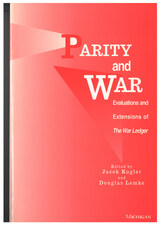
Parity and War
Evaluations and Extensions of The War Ledger
Jacek Kugler and Douglas Lemke, Editors
University of Michigan Press, 1996
Parity and War is an impressive explanation of why peace predominates in the international arena and why, on occasion, wars do start. Useful for college students and scholars alike, the work scrutinzes and tests ideas about power preponderance, first discussed over a decade ago in the widely acclaimed book The War Ledger. An alternative to traditional realism, power preponderence contends that peace is preserved when a preponderant nation supports the status quo. The theory convincingly accounts for war initiation, recovery, and peace by analyzing military arms buildups, alliances, territorial threats, economic cycles, and nuclear environment deterrence and proliferation. The contributors to this volume examine and analyze cases as diverse as the peaceful collapse of the Soviet Union, the presence of interstate war in South America in the last century and the absence thereof--despite domestic war--in this century, the economic and political consequences of the American Civil War, and the observation of long-term patterns of conflict and peace in international relations. Moreover, contributors to Parity and War utilize game theory, expected utility, and differential calculus techniques to model major war and to formalize the originally intuitive propositions of power preponderance. Their timely research shows that, in this era of nuclear weapons dominated by a single super power, effective regime guidance by the United States can insure peace for the next century.Contributors include Arina Arbetman, Bruce Bueno de Mesquita, Vesna Danilovic, Daniel S. Geller, Kenk W. Houweling, Kelly M. Kadera, Woosang Kim, Jacek Kugler, Douglas Lemke, Ross A. Miller, James D. Morrow, A. F. K. Organski, Jan G. Siccama, Randoph M. Siverson, Ronald Tammen, William R. Thompson, John A. Vasquez, Frank Whelon Wayman, Suzanne Werner, and Frank C. Zagare.
[more]
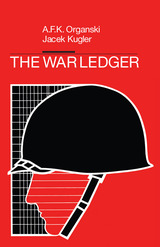
The War Ledger
A. F. K. Organski and Jacek Kugler
University of Chicago Press, 1980
The War Ledger provides fresh, sophisticated answers to fundamental questions about major modern wars: Why do major wars begin? What accounts for victory or defeat in war? How do victory and defeat influence the recovery of the combatants? Are the rules governing conflict behavior between nations the same since the advent of the nuclear era?
The authors find such well-known theories as the balance of power and collective security systems inadequate to explain how conflict erupts in the international system. Their rigorous empirical analysis proves that the power-transition theory, hinging on economic, social, and political growth, is more accurate; it is the differential rate of growth of the two most powerful nations in the system—the dominant nation and the challenger—that destabilizes all members and precipitates world wars.
Predictions of who will win or lose a war, the authors find, depend not only on the power potential of a nation but on the capability of its political systems to mobilize its resources—the "political capacity indicator." After examining the aftermath of major conflicts, the authors identify national growth as the determining factor in a nation's recovery. With victory, national capabilities may increase or decrease; with defeat, losses can be enormous. Unexpectedly, however, in less than two decades, losers make up for their losses and all combatants find themselves where they would have been had no war occurred.
Finally, the authors address the question of nuclear arsenals. They find that these arsenals do not make the difference that is usually assumed. Nuclear weapons have not changed the structure of power on which international politics rests. Nor does the behavior of participants in nuclear confrontation meet the expectations set out in deterrence theory.
The authors find such well-known theories as the balance of power and collective security systems inadequate to explain how conflict erupts in the international system. Their rigorous empirical analysis proves that the power-transition theory, hinging on economic, social, and political growth, is more accurate; it is the differential rate of growth of the two most powerful nations in the system—the dominant nation and the challenger—that destabilizes all members and precipitates world wars.
Predictions of who will win or lose a war, the authors find, depend not only on the power potential of a nation but on the capability of its political systems to mobilize its resources—the "political capacity indicator." After examining the aftermath of major conflicts, the authors identify national growth as the determining factor in a nation's recovery. With victory, national capabilities may increase or decrease; with defeat, losses can be enormous. Unexpectedly, however, in less than two decades, losers make up for their losses and all combatants find themselves where they would have been had no war occurred.
Finally, the authors address the question of nuclear arsenals. They find that these arsenals do not make the difference that is usually assumed. Nuclear weapons have not changed the structure of power on which international politics rests. Nor does the behavior of participants in nuclear confrontation meet the expectations set out in deterrence theory.
[more]
READERS
Browse our collection.
PUBLISHERS
See BiblioVault's publisher services.
STUDENT SERVICES
Files for college accessibility offices.
RECENTLY PUBLISHED







UChicago Accessibility Resources
home | accessibility | search | about | contact us
BiblioVault ® 2001 - 2026
The University of Chicago Press