
 A SCHOLARLY BOOK REPOSITORY
Results by Title
2 books about Language and sex
2 books about Language and sex
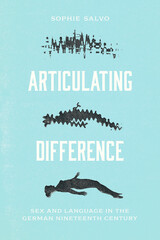
Articulating Difference
Sex and Language in the German Nineteenth Century
Sophie Salvo
University of Chicago Press, 2024
Enriches contemporary debates about gender and language by probing the histories of the philosophy and sciences of language.
Drawing on a wide range of texts, from understudied ethnographic and scientific works to canonical literature and philosophy, Sophie Salvo uncovers the prehistory of the inextricability of gender and language. Taking German discourses on language as her focus, she argues that we are not the inventors but, rather, the inheritors and adapters of the notion that gender and language are interrelated. Particularly during the long nineteenth century, ideas about sexual differences shaped how language was understood, classified, and analyzed. As Salvo explains, philosophers asserted the patriarchal origins of language, linguists investigated “women’s languages” and grammatical gender, and literary Modernists imagined “feminine” sign systems, and in doing so they not only deemed sex-based divisions to be necessary categories of language but also produced a plethora of gendered tropes and fictions, which they used both to support their claims and delimit their disciplines.
Articulating Difference charts new territory, revealing how gendered conceptions of language make possible the misogynistic logic of exclusion that underlies arguments claiming, for example, that women cannot be great orators or writers. While Salvo focuses on how male scholars aligned language study with masculinity, she also uncovers how women responded, highlighting the contributions of understudied nineteenth-century works on language that women wrote even as they were excluded from academic opportunities.
Drawing on a wide range of texts, from understudied ethnographic and scientific works to canonical literature and philosophy, Sophie Salvo uncovers the prehistory of the inextricability of gender and language. Taking German discourses on language as her focus, she argues that we are not the inventors but, rather, the inheritors and adapters of the notion that gender and language are interrelated. Particularly during the long nineteenth century, ideas about sexual differences shaped how language was understood, classified, and analyzed. As Salvo explains, philosophers asserted the patriarchal origins of language, linguists investigated “women’s languages” and grammatical gender, and literary Modernists imagined “feminine” sign systems, and in doing so they not only deemed sex-based divisions to be necessary categories of language but also produced a plethora of gendered tropes and fictions, which they used both to support their claims and delimit their disciplines.
Articulating Difference charts new territory, revealing how gendered conceptions of language make possible the misogynistic logic of exclusion that underlies arguments claiming, for example, that women cannot be great orators or writers. While Salvo focuses on how male scholars aligned language study with masculinity, she also uncovers how women responded, highlighting the contributions of understudied nineteenth-century works on language that women wrote even as they were excluded from academic opportunities.
[more]
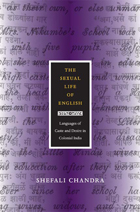
The Sexual Life of English
Languages of Caste and Desire in Colonial India
Shefali Chandra
Duke University Press, 2012
In The Sexual Life of English, Shefali Chandra examines how English became an Indian language. She rejects the idea that English was fully formed before its life in India or that it was imposed from without. Rather, by drawing attention to sexuality and power, Chandra argues that the English language was produced through conflicts over caste, religion, and class. Sentiments and experiences of desire, respectability, conjugality, status, consumption, and fashion came together to create the Indian history of English. The language was shaped by the sexual experiences of Indians and by native attempts to discipline the normative sexual subject. Focusing on the years between 1850 and 1930, Chandra scrutinizes the English-education project as Indians gained the power to direct it themselves. She delves into the history of schools, the composition of the student bodies, and disagreements about curricula; the way that English-educated subjects wrote about English; and debates in English and Marathi popular culture. Chandra shows how concerns over linguistic change were popularly voiced in a sexual idiom, how English and the vernacular were separated through the vocabulary of sexual difference, and how the demand for matrimony naturalized the social location of the English language.
[more]
READERS
Browse our collection.
PUBLISHERS
See BiblioVault's publisher services.
STUDENT SERVICES
Files for college accessibility offices.
RECENTLY PUBLISHED






UChicago Accessibility Resources
home | accessibility | search | about | contact us
BiblioVault ® 2001 - 2025
The University of Chicago Press