Gregory H. Williams
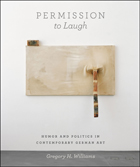
Permission to Laugh explores the work of three generations of German artists who, beginning in the 1960s, turned to jokes and wit in an effort to confront complex questions regarding German politics and history. Gregory H. Williams highlights six of them—Martin Kippenberger, Isa Genzken, Rosemarie Trockel, Albert Oehlen, Georg Herold, and Werner Büttner—who came of age in the mid-1970s in the art scenes of West Berlin, Cologne, and Hamburg. Williams argues that each employed a distinctive brand of humor that responded to the period of political apathy that followed a decade of intense political ferment in West Germany.
Situating these artists between the politically motivated art of 1960s West Germany and the trends that followed German unification in 1990, Williams describes how they no longer heeded calls for a brighter future, turning to jokes, anecdotes, and linguistic play in their work instead of overt political messages. He reveals that behind these practices is a profound loss of faith in the belief that art has the force to promulgate political change, and humor enabled artists to register this changed perspective while still supporting isolated instances of critical social commentary. Providing a much-needed examination of the development of postmodernism in Germany, Permission to Laugh will appeal to scholars, curators, and critics invested in modern and contemporary German art, as well as fans of these internationally renowned artists.