
 A SCHOLARLY BOOK REPOSITORY
Results by Title
4 books about Law and economic development
4 books about Law and economic development
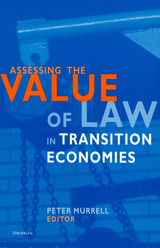
Assessing the Value of Law in Transition Economies
Peter Murrell, Editor
University of Michigan Press, 2001
Does law play a role in the economies that are moving from Soviet-style socialism to market capitalism? The essays in this book examine that question, providing a vivid picture of how the new institutions of capitalism affect the lives of business people, legal practitioners, investors, and bureaucrats. They analyze the determinants of successful institutional reform, suggesting that law can influence economic behavior even in inhospitable environments. Contributors--including economists, political scientists, and legal and business scholars--examine the pathways through which legal and institutional reforms affect behavior and identify the circumstances under which such reforms add value. They ask: What are the microeconomic mechanisms by which law contributes to the activities of economic agents? How do the characteristics of economic agents affect their ability to use the law? Which spheres of the economy are most affected by institutional reforms and where does law fail? What are the preconditions for effective legal and institutional reforms? Which types of political processes produce a workable system of economic legislation? The focus throughout is on the analysis of the individual economic agent who is subject to the new institutions, and thus the decisions of the individual actor, the shopkeeper, the lawyer, the court, the legislator-politician, the enterprise, the bureaucrat, the regulatory authority, and the outside investor. There are lessons on research methodology, on the economic role of institutions, and on the practice of institutional development. The focus is on the transition economies, but the conclusions and methodologies are pertinent when understanding the role of law in any context. The book will be important reading for scholars and practitioners with a wide range of interests and in a wide range of disciplines and of interest to all those concerned with economic, legal, and institutional development, economists, political scientists, lawyers, and development specialists alike.
[more]
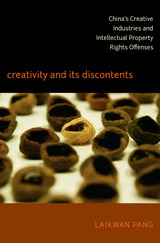
Creativity and Its Discontents
China's Creative Industries and Intellectual Property Rights Offenses
Laikwan Pang
Duke University Press, 2012
Creativity and Its Discontents is a sharp critique of the intellectual property rights (IPR)–based creative economy, particularly as it is embraced or ignored in China. Laikwan Pang argues that the creative economy—in which creativity is an individual asset to be commodified and protected as property—is an intensification of Western modernity and capitalism at odds with key aspects of Chinese culture. Nevertheless, globalization has compelled China to undertake endeavors involving intellectual property rights. Pang examines China’s IPR-compliant industries, as well as its numerous copyright violations. She describes how China promotes intellectual property rights in projects such as the development of cultural tourism in the World Heritage city of Lijiang, the transformation of Hong Kong cinema, and the cultural branding of Beijing. Meanwhile, copyright infringement proliferates, angering international trade organizations. Pang argues that piracy and counterfeiting embody the intimate connection between creativity and copying. She points to the lack of copyright protections for Japanese anime as the motor of China's dynamic anime culture. Theorizing the relationship between knockoffs and appropriation art, Pang offers an incisive interpretation of China’s flourishing art scene. Creativity and Its Discontents is a refreshing rejoinder to uncritical celebrations of the creative economy.
[more]
Global Prescriptions
The Production, Exportation, and Importation of a New Legal Orthodoxy
Yves Dezalay and Bryant G. Garth, Editors
University of Michigan Press, 2002
Global Prescriptions scrutinizes the movement to export a U.S.-oriented version of the " rule of law," found in the activities of philanthropic foundations, the World Bank, the U.S. Agency for International Development, and several other developmental organizations. Yves Dezalay and Bryant G. Garth have brought together a group of scholars from a variety of disciplines--anthropology, economics, history, law, political science, and sociology--to create tools for understanding this movement.
Comprised of two sections, the volume first develops theoretical perspectives key to an understanding of the production and impact of new "global legal prescriptions." The second part shifts attention to the national importation of these legal orthodoxies. The scholars provide a diverse set of sophisticated approaches, both to the circumstances promoting the production of these prescriptions and to the limitations of the prescriptions in the different national settings. Thus, Global Prescriptions provides a unique treatment for readers interested in globalization generally or the potential spread of the "rule of law" in particular.
This volume will intrigue scholars and students interested in a political science, economics, history, anthropology, law, and sociology.
Contributors are Jeremy Adelman, Robert Boyer, Elizabeth Heger Boyle, Miguel Angel Centeno, Heinz Klug, Larissa Adler Lomnitz, John W. Meyer, Setsuo Miyazawa, Hiroshi Otsuka, Rodrigo Salazar, Kathryn Sikkink, Anne-Marie Slaughter, and Catalina Smulovitz.
Yves Dezalay is Director of Research, National Center for Scientific Research, Paris. Bryant G. Garth is Director of the American Bar Foundation.
Comprised of two sections, the volume first develops theoretical perspectives key to an understanding of the production and impact of new "global legal prescriptions." The second part shifts attention to the national importation of these legal orthodoxies. The scholars provide a diverse set of sophisticated approaches, both to the circumstances promoting the production of these prescriptions and to the limitations of the prescriptions in the different national settings. Thus, Global Prescriptions provides a unique treatment for readers interested in globalization generally or the potential spread of the "rule of law" in particular.
This volume will intrigue scholars and students interested in a political science, economics, history, anthropology, law, and sociology.
Contributors are Jeremy Adelman, Robert Boyer, Elizabeth Heger Boyle, Miguel Angel Centeno, Heinz Klug, Larissa Adler Lomnitz, John W. Meyer, Setsuo Miyazawa, Hiroshi Otsuka, Rodrigo Salazar, Kathryn Sikkink, Anne-Marie Slaughter, and Catalina Smulovitz.
Yves Dezalay is Director of Research, National Center for Scientific Research, Paris. Bryant G. Garth is Director of the American Bar Foundation.
[more]

The Internationalization of Palace Wars
Lawyers, Economists, and the Contest to Transform Latin American States
Yves Dezalay and Bryant G. Garth
University of Chicago Press, 2002
How does globalization work? Focusing on Latin America, Yves Dezalay and Bryant G. Garth show that exports of expertise and ideals from the United States to Argentina, Brazil, Chile, and Mexico have played a crucial role in transforming their state forms and economies since World War II.
Based on more than 300 extensive interviews with major players in governments, foundations, law firms, universities, and think tanks, Dezalay and Garth examine both the production of northern exports such as neoliberal economics and international human rights law and the ways they are received south of the United States. They find that the content of what is exported and how it fares are profoundly shaped by domestic struggles for power and influence—"palace wars"—in the nations involved. For instance, challenges to the eastern intellectual establishment influenced the Reagan-era export of University of Chicago-style neoliberal economics to Chile, where it enjoyed a warm reception from Pinochet and his allies because they could use it to discredit the previous regime.
Innovative and sophisticated, The Internationalization of Palace Wars offers much needed concrete information about the transnational processes that shape our world.
Based on more than 300 extensive interviews with major players in governments, foundations, law firms, universities, and think tanks, Dezalay and Garth examine both the production of northern exports such as neoliberal economics and international human rights law and the ways they are received south of the United States. They find that the content of what is exported and how it fares are profoundly shaped by domestic struggles for power and influence—"palace wars"—in the nations involved. For instance, challenges to the eastern intellectual establishment influenced the Reagan-era export of University of Chicago-style neoliberal economics to Chile, where it enjoyed a warm reception from Pinochet and his allies because they could use it to discredit the previous regime.
Innovative and sophisticated, The Internationalization of Palace Wars offers much needed concrete information about the transnational processes that shape our world.
[more]
READERS
Browse our collection.
PUBLISHERS
See BiblioVault's publisher services.
STUDENT SERVICES
Files for college accessibility offices.
RECENTLY PUBLISHED




UChicago Accessibility Resources
home | accessibility | search | about | contact us
BiblioVault ® 2001 - 2025
The University of Chicago Press