
 A SCHOLARLY BOOK REPOSITORY
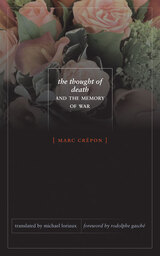
War lays bare death and our relation to it. And in the wars—or more precisely the memories of war—of the twentieth century, images of the deaths of countless faceless or nameless others eclipse the singularity of each victim’s death as well as the end of the world as such that each death signifies.
Marc Crépon’s The Thought of Death and the Memory of War is a call to resist such images in which death is no longer actual death since it happens to anonymous others, and to seek instead a world in which mourning the other whose mortality we always already share points us toward a cosmopolitics. Crépon pursues this path toward a cosmopolitics of mourning through readings of works by Freud, Heidegger, Sartre, Patocka, Levinas, Derrida, and Ricœur, and others. The movement among these writers, Crépon shows, marks a way through—and against—twentieth-century interpretation to argue that no war, genocide, or neglect of people is possible without suspending how one relates to the death of another human being.
A history of a critical strain in contemporary thought, this book is, as Rodolphe Gasché says in the Foreword, “a profound meditation on what constitutes evil and a rigorous and illuminating reflection on death, community, and world.”
The translation of this work received financial support from the French Ministry of Foreign Affairs.
READERS
Browse our collection.
PUBLISHERS
See BiblioVault's publisher services.
STUDENT SERVICES
Files for college accessibility offices.
RECENTLY PUBLISHED



UChicago Accessibility Resources
home | accessibility | search | about | contact us
BiblioVault ® 2001 - 2026
The University of Chicago Press