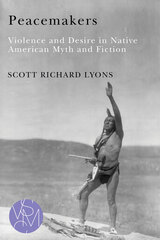
front cover of Peacemakers
Peacemakers
Violence and Desire in Native American Myth and Fiction
Scott Richard Lyons
Michigan State University Press, 2027

Employing the mimetic theory of René Girard as its heuristic, Peacemakers offers a unique analysis of Native American myth and fiction. It explores two important founding myths (Lac du Flambeau Ojibwe and Acoma Pueblo) and analyzes four modern novels: three from the Native American Renaissance of the 1960s and 1970s (N. Scott Momaday’s House Made of Dawn, James Welch’s Winter in the Blood, Leslie Marmon Silko’s Ceremony) and the fourth from the twenty-first century (Sherman Alexie’s Flight). While Native American literary criticism typically points to continuities across the traditional-modern divide, Scott Richard Lyons emphasizes a decisive break happening in the progressive era. Following Girard’s theory, Lyons finds that the Indigenous worlds of sacred tradition and secular modernity confront situations of mimetic desire and violence in significantly different ways, given their different cultural resources. Ultimately problems of violence and desire come down to questions of how people can live together peacefully with a sense of meaning and transcendence, questions that are more “religious” than “political.” Thus, the outlook of Peacemakers is more Shakespearian than Marxian.
[more]

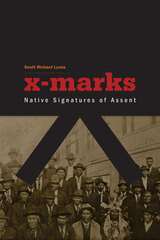
front cover of X-Marks
X-Marks
Native Signatures of Assent
Scott Richard Lyons
University of Minnesota Press, 2010
During the eighteenth and nineteenth centuries, North American Indian leaders commonly signed treaties with the European powers and the American and Canadian governments with an X, signifying their presence and assent to the terms. These x-marks indicated coercion (because the treaties were made under unfair conditions), resistance (because they were often met with protest), and acquiescence (to both a European modernity and the end of a particular moment of Indian history and identity).
 
In X-Marks, Scott Richard Lyons explores the complexity of contemporary Indian identity and current debates among Indians about traditionalism, nationalism, and tribalism. Employing the x-mark as a metaphor for what he calls the “Indian assent to the new,” Lyons offers a valuable alternative to both imperialist concepts of assimilation and nativist notions of resistance, calling into question the binary oppositions produced during the age of imperialism and maintaining that indigeneity is something that people do, not what they are. Drawing on his personal experiences and family history on the Leech Lake Ojibwe Reservation in northern Minnesota, discourses embedded in Ojibwemowin (the Ojibwe language), and disagreements about Indian identity within Native American studies, Lyons contends that Indians should be able to choose nontraditional ways of living, thinking, and being without fear of being condemned as inauthentic.
 
Arguing for a greater recognition of the diversity of Native America, X-Marks analyzes ongoing controversies about Indian identity, addresses the issue of culture and its use and misuse by essentialists, and considers the implications of the idea of an Indian nation. At once intellectually rigorous and deeply personal, X-Marks holds that indigenous peoples can operate in modern times while simultaneously honoring and defending their communities, practices, and values.
[more]


Send via email Share on Facebook Share on Twitter