
 A SCHOLARLY BOOK REPOSITORY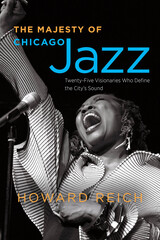
The first book to trace the vast influence of Chicago jazz from its origins to today—from Louis Armstrong and Jelly Roll Morton to Anita O’Day, Herbie Hancock, and the AACM.
Author and Chicago native Howard Reich gives readers a front-row seat to the history of Chicago jazz as it roared forth in jazz clubs, concert halls, and festivals. Reich covered Chicago jazz for more than thirty years as the Chicago Tribune’s staff critic, and in this collection, he argues that jazz as an art form is inconceivable without Chicago. Carefully choosing from among his thousands of articles on jazz, Reich highlights twenty-five of the most important Chicago jazz artists who pushed the art form forward.
The Majesty of Chicago Jazz begins with two New Orleans visionaries who achieved their artistic pinnacles in Chicago in the Roaring Twenties: Jelly Roll Morton and Louis Armstrong. In the decades that followed, Chicago produced an uninterrupted line of innovators: revolutionaries Ahmad Jamal and Sun Ra, iconoclasts Von Freeman and Fred Anderson, populists Herbie Hancock and Ramsey Lewis, chameleons Patricia Barber and Kurt Elling, and the breakthrough band of the Association for the Advancement of Creative Musicians (AACM), among others. Reich offers two pieces on each of the book’s twenty-five visionaries, including profiles, reviews, appreciations, and obituaries. The book concludes with a beginner-friendly discography, perfect for those looking to listen along.
The Majesty of Chicago Jazz is captivating for jazz newcomers and aficionados alike—all are guaranteed to learn something surprising here. With a musician’s ear and a journalist’s expertise, Reich offers listeners a valuable guide to the groundbreaking jazz that has come out of Chicago, a city that remains a fertile breeding ground for musical experimentation.
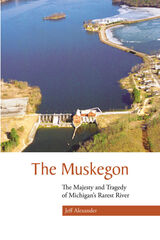
Muskegon is a derivation of a Native American word meaning "river with marshes." Jeff Alexander examines the creation, uses of, devastation, and restoration of Michigan's historic and beautiful Muskegon River.
Four of the five Great Lakes touch Michigan's shores; the state's shoreline spans more than 4,500 miles, not to mention more than 11,000 inland lakes and a multitude of rivers. The Muskegon River, the state's second longest river, runs 227 miles and has the most diverse features of any of Michigan’s many rivers. The Muskegon rises from the center of the state, widens, and moves westward, passing through the Pere Marquette and AuSable State Forests. The river ultimately flows toward Lake Michigan, where it opens into Muskegon Lake, a 12 square-mile, broad harbor located between the Muskegon River and Lake Michigan.
Formed several thousand years ago, when the glaciers that created the Great Lakes receded, and later inhabited by Ottawa and Potawatomi Indians, the Muskegon River was used by French fur trappers in the 1600s. Rich in white pine, the area was developed during the turn-of-the-century lumber boom, and at one time Muskegon Lake boasted more than 47 sawmills. The Muskegon was ravaged following settlement by Europeans, when rivers and streams were used to transport logs to the newly developing cities. Dams on rivers and larger streams provided power for sawmills and grain milling, and later provided energy for generating electricity as technology advanced.
There is now an ambitious effort to restore and protect this mighty river's natural features in the face of encroaching urbanization and land development that threatens to turn this majestic waterway into a mirror image of the Grand River, Michigan's longest river and one of its most polluted.
READERS
Browse our collection.
PUBLISHERS
See BiblioVault's publisher services.
STUDENT SERVICES
Files for college accessibility offices.
RECENTLY PUBLISHED




UChicago Accessibility Resources
home | accessibility | search | about | contact us
BiblioVault ® 2001 - 2026
The University of Chicago Press