
 A SCHOLARLY BOOK REPOSITORY
Across Continents employs Goan literary subjectivity as epistemology to critique a specific limitation of postcolonial thought, one that does not account for the situations or afterlife of Portuguese colonialism. Employing various novels, R. Benedito Ferrão considers the relationship between Portuguese and British colonialisms through the displacement of Goan characters across Asia, Africa, Europe, and North America, and in so doing, highlights the cultural, historical, and political linkages between these continents. The experiences of these figures in dealing with the processes of nation, statecraft, and political intrigue at various historical junctures offer a comparative understanding of the tumultuous conditions of postcoloniality in the making of marginalized subjectivity.
Examining the mobility and diversity of Goan experiences as represented in works by Salman Rushdie, M.G. Vassanji, Roger King, and Margaret Mascarenhas, this book calls into question limits of citizenship, nationality, and notions of belonging. Ferrão centers seemingly minor figures to exemplify the effects of colonial and postcolonial changes that connect diverse geopolities.
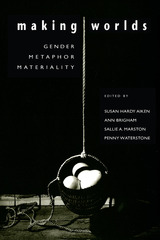
In recent years these questions have occasioned intensifying debates, but they have seldom extended beyond the boundaries of individual academic disciplines or crossed the divide that has traditionally separated the academy from the "outside" world. Making Worlds both questions and traverses those divisions by combining personal essays, activist political rhetoric, oral history, poetry, iconography, and performance art with interdisciplinary academic discourses.
Representing a wide range of perspectives, Making Worlds develops a provocative conversation about gender and spatiality in the interwoven symbolic and material environments we create. The contributors engage such issues as the body as site of symbolic action, fabrication, and desire; the place and play of sexualities; the cultural implications of everyday life—home, travel, work, childbirth, food, disease, and death; technology and mass media; surveillance, confinement, and the law; the dynamics of race and ethnicity; imperialism, oppression, and resistance; the politics of urban spaces; landscape and cultural memory; the experience of time; and the nature of "Nature." For students and scholars in cultural studies, geography, literary criticism, anthropology, history, and women's studies, it offers new ways of thinking about space, place, and the spatial contexts of social thought and action.
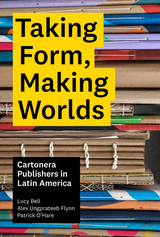
2023 LASA Visual Culture Studies Section Book Prize, Latin American Studies Association (LASA)
The first comprehensive study of cartonera, a vibrant publishing phenomenon born in Latin America.
A publishing phenomenon and artistic project, cartonera was born in the wake of Argentina’s 2001 economic crisis. Infused with a rebellious spirit, it has exploded in popularity, with hundreds of publishers across Latin America and Europe making colorful, low-cost books out of cardboard salvaged from the street. Taking Form, Making Worlds is the first comprehensive study of cartonera. Drawing on interdisciplinary research conducted across Mexico, Brazil, and Argentina, the authors show how this hands-on practice has fostered a politically engaged network of writers, artists, and readers. More than a social movement, cartonera uses texts, workshops, encounters, and exhibitions to foster community and engagement through open-ended forms that are at once artistic and social. For various groups including waste-pickers, Indigenous communities, rural children, and imprisoned women, cartonera provides a platform for unique stories and sparks collaborations that bring the walls of the “lettered city” tumbling down. In contexts of stigma and exclusion, cartonera collectives give form to a decolonial aesthetics of resistance, making possible a space of creative experimentation through which plural worlds can be brought to life.
READERS
Browse our collection.
PUBLISHERS
See BiblioVault's publisher services.
STUDENT SERVICES
Files for college accessibility offices.
RECENTLY PUBLISHED




UChicago Accessibility Resources
home | accessibility | search | about | contact us
BiblioVault ® 2001 - 2025
The University of Chicago Press