
 A SCHOLARLY BOOK REPOSITORY
35 start with A start with A
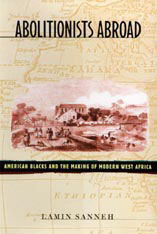
In 1792, nearly 1,200 freed American slaves crossed the Atlantic and established themselves in Freetown, West Africa, a community dedicated to anti-slavery and opposed to the African chieftain hierarchy that was tied to slavery. Thus began an unprecedented movement with critical long-term effects on the evolution of social, religious, and political institutions in modern Africa.
Lamin Sanneh's engrossing book narrates the story of freed slaves who led efforts to abolish the slave trade by attacking its base operation: the capture and sale of people by African chiefs. Sanneh's protagonists set out to establish in West Africa colonies founded on equal rights and opportunity for personal enterprise, communities that would be havens for ex-slaves and an example to the rest of Africa. Among the most striking of these leaders is the Nigerian Samuel Ajayi Crowther, a recaptured slave who joined a colony in Sierra Leone and subsequently established satellite communities in Nigeria. The ex-slave repatriates brought with them an evangelical Christianity that encouraged individual spirituality--a revolutionary vision in a land where European missionaries had long assumed they could Christianize the whole society by converting chiefs and rulers.
Tracking this potent African American anti-slavery and democratizing movement through the nineteenth century, Lamin Sanneh draws a clear picture of the religious grounding of its conflict with the traditional chieftain authorities. His study recounts a crucial development in the history of West Africa.
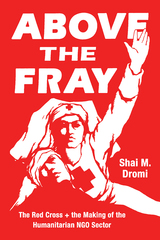
Drawing on archival research, Dromi traces the genesis of the Red Cross to a Calvinist movement working in mid-nineteenth-century Geneva. He shows how global humanitarian policies emerged from the Red Cross founding members’ faith that an international volunteer program not beholden to the state was the only ethical way to provide relief to victims of armed conflict. By illustrating how Calvinism shaped the humanitarian field, Dromi argues for the key role belief systems play in establishing social fields and institutions. Ultimately, Dromi shows the immeasurable social good that NGOs have achieved, but also points to their limitations and suggests that alternative models of humanitarian relief need to be considered.
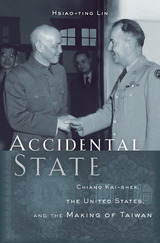
The existence of two Chinese states—one controlling mainland China, the other controlling the island of Taiwan—is often understood as a seemingly inevitable outcome of the Chinese civil war. Defeated by Mao Zedong, Chiang Kai-shek’s Nationalists fled to Taiwan to establish a rival state, thereby creating the “Two Chinas” dilemma that vexes international diplomacy to this day. Accidental State challenges this conventional narrative to offer a new perspective on the founding of modern Taiwan.
Hsiao-ting Lin marshals extensive research in recently declassified archives to show that the creation of a Taiwanese state in the early 1950s owed more to serendipity than careful geostrategic planning. It was the cumulative outcome of ad hoc half-measures and imperfect compromises, particularly when it came to the Nationalists’ often contentious relationship with the United States.
Taiwan’s political status was fraught from the start. The island had been formally ceded to Japan after the First Sino-Japanese War, and during World War II the Allies promised Chiang that Taiwan would revert to Chinese rule after Japan’s defeat. But as the Chinese civil war turned against the Nationalists, U.S. policymakers reassessed the wisdom of backing Chiang. The idea of placing Taiwan under United Nations trusteeship gained traction. Cold War realities, and the fear of Taiwan falling into Communist hands, led Washington to recalibrate U.S. policy. Yet American support of a Taiwan-based Republic of China remained ambivalent, and Taiwan had to eke out a place for itself in international affairs as a de facto, if not fully sovereign, state.
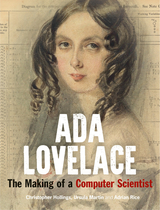
Although it was an unusual pursuit for women at the time, Ada Lovelace studied science and mathematics from a young age. This book uses previously unpublished archival material to explore her precocious childhood—from her curiosity about the science of rainbows to her design for a steam-powered flying horse—as well as her ambitious young adulthood. Active in Victorian London’s social and scientific elite alongside Mary Somerville, Michael Faraday, and Charles Dickens, Ada Lovelace became fascinated by the computing machines of Charles Babbage, whose ambitious, unbuilt invention known as the “Analytical Engine” inspired Lovelace to devise a table of mathematical formulae which many now refer to as the “first program.”
Ada Lovelace died at just thirty-six, but her work strikes a chord to this day, offering clear explanations of the principles of computing, and exploring ideas about computer music and artificial intelligence that have been realized in modern digital computers. Featuring detailed illustrations of the “first program” alongside mathematical models, correspondence, and contemporary images, this book shows how Ada Lovelace, with astonishing prescience, first investigated the key mathematical questions behind the principles of modern computing.
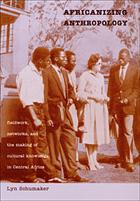
Schumaker shows how local conditions and local ideas about culture and history, as well as previous experience of outsiders’ interest, shape local people’s responses to anthropological fieldwork and help them, in turn, to influence the construction of knowledge about their societies and lives. Bringing to the fore a wide range of actors—missionaries, administrators, settlers, the families of anthropologists—Schumaker emphasizes the daily practices of researchers, demonstrating how these are as centrally implicated in the making of anthropological knowlege as the discipline’s methods. Selecting a prominent group of anthropologists—The Manchester School—she reveals how they achieved the advances in theory and method that made them famous in the 1950s and 1960s.
This book makes important contributions to anthropology, African history, and the history of science.
"Where do nationalists go once they get what they want? We know rather little about how nationalist movements transform themselves into the governments of new states, or how they can become opponents of new regimes that, in their view, have not taken the self-determination drive far enough. This stellar collection contributes not only to comparative theorizing on nationalist movements, but also deepens our understanding of the contentious politics of nationalism's ultimate product--new countries."
--Charles King, Chair of the Faculty and Ion Ratiu Associate Professor, Georgetown University School of Foreign Service
"This well-integrated volume analyzes two important variants of nationalism-postcolonial and postcommunist-in a sober, lucid way and will benefit students and scholars alike."
--Zvi Gitelman, University of Michigan
Lowell W. Barrington is Associate Professor of Political Science, Marquette University.
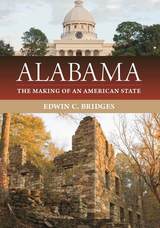
Alabama: The Making of an American State is itself a watershed event in the long and storied history of the state of Alabama. Here, presented for the first time ever in a single, magnificently illustrated volume, Edwin C. Bridges conveys the magisterial sweep of Alabama’s rich, difficult, and remarkable history with verve, eloquence, and an unblinking eye.
From Alabama’s earliest fossil records to its settlement by Native Americans and later by European settlers and African slaves, from its territorial birth pangs and statehood through the upheavals of the Civil War and the civil rights movement, Bridges makes evident in clear, direct storytelling the unique social, political, economic, and cultural forces that have indelibly shaped this historically rich and unique American region.
Illustrated lavishly with maps, archival photographs, and archaeological artifacts, as well as art works, portraiture, and specimens of Alabama craftsmanship—many never before published—Alabama: The Making of an American State makes evident as rarely seen before Alabama’s most significant struggles, conflicts, achievements, and developments.
Drawn from decades of research and the deep archival holdings of the Alabama Department of Archives and History, this volume will be the definitive resource for decades to come for anyone seeking a broad understanding of Alabama’s evolving legacy.

Alexander Williamson was a leading scientist and professor of chemistry at University College London in the late nineteenth century. He taught and cared for visiting Japanese students, assisting them with their goal of modernizing Japan. This short, accessible biography explores his contribution to nineteenth-century science, as well as his lasting impact on Japanese society. In 1863 five students from the Chōshū clan, with a desperate desire to learn from the West, made their way to England. They were put in the care of Williamson and his wife. Their mission was to learn about cutting-edge Western technology, science, economics, and politics. When they returned home, they rapidly became leading figures in Japanese life. The remarkable story of the part Williamson and University College London played in the modernization of Japan is little known today. This biography will promote a deeper understanding of Williamson’s scientific innovations and his legacy for Anglo-Japanese relations.

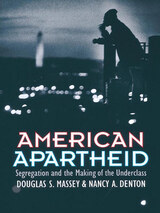
This powerful and disturbing book clearly links persistent poverty among blacks in the United States to the unparalleled degree of deliberate segregation they experience in American cities.
American Apartheid shows how the black ghetto was created by whites during the first half of the twentieth century in order to isolate growing urban black populations. It goes on to show that, despite the Fair Housing Act of 1968, segregation is perpetuated today through an interlocking set of individual actions, institutional practices, and governmental policies. In some urban areas the degree of black segregation is so intense and occurs in so many dimensions simultaneously that it amounts to "hypersegregation."
The authors demonstrate that this systematic segregation of African Americans leads inexorably to the creation of underclass communities during periods of economic downturn. Under conditions of extreme segregation, any increase in the overall rate of black poverty yields a marked increase in the geographic concentration of indigence and the deterioration of social and economic conditions in black communities. As ghetto residents adapt to this increasingly harsh environment under a climate of racial isolation, they evolve attitudes, behaviors, and practices that further marginalize their neighborhoods and undermine their chances of success in mainstream American society. This book is a sober challenge to those who argue that race is of declining significance in the United States today.
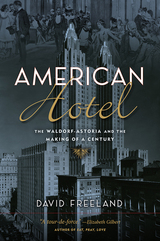
American Hotel takes us behind the glittering image to reveal the full extent of the Waldorf’s contribution toward shaping twentieth-century life and culture. Historian David Freeland examines the Waldorf from the opening of its first location in 1893 through its rise to a place of influence on the local, national, and international stage. Along the way, he explores how the hotel’s mission to provide hospitality to a diverse range of guests was put to the test by events such as Prohibition, the anticommunist Red Scare, and civil rights struggles.
Alongside famous guests like Frank Sinatra, Martin Luther King, Richard Nixon, and Eleanor Roosevelt, readers will meet the lesser-known men and women who made the Waldorf a leader in the hotel industry and a key setting for international events. American Hotel chronicles how institutions such as the Waldorf-Astoria played an essential role in New York’s growth as a world capital.
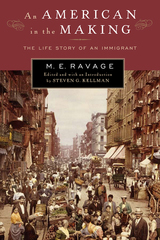
Steven G. Kellman brings Ravage's story to life again in this new edition, providing a brief biography and introduction that place the memoir within historical and literary contexts. An American in the Making contributes to a broader understanding of the global notion of "America" and remains timely, especially in an era when massive immigration, now from Latin America and Asia, challenges ideas of national identity.

In 1973, not long after the last American combat troops returned from Vietnam, President Nixon fulfilled his campaign promise and ended the draft. No longer would young men find their futures determined by the selective service system; nor would the U.S. military have a guaranteed source of recruits.
America’s Army is the story of the all-volunteer force, from the draft protests and policy proposals of the 1960s through the Iraq War. It is also a history of America in the post-Vietnam era. In the Army, America directly confronted the legacies of civil rights and black power, the women’s movement, and gay rights. The volunteer force raised questions about the meaning of citizenship and the rights and obligations it carries; about whether liberty or equality is the more central American value; what role the military should play in American society not only in time of war, but in time of peace. And as the Army tried to create a volunteer force that could respond effectively to complex international situations, it had to compete with other “employers” in a national labor market and sell military service alongside soap and soft drinks.
Based on exhaustive archival research, as well as interviews with Army officers and recruiters, advertising executives, and policy makers, America’s Army confronts the political, moral, and social issues a volunteer force raises for a democratic society as well as for the defense of our nation.
For most Americans, the Revolution’s main achievement is summed up by the phrase “life, liberty, and the pursuit of happiness.” Yet far from a straightforward attempt to be free of Old World laws and customs, the American founding was also a bid for inclusion in the community of nations as it existed in 1776. America aspired to diplomatic recognition under international law and the authority to become a colonizing power itself.
As Eliga Gould shows in this reappraisal of American history, the Revolution was an international transformation of the first importance. To conform to the public law of Europe’s imperial powers, Americans crafted a union nearly as centralized as the one they had overthrown, endured taxes heavier than any they had faced as British colonists, and remained entangled with European Atlantic empires long after the Revolution ended.
No factor weighed more heavily on Americans than the legally plural Atlantic where they hoped to build their empire. Gould follows the region’s transfiguration from a fluid periphery with its own rules and norms to a place where people of all descriptions were expected to abide by the laws of Western Europe—“civilized” laws that precluded neither slavery nor the dispossession of Native Americans.
DeJean brilliantly reassesses our current culture wars from the perspective of that earlier fin de siècle (the first to think of itself as such), and rereads the seventeenth-century Quarrel from the vantage of our own warring "ancients" and "moderns." In so doing, DeJean shows that a fin de siècle taking place in the shadow of culture wars can be more a source of constructive cultural revolution than of apocalyptic gloom and doom. Just as the first fin de siècle's battle of the books served as the spark that set off the Enlightenment, introducing radically new sexual and social politics that laid the groundwork for modernity, so can our current culture wars result in radical, liberating changes—if we take an active stand against our own "ancients" who seek to stifle such reforms.
Winner, Frederick Jackson Turner Award, Organization Of American Historians, 1988
American Historical Association, Pacific Branch Book Award, 1989
Texas Institute of Letters Friends Of The Dallas Public Library Award, 1987
Texas Historical Commission T. R. Fehrenbach Award, Best Ethnic, Minority, And Women's History Publication, 1987



The Constitution of the United States is the product of a revolution in political thought as momentous as the winning of American independence. This profusely illustrated volume is a magnificent tribute to the oldest surviving charter of a federal republic. In a felicitous blend of words and pictures, Richard B. Bernstein retells the entire story of this revolution: the problems under the Articles of Confederation; the intense, often vituperative debate between Americans and Europeans over the brave new republican experiment; the arguing, reasoning, and reconciliation of interests before, during, and after the Federal Convention in 1787; the often bitter struggle for ratification in the thirteen states and the critical importance of The Federalist in the accompanying propaganda war; the beginnings of government under the Constitution; and the states' adoption of the Bill of Rights.
The delegates to the Federal Convention were the foremost men of their states and regions—bookish but not reclusive, activist but not undisciplined, principled but not rigid. Bernstein's colorful description of the intellectual and political ferment they first created and then controlled brings to life their heroic effort. Along with these lost chapters of our history, he shows how experiments in government were a critical part of Americans' attempts to define their identity as a nation and a people.
The Constitution was the result of no miracle; the outcome was never foreordained. A blend of theory and practicality, it was to be understood by all, not just by experts, and was no talisman against evils or unyielding to new experiences. As it bound up the founding generation, it was to be a guide to their successors. Illuminating his discussion—and our understanding—of the Constitution is a huge array of rare, in some cases unique, documents assembled by The New York Public Library for its exhibition commemorating the bicentennial of the Constitution.
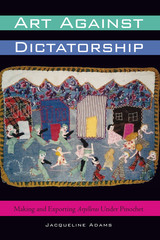
Art can be a powerful avenue of resistance to oppressive governments. During the dictatorship of Augusto Pinochet in Chile, some of the country’s least powerful citizens—impoverished women living in Santiago’s shantytowns—spotlighted the government’s failings and use of violence by creating and selling arpilleras, appliquéd pictures in cloth that portrayed the unemployment, poverty, and repression that they endured, their work to make ends meet, and their varied forms of protest. Smuggled out of Chile by human rights organizations, the arpilleras raised international awareness of the Pinochet regime’s abuses while providing income for the arpillera makers and creating a network of solidarity between the people of Chile and sympathizers throughout the world.
Using the Chilean arpilleras as a case study, this book explores how dissident art can be produced under dictatorship, when freedom of expression is absent and repression rife, and the consequences of its production for the resistance and for the artists. Taking a sociological approach based on interviews, participant observation, archival research, and analysis of a visual database, Jacqueline Adams examines the emergence of the arpilleras and then traces their journey from the workshops and homes in which they were made, to the human rights organizations that exported them, and on to sellers and buyers abroad, as well as in Chile. She then presents the perspectives of the arpillera makers and human rights organization staff, who discuss how the arpilleras strengthened the resistance and empowered the women who made them.
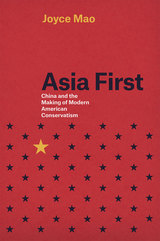
Mao explores the deep resonance American conservatives felt with the defeat of Chiang Kai-Shek and his exile to Taiwan, which they lamented as the loss of China to communism and the corrosion of traditional values. In response, they fomented aggressive anti-communist positions that urged greater action in the Pacific, a policy known as “Asia First.” While this policy would do nothing to oust the communists from China, it was powerfully effective at home. Asia First provided American conservatives a set of ideals—American sovereignty, selective military intervention, strident anti-communism, and the promotion of a technological defense state—that would bring them into the global era with the positions that are now their hallmark.
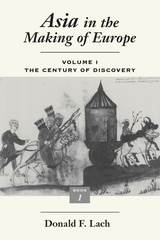
Volume I: The Century of Discovery brings together "everything that a European could know of India, Southeast Asia, China, and Japan, from printed books, missionary reports, traders' accounts and maps" (The New York Review of Books). Volume II: A Century of Wonder examines the influence of that vast new body of information about Asia on the arts, institutions, literatures, and ideas of sixteenth-century Europe.
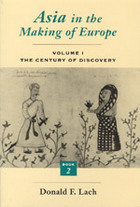
Volume I: The Century of Discovery brings together "everything that a European could know of India, Southeast Asia, China, and Japan, from printed books, missionary reports, traders' accounts and maps" (The New York Review of Books). Volume II: A Century of Wonder examines the influence of that vast new body of information about Asia on the arts, institutions, literatures, and ideas of sixteenth-century Europe.
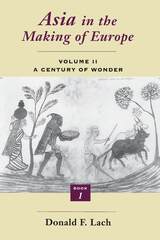
The rise to world dominance of the Western nations in modern times and the rapid industrial growth of the West, which outpaced the East in technical and military achievements, have led to a historical eclipse of the ancient and brilliant cultures of Asia.
Historican Donald F. Lach, in his influential scholarly work, Asia in the Making of Europe, points out that an eclipse is never permanent, that this one was never total, and that there was a period in early modern times when Asia and Europe were close rivals in brilliance and mutual influence.
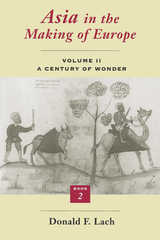
Volume I: The Century of Discovery brings together "everything that a European could know of India, Southeast Asia, China, and Japan, from printed books, missionary reports, traders' accounts and maps" (The New York Review of Books). Volume II: A Century of Wonder examines the influence of that vast new body of information about Asia on the arts, institutions, literatures, and ideas of sixteenth-century Europe.
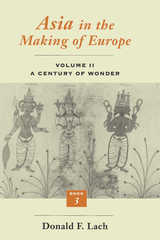
Volume I: The Century of Discovery brings together "everything that a European could know of India, Southeast Asia, China, and Japan, from printed books, missionary reports, traders' accounts and maps" (The New York Review of Books). Volume II: A Century of Wonder examines the influence of that vast new body of information about Asia on the arts, institutions, literatures, and ideas of sixteenth-century Europe.
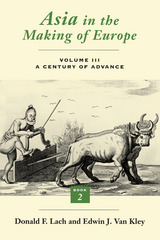
In Volume III: A Century of Advance, the authors have researched seventeenth-century European writings on Asia in an effort to understand how contemporaries saw Asian societies and peoples.
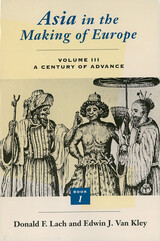
In Volume III: A Century of Advance, the authors have researched seventeenth-century European writings on Asia in an effort to understand how contemporaries saw Asian societies and peoples.
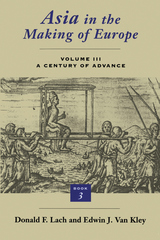
In Volume III: A Century of Advance, the authors have researched seventeenth-century European writings on Asia in an effort to understand how contemporaries saw Asian societies and peoples.
Book 3: Southeast Asia examines European images of the lands, societies, religions, and cultures of Southeast Asia. The continental nations of Siam, Vietnam, Malaya, Pegu, Arakan, Cambodia, and Laos are discussed, as are the islands of Java, Bali, Sumatra, Borneo, Amboina, the Moluccas, the Bandas, Celebes, the Lesser Sundas, New Guinea, Australia, New Zealand, the Philippines, Mindanao, Jolo, Guam, and the Marianas.
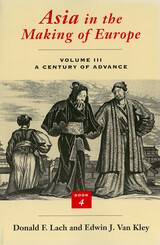
In Volume III: A Century of Advance, the authors have researched seventeenth-century European writings on Asia in an effort to understand how contemporaries saw Asian societies and peoples.

In Volume III: A Century of Advance, the authors have researched seventeenth-century European writings on Asia in an effort to understand how contemporaries saw Asian societies and peoples.
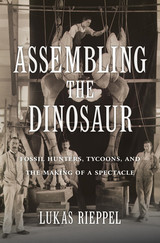
A lively account of how dinosaurs became a symbol of American power and prosperity and gripped the popular imagination during the Gilded Age, when their fossil remains were collected and displayed in museums financed by North America’s wealthiest business tycoons.
Although dinosaur fossils were first found in England, a series of dramatic discoveries during the late 1800s turned North America into a world center for vertebrate paleontology. At the same time, the United States emerged as the world’s largest industrial economy, and creatures like Tyrannosaurus, Brontosaurus, and Triceratops became emblems of American capitalism. Large, fierce, and spectacular, American dinosaurs dominated the popular imagination, making front-page headlines and appearing in feature films.
Assembling the Dinosaur follows dinosaur fossils from the field to the museum and into the commercial culture of North America’s Gilded Age. Business tycoons like Andrew Carnegie and J. P. Morgan made common cause with vertebrate paleontologists to capitalize on the widespread appeal of dinosaurs, using them to project American exceptionalism back into prehistory. Learning from the show-stopping techniques of P. T. Barnum, museums exhibited dinosaurs to attract, entertain, and educate the public. By assembling the skeletons of dinosaurs into eye-catching displays, wealthy industrialists sought to cement their own reputations as generous benefactors of science, showing that modern capitalism could produce public goods in addition to profits. Behind the scenes, museums adopted corporate management practices to control the movement of dinosaur bones, restricting their circulation to influence their meaning and value in popular culture.
Tracing the entwined relationship of dinosaurs, capitalism, and culture during the Gilded Age, Lukas Rieppel reveals the outsized role these giant reptiles played during one of the most consequential periods in American history.
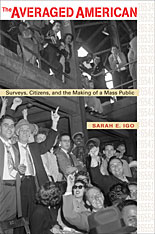
Americans today “know” that a majority of the population supports the death penalty, that half of all marriages end in divorce, and that four out of five prefer a particular brand of toothpaste. Through statistics like these, we feel that we understand our fellow citizens. But remarkably, such data—now woven into our social fabric—became common currency only in the last century. Sarah Igo tells the story, for the first time, of how opinion polls, man-in-the-street interviews, sex surveys, community studies, and consumer research transformed the United States public.
Igo argues that modern surveys, from the Middletown studies to the Gallup Poll and the Kinsey Reports, projected new visions of the nation: authoritative accounts of majorities and minorities, the mainstream and the marginal. They also infiltrated the lives of those who opened their doors to pollsters, or measured their habits and beliefs against statistics culled from strangers. Survey data underwrote categories as abstract as “the average American” and as intimate as the sexual self.
With a bold and sophisticated analysis, Igo demonstrates the power of scientific surveys to shape Americans’ sense of themselves as individuals, members of communities, and citizens of a nation. Tracing how ordinary people argued about and adapted to a public awash in aggregate data, she reveals how survey techniques and findings became the vocabulary of mass society—and essential to understanding who we, as modern Americans, think we are.
READERS
Browse our collection.
PUBLISHERS
See BiblioVault's publisher services.
STUDENT SERVICES
Files for college accessibility offices.
RECENTLY PUBLISHED


UChicago Accessibility Resources
home | accessibility | search | about | contact us
BiblioVault ® 2001 - 2024
The University of Chicago Press