
front cover of The Christian Philosophy of Jacques Maritain
The Christian Philosophy of Jacques Maritain
Jason L.A. West
Catholic University of America Press, 2025
A study of the Christian philosophy of Jacques Maritain (1882-1973), an influential, creative, and prolific writer. He was widely recognized as one of the most prominent Catholic intellectuals during his own lifetime and was widely seen as a spokesman for the Thomistic revival. This study aims to present Maritain’s thought as a dynamic and coherent philosophy in its own right. This is the only book in English to present Maritain’s philosophy on the full range of topics upon which he wrote. It focusses on Maritain as a twentieth-century philosopher, rather than an interpreter of Aquinas. Accordingly, this book presents Maritain’s philosophy in its own context. Finally, this work is also attentive to the religious context of Maritain’s philosophy and highlights his overlooked contributions to theology and other areas of philosophy that are informed by his theological commitments, e.g. mysticism, ecclesiology, education and philosophy of history. Accordingly, The Christian Philosophy of Jacques Maritain aims at providing the reader with a comprehensive presentation of Maritain’s thought and a clear vision of his philosophy as a whole.
[more]

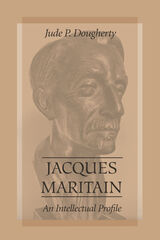
front cover of Jacques Maritain
Jacques Maritain
An Intellectual Profile
Jude P. Dougherty
Catholic University of America Press, 2003
In Jacques Maritain: An Intellectual Profile, Jude P. Dougherty shares his lifetime interest in and study of Maritain with readers. He offers the most complete introduction to Maritain yet to be published, highlighting Maritain's many contributions to philosophy.
[more]

front cover of Man and the State
Man and the State
Jacques Maritain
Catholic University of America Press, 1998

logo for St. Augustine's Press
Natural Law
Reflections On Theory & Practice
Jacques Maritain
St. Augustine's Press, 2001

Can there be universal moral principles in a culturally and religiously diverse world? Are such principles provided by a theory of natural law? Jacques' response to both questions is "yes".

These essays, selected from the writings of one of the most influential philosophers of the past hundred years, provide a clear statement of Maritain's theory of natural law and natural rights. Maritain's ethics and political philosophy occupies a middle ground between the extremes of individualism and collectivism. Written during a period when cultural diversity and pluralism were beginning to have an impact on ethics and politics, these essays provide a defense of natural law and natural right that continues to be timely.

The first essay introduces Maritain's theory of connatural knowledge -- knowledge by inclination -- that lies at the basis of his distinctive views on moral philosophy, aesthetics, and mystical belief. The second essay gives Maritain's principal metaphysical arguments for natural law as well as his account of how that law can be naturally known and universally held.

The third essay in this collection explains the roots of the natural law and shows how it provides a rational foundation for other kinds of law and for human rights. In the fourth essay, reflecting his personalism and integral humanism, Maritain indicates how he extends his understanding of human rights to include the rights of the civic and of the social or working person.

[more]

logo for University of Scranton Press
Passion of Israel
Jacques Maritain, Catholic Conscience, and the Holocaust
Richard Francis Crane
University of Scranton Press, 2010

In his lifetime, French philosopher Jacques Maritain (1882–1973) achieved a reputation as both a leading Catholic intellectual and as an outspoken critic of antisemitism. Here historian Richard Francis Crane traces the development of Maritain’s opposition toward antisemitism and analyzes the Catholic appreciation of Judaism that animated his stance. Crane probes the writings and teachings of Maritain—from before, during, and after the Holocaust—and illuminates how his ideas altered Christian perceptions of Jews and Judaism during his lifetime and continue to do so today.
[more]

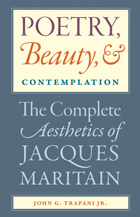
front cover of Poetry, Beauty, and Contemplation
Poetry, Beauty, and Contemplation
The Complete Aesthetics of Jacques Maritain
John G. Trapani Jr.
Catholic University of America Press, 2011
Poetry, Beauty, and Contemplation provides a basic introduction to, and an extensive examination of, Maritain's philosophy of art and beauty
[more]

logo for Catholic University of America Press
Truth Matters
Essays in Honor of Jacques Maritain (American Maritain Association Publications)
John G. Trapani Jr.
Catholic University of America Press, 2004

front cover of The Vision of the Soul
The Vision of the Soul
James Matthew Wilson
Catholic University of America Press, 2017
Ours is an age full of desires but impoverished in its understanding of where those desires lead—an age that claims mastery over the world but also claims to find the world as a whole absurd or unintelligible. In The Vision of the Soul, James Matthew Wilson seeks to conserve the great insights of the western tradition by giving us a new account of them responsive to modern discontents. The western— or Christian Platonist—tradition, he argues, tells us that man is an intellectual animal, born to pursue the good, to know the true, and to contemplate all things in beauty. Wilson begins by reconceiving the intellectual conservatism born of Edmund Burke’s jeremiad against the French Revolution as an eff­ort to preserve the West’s vision of man and the cosmos as ordered by and to beauty. After defining the achievement of that vision and its tradition, Wilson off­ers an extended study of the nature of beauty and the role of the fine arts in shaping a culture but above all in opening the human intellect to the perception of the form of reality. Through close studies of Theodor W. Adorno and Jacques Maritain, he recovers the classical vision of beauty as a revelation of truth and being. Finally, he revisits the ancient distinction between reason and story-telling, between mythos and logos, in order to rejoin the two.

Story-telling is foundational to the forms of the fine arts, but it is no less foundational to human reason. Human life in turn constitutes a specific kind of form—a story form. The ancient conception of human life as a pilgrimage to beauty itself is one that we can fully embrace only if we see the essential correlation between reason and story and the essential convertibility of truth, goodness and beauty in beauty. By turns a study in fundamental ontology, aesthetics, and political philosophy, Wilson’s book invites its readers to a renewal of the West’s intellectual tradition.
[more]


Send via email Share on Facebook Share on Twitter