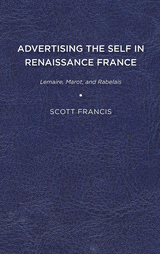
front cover of Advertising the Self in Renaissance France
Advertising the Self in Renaissance France
Lemaire, Marot, and Rabelais
Scott Francis
University of Delaware Press, 2019
Advertising the Self in Renaissance France is a study of how authors and readers are represented in printed editions of three major literary figures of the French Renaissance: Jean Lemaire de Belges, Clément Marot, and François Rabelais. Print culture is marked by an anxiety of reception that became much more pronounced with increasingly anonymous and unpredictable readerships in the sixteenth century. To allay this anxiety, authors, as well as editors and printers, turned to self-fashioning in order to sell not only their books, but also particular ways of reading. They advertised correct modes of reading as transformative experiences that helped the actual reader attain the image of the ideal reader held up by the text and paratext, experiences provided by selfless authors. Thus, authorial personae were constructed around the self-fashioning offered to readers, creating an interdependent relationship that anticipated modern advertising.

Published by University of Delaware Press. Distributed worldwide by Rutgers University Press.
 
[more]

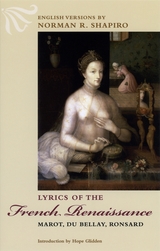
front cover of Lyrics of the French Renaissance
Lyrics of the French Renaissance
Marot, Du Bellay, Ronsard
Edited by Norman R. Shapiro
University of Chicago Press, 2006
Renowned translator Norman R. Shapiro here presents fresh English versions of poems by three of Western literature’s most gifted and prolific poets—the French Renaissance writers Clément Marot, Joachim Du Bellay, and Pierre de Ronsard.  Writing in the rhymed and metered verse typical of the original French poems (which appear on facing pages), Shapiro skillfully adheres to their messages but avoids slavishly literal translations, instead offering creative and spirited equivalents. 

Hope Glidden’s accessible introduction, along with the notes she and Shapiro provide on specific poems, will increase readers’ enjoyment and illuminate the historical and linguistic issues relating to this wealth of more than 150 lyric poems. 

“A marvelous micro-anthology of sixteenth-century French letters. Representing the pinnacle of French Renaissance verse, the poems singled out here are sensitively interpreted in rhymed English versions. . . . There is a pleasant and inspiring craftsmanship in these interpretations.”—Virginia Quarterly Review

[more]


Send via email Share on Facebook Share on Twitter