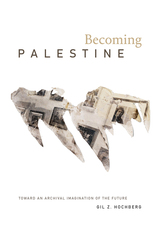
front cover of Becoming Palestine
Becoming Palestine
Toward an Archival Imagination of the Future
Gil Z. Hochberg
Duke University Press, 2021
In Becoming Palestine, Gil Z. Hochberg examines how contemporary Palestinian artists, filmmakers, dancers, and activists use the archive in order to radically imagine Palestine's future. She shows how artists such as Jumana Manna, Kamal Aljafari, Larissa Sansour, Farah Saleh, Basel Abbas, and Ruanne Abou-Rahme reimagine the archive, approaching it not through the desire to unearth hidden knowledge, but to sever the identification of the archive with the past. In their use of archaeology, musical traditions, and archival film and cinematic footage, these artists imagine a Palestinian future unbounded from colonial space and time. By urging readers to think about archives as a break from history rather than as history's repository, Hochberg presents a fundamental reconceptualization of the archive's liberatory potential.
[more]

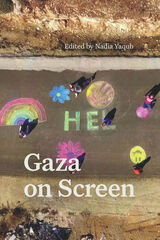
front cover of Gaza on Screen
Gaza on Screen
Nadia Yaqub, editor
Duke University Press, 2023
Gaza’s long association with resistance and humanitarian need has generated a complex and ever shifting range of visual material, comprising not just news reports and documentaries, but also essay, experimental, and fiction films, militant videos, and solidarity images. Contributors to Gaza on Screen, who include scholars and Gazan filmmakers, explore the practice, production, and impact of film and videos from and about the Gaza Strip. Conceptualizing screens—both large and small—as tools for mediation that are laden with power, the volume explores Gazan film and video in relation to humanitarianism and human rights, care, community, environment, mobility and confinement, and decolonization. The volume includes visual material ranging from solidarity broadcasts on Lebanese television, mid-twentieth-century British Pathé newsreels, and fiction films to breaking news, visuals of contemporary militant resistance, documentaries, and found footage films, arguing for a visual ecosystem in which differing types of film and video affect and inform each other. Throughout, Gaza on Screen demonstrates that screens shape and sustain relationships between Gaza and the world, and help to sustain the possibility of a different future.

Contributors. Nayrouz Abu Hatoum, Shahd Abusalama, Samirah Alkassim, Basma Alsharif, Hadeel Assali, Azza El-Hassan, Hatim El-Hibri, Mohamed Jabaly, Ahmed Mansour, Arab Nasser, Tarzan Nasser, Kamran Rastegar, Viviane Saglier, Abdelsalam Shehada, Yaron Shemer, Rebecca L. Stein, Helga Tawil-Souri, Shaira Vadasaria, Nadia Yaqub
[more]

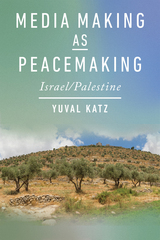
front cover of Media Making as Peacemaking
Media Making as Peacemaking
Israel/Palestine
Yuval Katz
Rutgers University Press, 2026

The horrific events of October 7 and the devastating war in Gaza have brought Israel/Palestine to the headlines once again. We have seen this all play out before: another ambitious peace plan, which secured a ceasefire, is imagined as the dawn of a new era of peace in the Middle East. But is it? Critiquing traditional state-centered approaches to peace, which usually highlight the work of diplomats and politicians, and which historically failed miserably in Israel/Palestine, Media Making as Peacemaking shifts our attention to the experiences of ordinary people. Investigating the idea of media encounters, this book shows how the collaboration of Palestinian and Jewish media practitioners and the popular texts they create together in television dramas, digital activism and mainstream journalism offer a new and exciting way to think about peace . A peace which does not maintain a repressive status quo, but seeks to deliver equality and justice to all people, Palestinians and Jews, living between the Jordan River and the Mediterranean Sea.
[more]

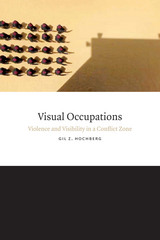
front cover of Visual Occupations
Visual Occupations
Violence and Visibility in a Conflict Zone
Gil Z. Hochberg
Duke University Press, 2015
In Visual Occupations Gil Z. Hochberg shows how the Israeli Occupation of Palestine is driven by the unequal access to visual rights, or the right to control what can be seen, how, and from which position. Israel maintains this unequal balance by erasing the history and denying the existence of Palestinians, and by carefully concealing its own militarization. Israeli surveillance of Palestinians, combined with the militarized gaze of Israeli soldiers at places like roadside checkpoints, also serve as tools of dominance. Hochberg analyzes various works by Palestinian and Israeli artists, among them Elia Suleiman, Rula Halawani, Sharif Waked, Ari Folman, and Larry Abramson, whose films, art, and photography challenge the inequity of visual rights by altering, queering, and manipulating dominant modes of representing the conflict. These artists' creation of new ways of seeing—such as the refusal of Palestinian filmmakers and photographers to show Palestinian suffering or the Israeli artists' exposure of state manipulated Israeli blindness —offers a crucial gateway, Hochberg suggests, for overcoming and undoing Israel's militarized dominance and political oppression of Palestinians.
[more]


Send via email Share on Facebook Share on Twitter