logo for Intellect Books
Bangladesh’s Changing Mediascape
From State Control to Market Forces
Edited by Brian Shoesmith, Jude William Genilo, and Md Asiuzzaman
Intellect Books, 2013

With contributions from a diverse group of media and communications scholars from around the globe, Bangladesh’s Changing Mediascape presents a pioneering study of the trends, patterns, and prospects shaping the contemporary Bangladeshi media. Among the many topics discussed here are the difference among specific media formats, including television, newspapers, radio, film, and photography; policy issues; and the challenge that new media poses to governance in a developing nation faced with innumerable economic, social, and political problems. Eschewing the currently dominant development communication model, the editors argue that market forces rather than planned state interventions will contribute to a more equitable communication environment.
[more]

logo for Intellect Books
Comparative Media Policy, Regulation and Governance in Europe
Unpacking the Policy Cycle
Edited by Leen d’Haenens, Helena Sousa, and Josef Trappel
Intellect Books, 2018
This book offers a comprehensive overview of the current European media in a period of disruptive transformation. It maps the full scope of contemporary media policy and industry activities while also assessing the impact of new technologies and radical changes in distribution and consumption on media practices, organizations, and strategies. Combining a critical assessment of media systems with a thematic approach, it can serve as a resource for scholars or as a textbook, as well as a source of good practices for steering media policy, international communication, and the media landscape across Europe.
[more]

front cover of Comparative Media Systems
Comparative Media Systems
European and Global Perspectives
Miklós Sükösd
Central European University Press, 2010
Leading researchers from different regions of Europe and the United States address five major interrelated themes: 1) how ideological and normative constructs gave way to empirical systematic comparative work in media research; 2) the role of foreign media groups in post-communist regions and the effects of ownership in terms of impacts on media freedom; 3) the various dimensions of the relationship between mass media and political systems in a comparative perspective; 4) professionalization of journalism in different political cultures—autonomy of journalists, professional norms and practices, political instrumentalization and the commercialization of the media; 5) the role of state intervention in media systems
[more]

front cover of Competing Norms
Competing Norms
State Regulations and Local Praxis in sub-Saharan Africa
Edited by Mamadou Diawara and Ute Röschenthaler
Campus Verlag, 2016
States in sub-Saharan Africa, as anywhere else, are vested with the authority to implement laws and sanction their application. But in spite of a growing emphasis in Africa on participatory approaches to legislation, little research has focused on the extent to which the public has become involved in policy making and whether the state regulations that have been produced have proven publicly beneficial. Offering a new anthropological perspective, Competing Norms fills that gap by exploring how people in sub-Saharan Africa view new regulations in the light of preexisting local norms with which new regulations often compete. A collection of international, interdisciplinary contributors discusses the competing local, state, and international norms as they have evolved over time, unfolding the intricate ambivalences and contradictions that often characterize state regulations.
[more]

front cover of The Currency of Truth
The Currency of Truth
Newsmaking and the Late-Socialist Imaginaries of China's Digital Era
Emily H. C. Chua
University of Michigan Press, 2023
China’s news sector is a place where newsmakers, advertising executives, company bosses, and Party officials engage one another in contingent and evolving arrangements that run from cooperation and collaboration to manipulation and betrayal. Drawing on long-term ethnographic fieldwork with journalists, editors, and executives at a newspaper in Guangzhou, The Currency of Truth brings its readers into the lives of the people who write, publish, and profit from news in this milieu. The book shows that far from working as mere cogs in a Party propaganda machine, these individuals are immersed in fluidly shifting networks of formal and informal relationships, which they carefully navigate to pursue diverse goals.

In The Currency of Truth, Emily H. C. Chua argues that news in China works less as a medium of mass communication than as a kind of currency as industry players make and use news articles to create agreements, build connections, and protect and advance their positions against one another. Looking at the ethical and professional principles that well-intentioned and civically minded journalists strive to uphold, and the challenges and doubts that they grapple with in the process, Chua brings her findings into conversation around “post-truth” news and the “crisis” of professional journalism in the West.  The book encourages readers to rethink contemporary news, arguing that rather than setting out from the assumption that news works either to inform or deceive its publics, we should explore the “post-public” social and political imaginaries emerging among today’s newsmakers and remaking the terms of their practice.
[more]

front cover of Digital Dilemmas
Digital Dilemmas
The State, the Individual, and Digital Media in Cuba
Venegas, Cristina
Rutgers University Press, 2010
The contentious debate in Cuba over Internet use and digital media primarily focuses on three issuesùmaximizing the potential for economic and cultural development, establishing stronger ties to the outside world, and changing the hierarchy of control. A growing number of users decry censorship and insist on personal freedom in accessing the web, while the centrally managed system benefits the government in circumventing U.S. sanctions against the country and in controlling what limited capacity exists.

Digital Dilemmas views Cuba from the Soviet Union's demise to the present, to assess how conflicts over media access play out in their both liberating and repressive potential. Drawing on extensive scholarship and interviews, Cristina Venegas questions myths of how Internet use necessarily fosters global democracy and reveals the impact of new technologies on the country's governance and culture. She includes film in the context of broader media history, as well as artistic practices such as digital art and networks of diasporic communities connected by the Web. This book is a model for understanding the geopolitic location of power relations in the age of digital information sharing.


[more]

logo for Pluto Press
Don't Mention the War
Northern Ireland, Propaganda and the Media
David Miller
Pluto Press, 1994

front cover of Indirect Subjects
Indirect Subjects
Nollywood's Local Address
Matthew H. Brown
Duke University Press, 2021
In Indirect Subjects, Matthew H. Brown analyzes the content of the prolific Nigerian film industry's mostly direct-to-video movies alongside local practices of production and circulation to show how screen media play spatial roles in global power relations. Scrutinizing the deep structural and aesthetic relationship between Nollywood, as the industry is known, and Nigerian state television, Brown tracks how several Nollywood films, in ways similar to both state television programs and colonial cinema productions, invite local spectators to experience liberal capitalism not only as a form of exploitation but as a set of expectations about the future. This mode of address, which Brown refers to as “periliberalism,” sustains global power imbalances by locating viewers within liberalism but distancing them from its processes and benefits. Locating the wellspring of this hypocrisy in the British Empire's practice of indirect rule, Brown contends that culture industries like Nollywood can sustain capitalism by isolating ordinary African people, whose labor and consumption fuel it, from its exclusive privileges.
[more]

front cover of Latin Politics, Global Media
Latin Politics, Global Media
Edited by Elizabeth Fox and Silvio Waisbord
University of Texas Press, 2002

The globalization of media industries that began during the 1980s and 1990s occurred at the same time as the establishment of or return to democratic forms of government in many Latin American countries. In this volume of specially commissioned essays, thirteen well-known media experts examine how the intersection of globalization and democratization has transformed media systems and policies throughout Latin America.

Following an extensive overview by editors Elizabeth Fox and Silvio Waisbord, the contributors investigate the interaction of local politics and global media in individual Latin American countries. Some of the issues they discuss include the privatization and liberalization of the media, the rise of media conglomerates, the impact of trade agreements on media industries, the role of the state, the mediazation of politics, the state of public television, and the role of domestic and global forces. The contributors address these topics with a variety of theoretical approaches, combining institutional, historical, economic, and legal perspectives.

[more]

logo for Intellect Books
Media and Identity in Contemporary Europe
Consequences of global convergence
Richard Collins
Intellect Books, 1995
Chapters focus on technological change and its impact on cultural and political identities, the role of the cultural industries in the 'New Economy' and the impact of European integration on national institutions - public service broadcasting in particular.

Because technological change in broadcasting has enabled us to open up media markets, the shape of media and of society has become more internationally-oriented. Indeed, modern international media has bought into question the very legitimacy of national communities and ideologies. And this is a phenomenon whose greatest impact has been in Europe.

These studies address the future of public service broadcasting and the power of national regulators to shape trans-national media relationships. The author takes an empirical approach to analysis of these issues, exploring media and communication studies very much as a social science.
[more]

front cover of Media Constrained by Context
Media Constrained by Context
International Assistance and Democratic Media Transition in the Western Balkans
Kristina Irion
Central European University Press, 2018
This books draws a comparative balance of twenty years' international media assistance in the five countries of the Western Balkans. The central question was what happens to imported models when they are transposed onto the newly evolving media systems of transitional societies. Albania, Bosnia-Herzegovina, Kosovo, Macedonia and Serbia undertook a range of media reforms to conform with accession requirements of the European Union and the standards of the Council of Europe, among others. The essays explore the nexus between the democratic transformation of the media and international media assistance. The cross-national analysis concludes that the effects of international assistance are highly constrained by the local context. From today's vantage point it becomes obvious, that scaling media assistance does not necessarily improve outcomes. The experiences in the region suggest that imported solutions have not been very cognitive in all aspects of local conditions but international strategies tent to be rather schematic and lacked strategic approaches to promote media policy stability, credible media reform and implementation. The book offers valuable insights into the nature and effects of media assistance and the strategies deployed by international aid agencies, local political forces, media professionals, civil society organizations and other actors.
[more]

front cover of Media Freedom and Pluralism
Media Freedom and Pluralism
Media Policy Challenges in the Enlarged Europe
Beata Klimkiewicz
Central European University Press, 2010
Addresses a critical analysis of major media policies in the European Union and Council of Europe at the period of profound changes affecting both media environments and use, as well as the logic of media policy-making and reconfiguration of traditional regulatory models. The analytical problem-related approach seems to better reflect a media policy process as an interrelated part of European integration, formation of European citizenship, and exercise of communication rights within the European communicative space. The question of normative expectations is to be compared in this case with media policy rationales, mechanisms of implementation (transposing rules from EU to national levels), and outcomes.
[more]

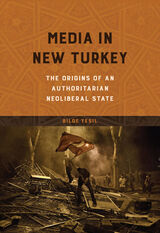
front cover of Media in New Turkey
Media in New Turkey
The Origins of an Authoritarian Neoliberal State
Bilge Yesil
University of Illinois Press, 2016
In Media in New Turkey, Bilge Yesil unlocks the complexities surrounding and penetrating today's Turkish media. Yesil focuses on a convergence of global and domestic forces that range from the 1980 military coup to globalization's inroads and the recent resurgence of political Islam. Her analysis foregrounds how these and other forces become intertwined, and she uses Turkey's media to unpack the ever-more-complex relationships.
 
Yesil confronts essential questions regarding: the role of the state and military in building the structures that shaped Turkey's media system; media adaptations to ever-shifting contours of political and economic power; how the far-flung economic interests of media conglomerates leave them vulnerable to state pressure; and the ways Turkey's politicized judiciary criminalizes certain speech.
 
Drawing on local knowledge and a wealth of Turkish sources, Yesil provides an engrossing look at the fault lines carved by authoritarianism, tradition, neoliberal reform, and globalization within Turkey's increasingly far-reaching media.
 
[more]

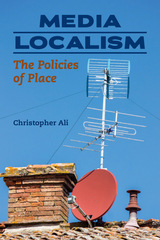
front cover of Media Localism
Media Localism
The Policies of Place
Christopher Ali
University of Illinois Press, 2017
We live in a boosterish era that exhorts us to play local and buy local. But what does it mean to support local media? How should we define local media in the first place? Christopher Ali delves into our ideas about localism and their far-reaching repercussions for the discourse of federal media policy and regulation. His critique focuses on the new interest in localism among regulators in the United States, the United Kingdom, and Canada. As he shows, the many different and often contradictory meanings of localism complicate efforts to study local voices. At the same time, market factors and regulators' unwillingness to critically examine local media blunt challenges to the status quo. Ali argues that reconciling the places where we live with the spaces we inhabit will point regulators toward effective policies that strengthens local media. That new approach will again elevate local media to its rightful place as a vital part of the public good.
[more]

logo for University of Illinois Press
Media, Market, and Democracy in China
Between the Party Line and the Bottom Line
Yuezhi Zhao
University of Illinois Press, 1998

How do market forces influence the media in China? How does the Party both introduce and try to contain the market's influence? How do commercial imperatives both accommodate and challenge Party control? 

Yuezhi Zhao interviewed a wide range of scholars, media administrators, and media professionals to answer these and other questions. Working in China in 1994 and 1995, she monitored media content, carried out extensive documentary research in Beijing, and held off-the-record meetings with Chinese media insiders. What she found informs an in-depth look at the intertwining nature of the Communist Party and the news media in China, how they affect each other, and what the future might hold for each. 

A rare on-the-ground portrait, Media, Market, and Democracy in China is must reading for scholars, media and business professionals, and policymakers who need to understand what happened to China and its mass media during a period of dynamic growth and change.
[more]

front cover of Media, Nationalism and European Identities
Media, Nationalism and European Identities
Karol Jakubowicz
Central European University Press, 2011
Explores patterns of interaction between the mass media and identity formation in the context of Europeanization. On the one hand, the major contribution of the volume is a comprehensive framework that considers media impacts on four levels of identity: European, regional, national, and ethnic minority identities. On the other hand, authors offer cutting edge analysis of the structural transformation of European media institutions, and policies that shape the future of European media.
[more]

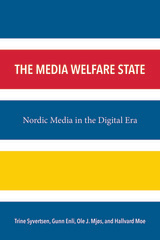
front cover of The Media Welfare State
The Media Welfare State
Nordic Media in the Digital Era
Trine Syvertsen, Gunn Enli, Ole J. Mjøs, and Hallvard Moe
University of Michigan Press, 2014

The Media Welfare State: Nordic Media in the Digital Era comprehensively addresses the central dynamics of the digitalization of the media industry in the Nordic countries—Sweden, Norway, Denmark, Finland, and Iceland—and the ways media organizations there are transforming to address the new digital environment. Taking a comparative approach, the authors provide an overview of media institutions, content, use, and policy throughout the region, focusing on the impact of information and communication technology/internet and digitalization on the Nordic media sector. Illustrating the shifting media landscape the authors draw on a wide range of cases, including developments in the press, television, the public service media institutions, and telecommunication.
[more]

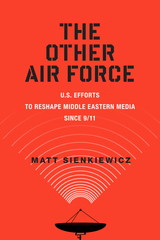
front cover of The Other Air Force
The Other Air Force
U.S. Efforts to Reshape Middle Eastern Media Since 9/11
Sienkiewicz, Matt
Rutgers University Press, 2016
Winner of the 2019 Alpha Sigma Nu Book Award

As it seeks to win the hearts and minds of citizens in the Muslim world, the United States has poured millions of dollars into local television and radio programming, hoping to generate pro-American currents on Middle Eastern airwaves. However, as this fascinating new book shows, the Middle Eastern media producers who rely on these funds are hardly puppets on an American string, but instead contribute their own political and creative agendas while working within U.S. restrictions.  
 
The Other Air Force gives readers a unique inside look at television and radio production in Afghanistan and the Palestinian territories, from the isolated villages of the Afghan Panjshir Valley to the congested streets of Ramallah. Communications scholar Matt Sienkiewicz explores how the U.S. takes a “soft-psy” approach to its media efforts combining “soft” methods of encouraging entertainment programming, such as adaptations of The Voice and The Apprentice with more militaristic “psy-ops” approaches to information control. Drawing from years of field research and interviews with everyone from millionaire executives to underpaid but ever resourceful cameramen, Sienkiewicz considers the perspectives of the Afghan and Palestinian media workers trying to forge viable broadcasting businesses without straying outside American-set boundaries for acceptable content.   
 
As it carefully examines the interplay of U.S. military and economic might with the capacity for local ingenuity and resistance, the book also analyzes the intriguingly complex programming that emerges from this tension. Combining eyewitness reportage with cutting-edge scholarship, The Other Air Force reveals the remarkable creative output that can emerge even from the world’s tensest conflict zones.
 
[more]


Send via email Share on Facebook Share on Twitter