
 A SCHOLARLY BOOK REPOSITORY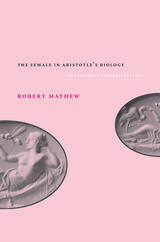
Mayhew points out that the tools of modern science and scientific experimentation were not available to the Greeks during Aristotle's time and that, consequently, Aristotle had relied not only on empirical observations when writing about living organisms but also on a fair amount of speculation. Further, he argues that Aristotle's remarks about females in his biological writings did not tend to promote the inferior status of ancient Greek women.
Written with passion and precision, The Female in Aristotle's Biology will be of enormous value to students of philosophy, the history of science, and classical literature.
Peripatetic potpourri.
Aristotle of Stagirus (384–322 BC), the great Greek philosopher, researcher, logician, and scholar, studied with Plato at Athens and taught in the Academy (367–347). Subsequently he spent three years in Asia Minor at the court of his former pupil Hermeias, where he married Pythias, one of Hermeias’ relations. After some time at Mitylene, he was appointed in 343/2 by King Philip of Macedon to be tutor of his teen-aged son Alexander. After Philip’s death in 336, Aristotle became head of his own school (of “Peripatetics”), the Lyceum at Athens. Because of anti-Macedonian feeling there after Alexander’s death in 323, he withdrew to Chalcis in Euboea, where he died the following year.
Problems, the third-longest work in the Aristotelian corpus, contains thirty-eight books covering more than 900 problems about living things, meteorology, ethical and intellectual virtues, parts of the human body, and other topics. Although Problems is an accretion of multiple authorship over several centuries, it offers a fascinating technical view of Peripatetic method and thought. Problems, in two volumes, replaces the earlier Loeb edition by Hett, with a text and translation incorporating the latest scholarship.
Peripatetic potpourri.
Aristotle of Stagirus (384–322 BC), the great Greek philosopher, researcher, logician, and scholar, studied with Plato at Athens and taught in the Academy (367–347). Subsequently he spent three years in Asia Minor at the court of his former pupil Hermeias, where he married Pythias, one of Hermeias’ relations. After some time at Mitylene, he was appointed in 343/2 by King Philip of Macedon to be tutor of his teen-aged son Alexander. After Philip’s death in 336, Aristotle became head of his own school (of “Peripatetics”), the Lyceum at Athens. Because of anti-Macedonian feeling there after Alexander’s death in 323, he withdrew to Chalcis in Euboea, where he died the following year.
Problems, the third-longest work in the Aristotelian corpus, contains thirty-eight books covering more than 900 problems about living things, meteorology, ethical and intellectual virtues, parts of the human body, and other topics. Although Problems is an accretion of multiple authorship over several centuries, it offers a fascinating technical view of Peripatetic method and thought. Both Problems, in two volumes, and Rhetoric to Alexander replace the earlier Loeb edition by Hett and Rackham, with texts and translations incorporating the latest scholarship.
READERS
Browse our collection.
PUBLISHERS
See BiblioVault's publisher services.
STUDENT SERVICES
Files for college accessibility offices.
RECENTLY PUBLISHED





UChicago Accessibility Resources
home | accessibility | search | about | contact us
BiblioVault ® 2001 - 2025
The University of Chicago Press