logo for Assoc of College & Research Libraries
The 360 Librarian
A Framework for Integrating Mindfulness, Emotional Intelligence, and Critical Reflection in the Workplace
Tammi M. Owens
Assoc of College & Research Libraries, 2019

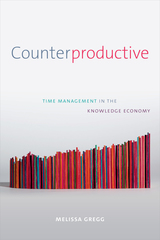
front cover of Counterproductive
Counterproductive
Time Management in the Knowledge Economy
Melissa Gregg
Duke University Press, 2018
As online distractions increasingly colonize our time, why has productivity become such a vital demonstration of personal and professional competence? When corporate profits are soaring but worker salaries remain stagnant, how does technology exacerbate the demand for ever greater productivity? In Counterproductive Melissa Gregg explores how productivity emerged as a way of thinking about job performance at the turn of the last century and why it remains prominent in the different work worlds of today. Examining historical and archival material alongside popular self-help genres—from housekeeping manuals to bootstrapping business gurus, and the growing interest in productivity and mindfulness software—Gregg shows how a focus on productivity isolates workers from one another and erases their collective efforts to define work limits. Questioning our faith in productivity as the ultimate measure of success, Gregg's novel analysis conveys the futility, pointlessness, and danger of seeking time management as a salve for the always-on workplace.
[more]

logo for Catholic University of America Press
Meditation as Spiritual Therapy
Bernard of Clairvaux's De consideratione
Matthew McWhorter
Catholic University of America Press, 2024
Christian persons today might seek spiritual development and ponder the benefit of mindfulness exercises but also maintain concerns if they perceive such exercises to originate from other religious traditions. Such persons may not be aware of a long tradition of meditation practice in Christianity that promotes personal growth. This spiritual tradition receives a careful formulation by Christian mo- nastic authors in the twelfth century. One such teaching on meditation is found in the treatise De consideratione written by St. Bernard of Clairvaux (d. 1153) to Pope Eugene III (d. 1153). In textual passages where St. Bernard exhibits a clear concern for the mental health of the Pope (due to numerous ongoing ecclesial, political, and military problems), St. Bernard reminds Eugene III of his original monastic vocation and the meditation exercises associated with that vocation. The advice that St. Bernard gives to Eugene III can be received today in a way that provides a structure for Christian meditation practice which is relevant for personal develop- ment, spiritual direction, and civil psychotherapy that integrates a client’s spirituality into the course of treatment. St. Bernard thus might be interpreted as a teacher of a kind of Christian mindfulness that can benefit both a person’s mental health as well as a person’s relationship with God. Meditation as Spiritual Therapy examines the historical context of Bernard’s work, his purpose for writing it, as well as the numerous Christian sources he drew upon to formulate his teaching. Bernard’s teaching on the course of meditation itself is explored in depth and in dialogue with his other treatises, letters, and sermons. Lastly, a contemporary summary of Bernard’s teaching is provided with reflections concerning the relationship of this teaching to contemporary spiritual direction and spiritually integrated civil psychotherapy.
[more]

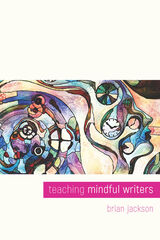
front cover of Teaching Mindful Writers
Teaching Mindful Writers
Brian Jackson
Utah State University Press, 2020

Teaching Mindful Writers introduces new writing teachers to a learning cycle that will help students become self-directed writers through planning, practicing, revising, and reflecting. Focusing on the art and science of instructing self-directed writers through major writing tasks, Brian Jackson helps teachers prepare students to engage purposefully in any writing task by developing the habits of mind and cognitive strategies of the mindful writer.

Relying on the most recent research in writing studies and learning theory, Jackson gives new teachers practical advice about setting up writing tasks, using daily writing, leading class discussions, providing feedback, joining teaching communities, and other essential tools that should be in every writing teacher’s toolbox. Teaching Mindful Writers is a timely, fresh perspective on teaching students to be self-directed writers.
[more]

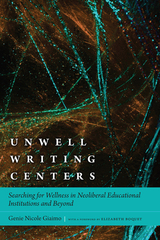
front cover of Unwell Writing Centers
Unwell Writing Centers
Searching for Wellness in Neoliberal Educational Institutions and Beyond
Genie Nicole Giaimo
Utah State University Press, 2022
Unwell Writing Centers focuses on the inroads the wellness industry has made into higher education. Following graduate and undergraduate writing tutors during a particularly stressful period (2016–2019), Genie Nicole Giaimo examines how top-down and bottom-up wellness interventions are received and taken up by workers. Engaging sociocultural research on how workers react to and experience workplace conflict, Giaimo demonstrates the kinds of interventions welcomed by workers as well as those that fall flat, including the “easy” fixes to workplace issues that institutions provide in lieu of meaningful and community-based support.
 
The book is broken into sections based on journeying: searching for wellness, finding wellness, and imagining a “well” future that includes a sustainable model of writing center work. Each chapter begins with a personal narrative about wellness issues in writing centers, including the author’s experiences in and responses to local emergencies. She shares findings from a longitudinal assessment study on non-institutional interventions in writing centers and provides resources for administrators to create more ethical "well" writing centers. The book also includes an appendix of training documents, emergency planning documents, and several wellness-specific interventions developed from anti-racist, anti-neoliberal, and organizational theories.
 
Establishing the need for a field-specific response to the austerity-minded eruption of wellness-focused interventions in higher education, Unwell Writing Centers is a critical text for graduate students and new directors that can easily be applied in workplaces in and outside of higher education.
 
[more]


Send via email Share on Facebook Share on Twitter