
 A SCHOLARLY BOOK REPOSITORY
Arijana Lekić-Fridrih: All Art is a Political Statement introduces audiences to the work of Croatian artist Arijana Lekić-Fridrih and, in particular, to her Silent Mass, a performance resisting the “Be Manly” movement, a series of mass prayer events held in Croatian public squares by a battalion of men who pray for the abolition of women’s rights, for women’s “chastity,” and for men’s “masculine authority.” All Art is a Political Statement links the erosion of women’s rights across intercontinental boundaries and offers Lekić-Fridrih’s multimedia art as a guide for activism against retrograde restrictions on the freedom of women.
Arijana Lekić-Fridrih: Svaka umjetnost je politička izjava upoznaje publiku s radom hrvatske umjetnice Arijane Lekić-Fridrih, a posebno s njezinom Tihom misom, performansom otpora pokretu “Budi muško”, nizu masovnih molitvenih događanja koje na hrvatskim javnim trgovima održava bataljun muškaraca moleći za ukidanje ženskih prava, za žensku “čednost”, a za muškarce “muški autoritet”. Svaka umjetnost je politička izjava spaja eroziju ženskih prava preko interkontinentalnih granica i nudi multimedijsku umjetnost Lekić-Fridrih kao vodič za aktivizam protiv nazadnih ograničenja slobode žena.
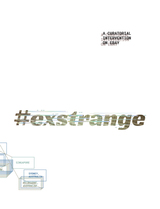
Over 80 contemporary artists and designers created “artworks as auctions” for #exstrange between January 15 and April 15, 2017, each using the elements of the auction listing—descriptive text, images, pricing, and categories—as tools of production.
Works include artist Lucy Pawlak’s collaboration with the Beat Officer to sell a series of clay objects as missing evidence from unexplained events in Mexico; IOCOSE’s sale of instant protests in the category “Specialty Services” where buyers chose the protest mantras, and outsourced performers demonstrated; and Susanne Cockrell & Ted Purves’ offering of a stick-gun with the memory of their son’s play in “Entertainment Memorabilia.”
Featured artists:
10.000 • Lanfranco Aceti • AILADI • Aysha Al Moayyed • Nasser Alzayani • Mary Ayling • Georgia Banks • Ann Bartges • Yogesh Barve • Kim Beck • Ajit Bhadoriya • Natalie Boterman • Sophia Brueckner • Carmel Buckley • Renee Carmichael • Alessio Chierico • Mia Cinelli • Susanne Cockrell • ConnX • Da Burn Gallery • Julia del Río • Tyler Denmead • César Escudero • Nihaal Faizal • FICTILIS • Eryn Foster • John D. Freyer • Elisa Giardina Papa • Angela Glanzmann • Maximilian Goldfarb • Archana Hande • Abhishek Hazra • Adam Hewins • Megan Hildebrandt • Joey Holder • Masimba Hwati • Regin Igloria • IOCOSE • JODI • Geraldine Juárez • KairUs Art+Research • Katerina Kamprani • Kamilia Kard • Tara Kelton • Matt Kenyon • Stephanie LaFreniere • Eno Laget • Nicolás Lamas • Martin Lang • Taekyeom Lee • LEXX Exhibitor Space • Lloyd Corporation • Silvio Lorusso • Breda Lynch • Garrett Lynch • Eva and Franco Mattes • Kembrew McLeod • Kathleen Meaney • Maria Miranda • Crisia Miroiu • Joana Moll • Martín Nadal • Norie Neumark • Xi Jie Ng • Maeve O'Neill • Chiara Passa • Lucy Pawlak • Sreshta Rit Premnath • Niko Princen • Ted Purves • Renuka Rajiv • Luis Romero • Armando Rosales • Robert Sakrowski • Alessandro Sambini • Sarah Ancelle Schönfeld • Anke Schüttler • Guido Segni • Chinar Shah • Jenine Sharabi • Yastika Prakash Shetty • Anupam Singh • Gagan Singh • Ishan Srivstava • Isabella Streffen • Surabhi Vaya • Wang Yue • Wu Jiaru • Yashaswini • Laura Yuile • Carlo Zanni • Huaqian Zhang
Guest curators:
Latifa Al Khalifa • Bani Brusadin • Peter Dykhuis • Fred Feinberg & Lu Zhang • Harrell Fletcher • Tamara Ibarra • João Laia • Nora O Murchú • Domenico Quaranta • Gaia Tedone • TSAO Yidi
Sing for the pro-Palestinian student activists who have, over these past two years, opened our hearts to the injustice and inhumanity of Israel’s war in Gaza.
This single sentence, concluding a brief commencement address by the University of Michigan’s Faculty Senate Chair, ignited a controversy that simmered for weeks. Professor Derek Peterson had praised the work of female, Jewish, and Black activists who had fought for inclusion, ending with a shoutout to students who protested the university’s financial ties to Israel’s war on Gaza.
Hours later, U-M President Domenico Grasso publicly apologized, calling the remarks “hurtful and insensitive.” Peterson faced a barrage of threatening hate mail, alongside demands that he be fired and the university defunded. Conversely, a chorus of passionate dissent argued that a college education should equip students for, not shield them from, sharp controversies.
This volume collects commentary from students, alumni, labor organizers, and faculty. Most, but not all, defend Peterson’s right to say what he said, reflecting on questions of academic freedom, repressive notions of what is “appropriate,” the institution’s traditions of moral courage, the danger of assuming a monolithic “Jewish community,” and the Palestine exception to free speech.

Now, for the first time, K-12 educators from across the nation give readers a teacher’s-eye view of the radical right crusade to take down public education, coordinated by well-funded, well-connected far-right political interests. Christian nationalists hell-bent on erasing the line between church and state, white supremacists opposed to a curriculum that teaches the enduring effects of anti-Black racism, political action committees, such as Moms for Liberty, calling for the banning of novels featuring LGBTQ+ people, and profiteers eager to divert taxpayer dollars into private schools are mounting a relentless attack on teachers, the students they serve, and the commitment to public education that is a cornerstone of democracy. “It’s a phenomenal, unprecedented moment that we’re in,” says a librarian, recently retired from her Texas school. “It’s surprising how many people don’t know what’s going on. I talk to reporters who have no idea. And they’re reporters.”
In Trouble in Censorville, public school teachers from states as far-flung as Florida, Texas, Kentucky, New Jersey, Tennessee, Wisconsin, and Washington describe, in their own words, being threatened, stalked, doxxed, ostracized, smeared as “pedophiles" and "Marxists," placed on leave, and fired for teaching historical truth and racial justice, supporting LGBTQ+ students and, in one case, for wearing "insufficiently" feminine attire. Their stories bring readers face-to-face with the human cost of these attacks, which range from social isolation to pent-up anger over institutional betrayal to the terrible toll on teachers’ mental and physical health.
And yet, teachers are fighting back. They’re mobilizing colleagues, parents, and community members who share their faith in the freedom to read, the freedom to think critically, the freedom to challenge small-minded provincialism. Their stories of frontline resistance, collected here, provide a battle plan for confronting censorship, rallying support, and mobilizing a grassroots defense of public schools.
Their gripping testimonials are enhanced by a timeline that situates today’s far-right war on public education in the context of American history, moving briskly from Reconstruction to the anti-left and anti-gay fearmongering of the McCarthy era to the Black Lives Matter movement to the Trump presidency.
Terrifying, infuriating, and inspiring, Trouble in Censorville sounds the alarm for a democracy on fire.
READERS
Browse our collection.
PUBLISHERS
See BiblioVault's publisher services.
STUDENT SERVICES
Files for college accessibility offices.
RECENTLY PUBLISHED



UChicago Accessibility Resources
home | accessibility | search | about | contact us
BiblioVault ® 2001 - 2026
The University of Chicago Press