
 A SCHOLARLY BOOK REPOSITORY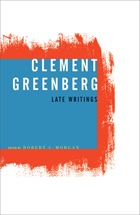
Clement Greenberg (1909-1994) was a colossus of twentieth-century American art, achieving a degree of authority almost unimaginable for a critic today. For more than thirty years he was both lionized as a proponent of formalism and criticized for his perceived dogmatism. In the postwar period Greenberg used his position of influence to advocate the importance of abstract expressionism and color-field painting and to establish the careers of such artists as Jackson Pollock, Hans Hofmann, Barnett Newman, and Willem de Kooning. With the coming of pop art, performance and conceptual art, and postmodernism, however, Greenberg found his position increasingly challenged.
Edited with an introduction by critic Robert C. Morgan, Clement Greenberg, Late Writings is the first collection from the period 1970 to 1990, and the only comprehensive resource for Greenberg’s thought during the last third of his life. While earlier works have covered Greenberg’s early and middle career, this volume spans his mature period, during which he reevaluates and refines many of his earlier tenets in some of his most carefully crafted and engaging work. Exploring a surprising breadth of issues and mediums and demonstrating a depth of aesthetic and philosophical insights, in these relatively unknown works Greenberg incites a new direction for modernism beyond the twentieth century.
This essential volume includes five interviews from the end of his life in which Greenberg revisits some of the concerns of his formative years, illuminating the progression of his thought. Late Writings is an integral resource as issues of quality and significance in the dynamic world of art continue to be redefined.
Clement Greenberg was the most influential art critic of the postwar period. He was the author of numerous books, and his essays appeared in art magazines as well as such publications as Partisan Review, Commentary, and The Nation.
Robert C. Morgan is the author of The End of the Art World and of a monograph on the optical painter Vasarely. In addition to his work as a critic, artist, art historian, and curator, he is visiting professor of art at Hunter College in New York City.
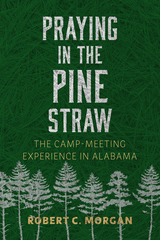
Step into the South’s brush arbors and piney woods where faith runs deep, stories run wild, and the old-time camp meeting was anything but quiet.
Praying in Pine Straw immerses readers in the raw, rollicking, and deeply human world of Alabama’s camp meetings—a Southern tradition where fire-and-brimstone preaching echoed through pine forests and where faith was often accompanied by contradiction. From “treeing the Devil” to “holy laughter,” these revivals blended heartfelt worship with all the complications of human nature. Mule-drawn wagons brought the faithful to rustic camps, where gospel fervor mingled with whiskey traders, local politicians, and opportunists of every kind. Preachers thundered against sin—even as they sometimes flirted with it themselves.
Robert C. Morgan offers a textured portrait of camp meetings as both spiritual experience and cultural spectacle, reviving a Southern tradition that flourished from the late nineteenth to mid-twentieth centuries. With a blend of humor and keen insight, Praying in the Pine Straw unveils the enduring contradictions of “old-time religion” and its significant influence on Southern culture and faith—a legacy that is both treasured and complex.
READERS
Browse our collection.
PUBLISHERS
See BiblioVault's publisher services.
STUDENT SERVICES
Files for college accessibility offices.
RECENTLY PUBLISHED


UChicago Accessibility Resources
home | accessibility | search | about | contact us
BiblioVault ® 2001 - 2026
The University of Chicago Press