
 A SCHOLARLY BOOK REPOSITORY
Results by Title
3 books about Music and war
3 books about Music and war

Instrument of War
Music and the Making of America's Soldiers
David Suisman
University of Chicago Press, 2024
An original history of music in the lives of American soldiers.
Since the Civil War, music has coursed through the United States military. Soldiers have sung while marching, listened to phonographs and armed forces radio, and packed the seats at large-scale USO shows. “Reveille” has roused soldiers in the morning and “Taps” has marked the end of a long day. Whether the sounds came from brass instruments, weary and homesick singers, or a pair of heavily used earbuds, where there was war, there was music, too.
Instrument of War is a first-of-its-kind study of music in the lives of American soldiers. Although musical activity has been part of war since time immemorial, the significance of the US military as a musical institution has generally gone unnoticed. Historian David Suisman traces how the US military used—and continues to use—music to train soldiers and regulate military life, and how soldiers themselves have turned to music to cope with war’s emotional and psychological realities. Opening our ears to these practices, Suisman reveals how music has enabled more than a century and a half of American war-making. Instrument of War unsettles assumptions about music as a force of uplift and beauty, demonstrating how it has also been entangled in large-scale state violence.
Whether it involves chanting “Sound off!” in basic training, switching on a phonograph or radio, or cueing up an iPod playlist while out on patrol, the sound of music has long resonated in soldiers’ wartime experiences. Now we all can finally hear it.
Since the Civil War, music has coursed through the United States military. Soldiers have sung while marching, listened to phonographs and armed forces radio, and packed the seats at large-scale USO shows. “Reveille” has roused soldiers in the morning and “Taps” has marked the end of a long day. Whether the sounds came from brass instruments, weary and homesick singers, or a pair of heavily used earbuds, where there was war, there was music, too.
Instrument of War is a first-of-its-kind study of music in the lives of American soldiers. Although musical activity has been part of war since time immemorial, the significance of the US military as a musical institution has generally gone unnoticed. Historian David Suisman traces how the US military used—and continues to use—music to train soldiers and regulate military life, and how soldiers themselves have turned to music to cope with war’s emotional and psychological realities. Opening our ears to these practices, Suisman reveals how music has enabled more than a century and a half of American war-making. Instrument of War unsettles assumptions about music as a force of uplift and beauty, demonstrating how it has also been entangled in large-scale state violence.
Whether it involves chanting “Sound off!” in basic training, switching on a phonograph or radio, or cueing up an iPod playlist while out on patrol, the sound of music has long resonated in soldiers’ wartime experiences. Now we all can finally hear it.
[more]
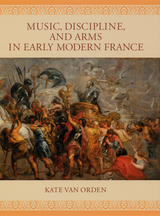
Music, Discipline, and Arms in Early Modern France
Kate van Orden
University of Chicago Press, 2005
In this groundbreaking new study, Kate van Orden examines noble education in the arts to show how music contributed to cultural and social transformation in early modern French society. She constructs a fresh account of music's importance in promoting the absolutism that the French monarchy would fully embrace under Louis XIV, uncovering many hitherto unpublished ballets and royal ceremonial performances.
The great pressure on French noblemen to take up the life of the warrior gave rise to bellicose art forms such as sword dances and equestrian ballets. Far from being construed as effeminizing, such combinations of music and the martial arts were at once refined and masculine-a perfect way to display military prowess. The incursion of music into riding schools and infantry drills contributed materially to disciplinary order, enabling the larger and more effective armies of the seventeenth century. This book is a history of the development of these musical spheres and how they brought forth new cultural priorities of civility, military discipline, and political harmony. Music, Discipline, and Arms in Early Modern France effectively illustrates the seminal role music played in mediating between the cultural spheres of letters and arms.
The great pressure on French noblemen to take up the life of the warrior gave rise to bellicose art forms such as sword dances and equestrian ballets. Far from being construed as effeminizing, such combinations of music and the martial arts were at once refined and masculine-a perfect way to display military prowess. The incursion of music into riding schools and infantry drills contributed materially to disciplinary order, enabling the larger and more effective armies of the seventeenth century. This book is a history of the development of these musical spheres and how they brought forth new cultural priorities of civility, military discipline, and political harmony. Music, Discipline, and Arms in Early Modern France effectively illustrates the seminal role music played in mediating between the cultural spheres of letters and arms.
[more]
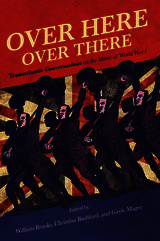
Over Here, Over There
Transatlantic Conversations on the Music of World War I
Edited by William Brooks, Christina Bashford, and Gayle Magee
University of Illinois Press, 2019
During the Great War, composers and performers created music that expressed common sentiments like patriotism, grief, and anxiety. Yet music also revealed the complexities of the partnership between France, Great Britain, Canada, and the United States. At times, music reaffirmed a commitment to the shared wartime mission. At other times, it reflected conflicting views about the war from one nation to another or within a single nation. Over Here, Over There examines how composition, performance, publication, recording, censorship, and policy shaped the Atlantic allies' musical response to the war. The first section of the collection offers studies of individuals. The second concentrates on communities, whether local, transnational, or on the spectrum in-between. Essay topics range from the sinking of the Lusitania through transformations of the entertainment industry to the influenza pandemic. Contributors: Christina Bashford, William Brooks, Deniz Ertan, Barbara L. Kelly, Kendra Preston Leonard, Gayle Magee, Jeffrey Magee, Michelle Meinhart, Brian C. Thompson, and Patrick Warfield
[more]
READERS
Browse our collection.
PUBLISHERS
See BiblioVault's publisher services.
STUDENT SERVICES
Files for college accessibility offices.
RECENTLY PUBLISHED



UChicago Accessibility Resources
home | accessibility | search | about | contact us
BiblioVault ® 2001 - 2026
The University of Chicago Press