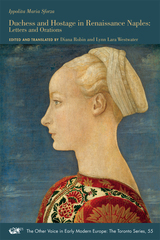
front cover of Duchess and Hostage in Renaissance Naples
Duchess and Hostage in Renaissance Naples
Letters and Orations
Ippolita Maria Sforza
Iter Press, 2017
This volume presents in translation 100 previously unknown letters of Ippolita Maria Sforza (1445–1488), daughter of the Duke of Milan, who was sent at age twenty to marry the son of the infamously brutal King Ferrante of Naples. Sforza’s letters display the adroit diplomacy she used to strengthen the alliance between Milan and Naples, then the two most powerful states in Italy, amid such grave crises as her brother’s assassination in Milan and the Turkish invasion of Otranto. Still, Ippolita lived as a hostage at the Neapolitan court, subject not only to the threat of foreign invasion but also to her husband’s well-known sexual adventures and her father-in-law’s ruthlessness. Soon after Ippolita’s mysterious death in 1488, the fraught Naples-Milan alliance collapsed.
[more]

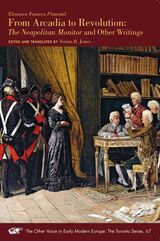
front cover of From Arcadia to Revolution
From Arcadia to Revolution
The Neapolitan Monitor and Other Writings
Eleonora Fonseca Pimentel
Iter Press, 2019
Eleonora Fonseca Pimentel was a poet, a political writer, a journalist, and a politician. She was the editor, and virtually the only writer of the Monitore Napoletano (Neapolitan Monitor), the journal in which she recorded the events and debates that took place in the short-lived Neapolitan Jacobin Republic of 1799. She sought to influence both government policy and public opinion. As a political analyst she also put forward with this journal one of the first analyses ever of popular culture and its political implications, and confronted the challenge of trying to implement a revolutionary political project in a situation of abject poverty intertwined with a deeply conservative populist mind-set.

The Other Voice in Early Modern Europe: The Toronto Series, Volume 67
[more]

logo for University of Chicago Press
History of the Kingdom of Naples
Benedetto Croce
University of Chicago Press, 1970

Prolific twentieth-century Italian intellectual gives an account of his native southern Italy.

In The History of the Kingdom of Naples, Benedetto Croce returns to his beloved city of Naples, combining empathy with historical detachment as he provides an account of the region. He offers an eloquent explanation of longstanding contrasts within southern Italy, which boasts both a rich cultural life and a pervasive lethargy, and he addresses controversy and scrutiny directed at southern Italy since World War II. Through a careful study of the Kingdom of Naples, Croce reveals how philosophy and history both play a part in shaping an expanded sense of Italy, and he calls for an embrace of Italy’s ever-evolving progress in contemporary politics.

Among historical philosophers Croce ranks as the outstanding representative of the twentieth-century idealist school. German influences played the greatest part in his education, along with the philosophical tradition of his beloved city of Naples. A private scholar throughout his life as well as a leading statesman just before and immediately after the Fascist regime, he remained confident in his chosen role as the thinker who would “deprovincialize” Italian intellectual life and bring it into the mainstream of European thought. His work serves as a significant contribution to Italian formal history and thought, and this volume is considered to be one of the finest examples of his historiography.


[more]


Send via email Share on Facebook Share on Twitter